
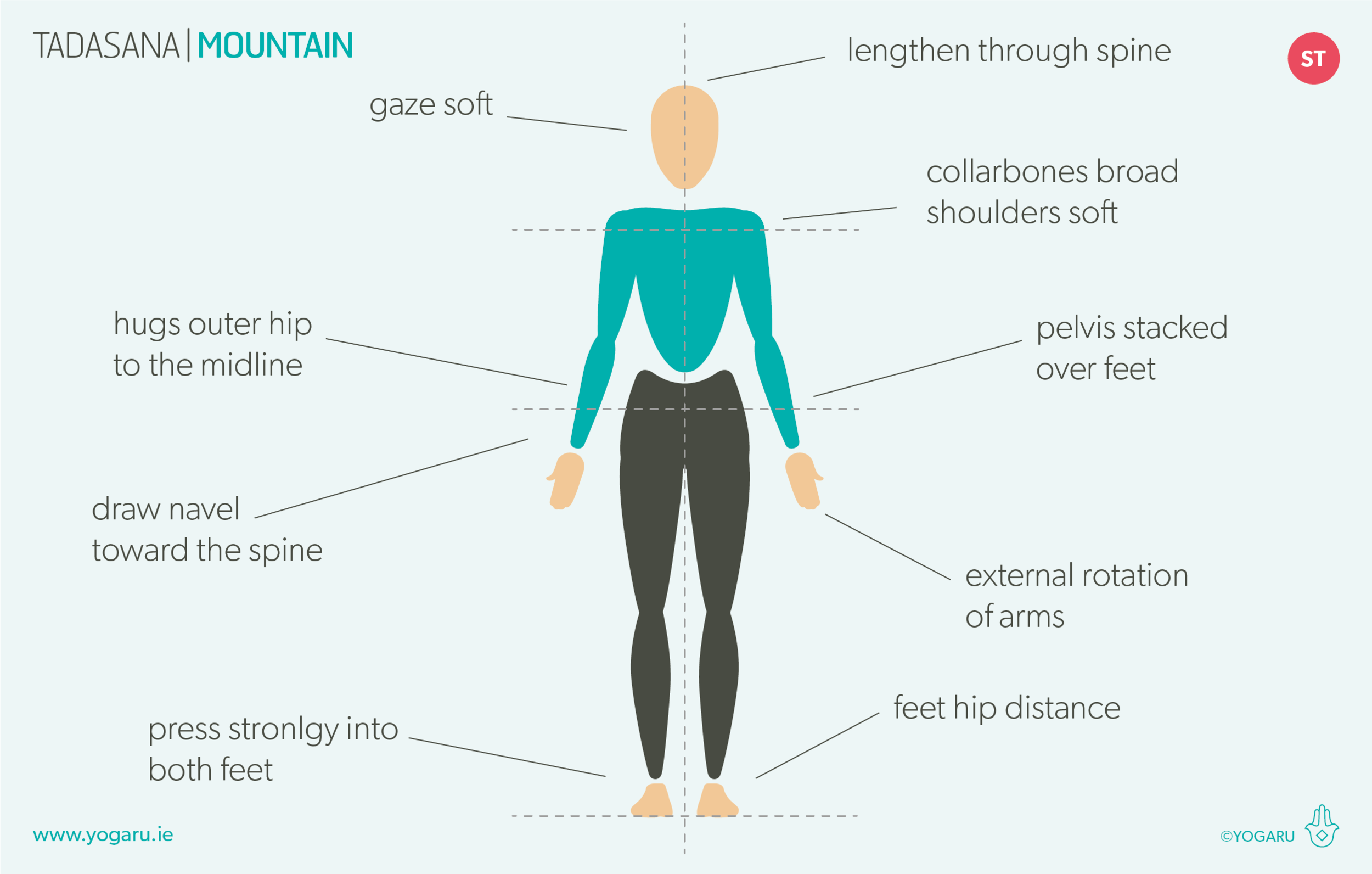
Tadasana - Mountain

YOGARU_Tadasana_PB.png

STANDING BLUEPRINT
Tadasana/Mountain is a pose that may not look like much is going on from the outside but done with integrity it is a strong pose that is the foundation of all standing poses and helps us find the natural curves of the spine. It also gives us the building blocks for finding balance to incorporate into more challenging poses like Vrksasana/Tree; the principle of press & reach; and how to apply effort & ease into each pose. We often come into Tadasana/Mountain to link mini flows in a sequence but may not be giving it the time it deserves and the credit for how it help us re-centre so that we can continue with our practice. Consciously coming to into this basic standing position, and spending a bit more time exploring it throughout your practice, will build muscle memory for your spine to carry you more upright off the mat, and allow the curves to do their job as a mechanism for shock absorption, as we move through our day. For new teachers out there, Tadasana/Mountain is a great pose to have in the memory bank for coming back to as a means to linking your mini flows together and helping your students find the all important pause in the practice before they eagerly jump into the next pose.

ALIGNMENT CUES
Feet position in Tadasana/Mountain is a personal preference. In general the wider the feet are the easier it is to find balance. If you want to challenge your proprioception and your spatial awareness stand with your feet together, big toes touching. Feet hip distance apart, directly stacked under their hip joint, is also kinder if you have any lower back knee issues. Use Tadasana/Mountain throughout your practice to retune your spine and find symmetry left and right before you move on to your next mini flow of poses. Similar to Savasana you can use it to assimilate the practice and let the effects of the poses ripple through you.

You may not think you need alignment cues for a pose that to the onlooker is essentially standing but there is lots to look for in Tadasana/Mountain:

  • Stand with your feet hip width apart or feet together.

  • Lift all ten toes up and place them down one at a time. Spread your feet like you’re trying to make the surface of contact with the ground as wide as possible.

  • Pour your weight equally into the three points of your feet - big toe mound, little toe and the centre of the heel, feel the lift of your arches and inner ankles.

  • Hug your outer hips to the midline, pelvis stacked over the foundation of your feet. Lengthen through the front, sides and back of the body. Draw your navel towards your spine.

  • Broaden through the collarbones, shoulders soften, arms hang down either side of the body, slight external rotation of the arms.

  • Lengthen through your spine to the tip of your crown, chin level with the ground, back of the neck long, gaze forward.

  • Notice the constant micro movement even within the stillness as your whole body works out how to stay upright against the force of gravity.

You can also try a slightly different version of Tadasana/Mountain from Vinyasa Krama which one of my favourite Dublin based yoga teachers Phelim May often adds into his Saturday morning class at The Yoga Room. Whenever he gently guides us into this version of Tadasana/Mountain I can’t help thinking of The Oscars, clearly I need to work a bit harder on my attention! Read the above alignment cues and add these small adjustments below:

  • Arms either side of the body, palm lightly pressing into your sides.

  • Hug your outer hips to the midline.

  • Squeeze your inner thighs together, lift up internally through the pelvic floor to your navel and draw your navel towards your spine.

  • Lift your chest up slightly and draw your shoulder blades together.

To save the images for personal use click and hold down the image until the ‘save image’ option appears; on Mac hold down ‘control’ and click the image to get the option box; on PC right click on the image to get the option box. Scroll down in the ‘option box’ and click ‘save image’.

Ruth Delahunty Yogaru
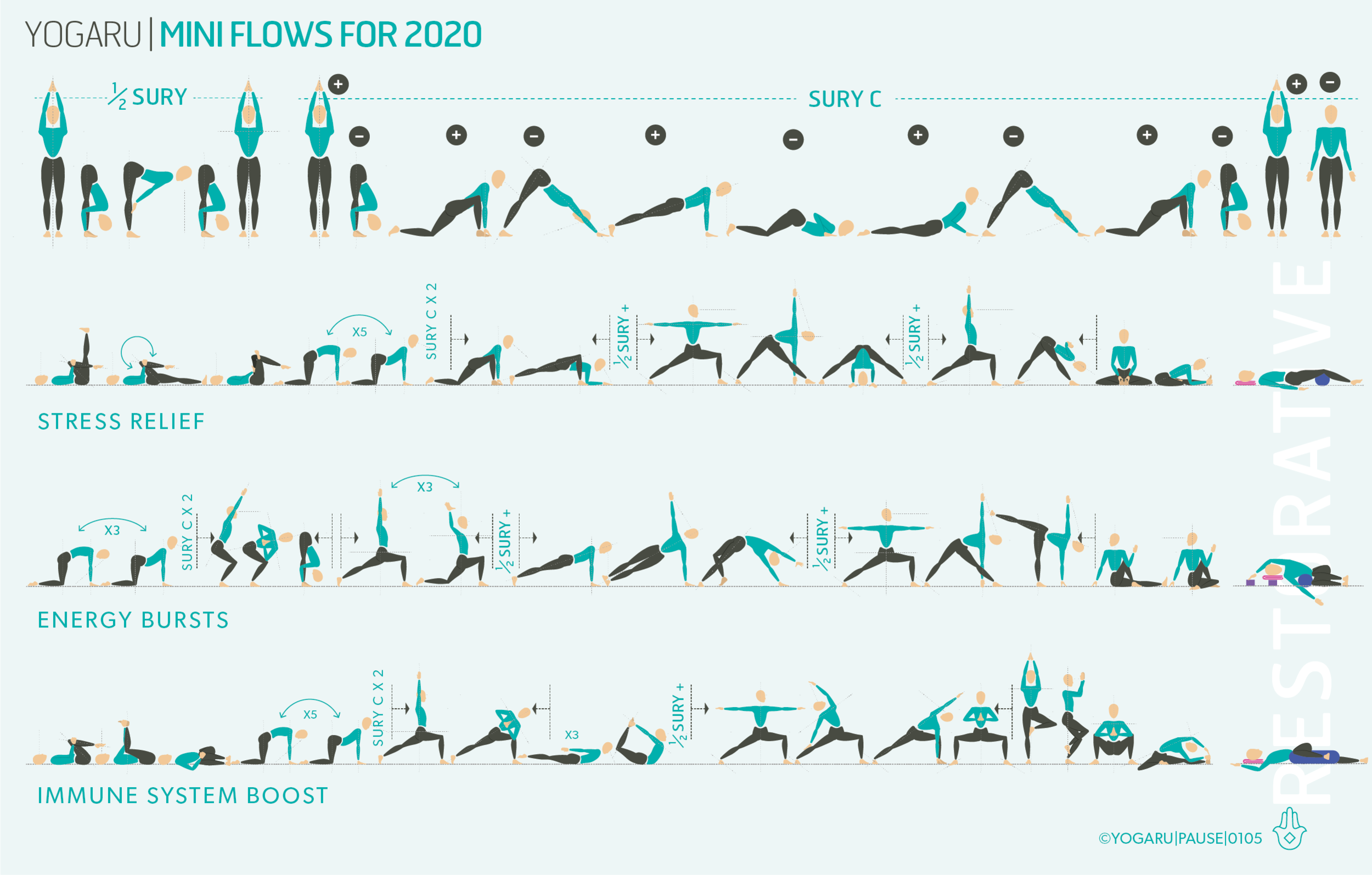
Mini flows for 2020

PAUSE_0105.png

BRINGING IT ALL TOGETHER
After teaching some Christmas restorative workshops I am reminded of the profound effect of consciously bringing the body to a state of complete relaxation. My intention for 2020 is to incorporate more restorative poses into my home practices, starting with these three simple mini flows. These three sequences give plenty of variety for the new year and help you settle at the end with a different restorative pose as an alternative to Savasana. Savasana is one of the most beneficial of the yoga poses but it’s all too tempting to roll up your mat at the end of a short home practice and jump back into your busyness. Incorporating a restorative pose will give you all the additional benefits of restorative yoga and help you to take that important pause to assimilate the practice before you move on.

BENEFITS OF RESTORATIVE
A lovely way to think of restorative yoga is ‘our body sleeps and our mind watches’. Our muscles can still be firing in different stages of sleep, particularly in a dream state. In restorative we consciously scan for any little bits of held tension in the body and mind and send signals to melt it away.

One of the main benefits of yoga, restorative yoga in particular, is that through the nervous system it strengthens the immune system. It does this with the breath which stimulates the vagus nerve, bringing the body into the rest, digest and restore response. This creates optimal conditions for the functionality of the organs of the body and strengthens the immune system, relieving symptoms of chronic stress, fatigue and tension.

EXPLORING MINI FLOWS FOR 2020 IN YOUR PRACTICE
These mini flows give you three new versions of the most downloaded themes from the website – stress relief with some hip opening and forward folds; energy bursts with twists and arm balancing poses; and immune system with plenty of twists and backbends to stimulate the digestive system where 80% of the immune system is made.

ALIGNMENT CUES
Below are the alignment cues to help you navigate the restorative poses. Comfort is king when practising restorative. Use plenty of props to find ultimate comfort. You don’t need to have an array of official yoga props. You can improvise with household items that can do just as good a job. The props you’ll need for these restorative poses are – a bolster, or use two stacked cushions; two yoga bricks, or two thick dictionaries; two to four yoga blankets, or regular blankets. I’m a big fan of blankets even if you are not feeling cold. The added weight on the body triggers sensors on the skin and tells you that you are safe and secure.

STRESS RELIEF - RESTING SAVASANA
Start lying on your back with a folded blanket under your head, a bolster under the creases of your knees and a blanket over you. Legs and arms extended, palms facing up, lift your buttocks and slide the flesh of the buttocks downwards. Feet gently flop out to the sides. Shoulders melt to the floor. Eyeballs become heavy in their sockets, skin on the forehead smooth as silk. Soften the temples and find ease in the tiny lines around the eyes.

ENERGY BURSTS - BLISSFUL BANANA
Make a pillow with a brick and a blanket on top of it at the top of the mat, place an additional brick above this at arms reach. Place your bolster horizontally on your mat with a space between your bolster and pillow. Sit with your right hip next to the long edge of the bolster, knees bent. Lengthen the spine along the mat and nestle the bolster into the curve of your waist. Place your head on your pillow, your shoulder in the space between your props and extend your right arm forward. Extend your left arm overhead and place it on the brick. If the raised arms doesn’t suit you bring your arm down and place it on your right arm. Repeat on the left side.

IMMUNE SYSTEM BOOST - BOLSTER TWIST
Place your bolster vertically along the left side of the middle of your mat. From lying, with a blanket under your head, extended both legs out along the mat and roll your hips to your left, bend your right knee and place it on the support of the bolster, left leg remains extended. To feel this twist let your upper body and right shoulders settle down onto the mat. Bring your arms to cactus position, with arms lifted and elbows bent either side of the body, gaze over your right shoulder. If the twist is too intense add a folder blanket under your knee on the bolster. If the raised arms doesn’t suit you bring your arms either side of the body palms facing up. Repeat of the left side.

To save the images for personal use click and hold down the image until the ‘save image’ option appears; on Mac hold down ‘control’ and click the image to get the option box; on PC right click on the image to get the option box. Scroll down in the ‘option box’ and click ‘save image’.

Ruth Delahunty Yogaru

10 benefits of twists

PAUSE_0104.png

WINTER TWISTS
When the temperatures drop and we start to move towards to depths of winter twists help to calm the nervous system, balance hormones, release tension, and help the body to adjust to the sudden change in season. They also stoke your internal generator to help you stay warm when there is a nip in the air, warming you from the inside out.

While Springtime is a time for getting into some deeper twists, Wintertime is more suitable for gentler twists to keep the spine supple over the winter months without going too deep into potentially seasonally tight muscles. Try this simple yoga sequence to get some twisting benefits into your day. Explore giving yourself permission to not go into your deepest twist and pause to take a few extra breaths in each twist to build strong winter ready lungs. Here are 10 benefits of adding these twist into your practice:

1. Aids digestion - twists penetrate deep into the body, stimulating the organs of the abdominal region. One of the most important organs which benefits from twists is the digestive system, also known as the enteric nervous system, or the ‘second brain’. Twists stimulate maximum nutrition absorption and distribution throughout the body.

2. Eases constipation - the digestive system is happiest when it is kept regular. Constipation can leave you feeling sluggish and bloated. Twists wake the digestive system up and gently squeeze it to help keep everything moving efficiently. When practising twists turn to the right first to stimulate the ascending colon, then twist to the left after, to stimulate the descending colon.

3. Aids detoxification - twists temporarily constrict blood flow in the bowel, liver and kidneys. In releasing the twist a surge of fresh oxygenated blood rushes back which flushes out unwanted toxins.

4. Increases metabolism - your metabolism is the rate at which your body process matter to create energy. Twists boosts the metabolism by aiding good digestive. The metabolism also functions best in a stress free environment – twists soothe physical and emotional tension in the body through triggering the parasympathetic nervous system.

5. Boosts immune system - a healthy immune system starts in your gut. As 80% of our immune system is generated in the gut it makes sense that twists are a very powerful tool for a strong immune system. Along with the digestive system, twists also stimulate the circulatory, the nervous and the endocrine systems – which all have an important part to play in building the immune system.

6. Increases circulation - good circulation brings oxygen and nutrients to the whole body. Sitting at a desk all day is one of the main culprits of poor circulation. Yoga, twists in particular, increase your circulation – with the additional benefit of adding a healthy glow to your complexion after your practice!

7. Energising - the increased circulation from twists of oxygenated blood to the brain gives you a fresh boost of energy. They also stir up your internal prana (life energy) and increases energy flow throughout the whole body.

8. Eases stress & anxiety - a healthy gut has a strong link to our moods and emotional well-being. Stress leads to gut issues and similarly gut issues lead to stress. As 95% of serotonin (the happy hormone) is produced in the bowel, stimulating the gut through twists release these happy hormones into the system.

9. Balances nervous system - the sympathetic nervous system (fight & flight) is in constant alert in our busy lives. Sometimes we may need a bit of ‘fight & flight’, but most of the time it’s a result of our brain being overwhelmed and leads us to make impulsive decisions. Slowing down and taking some deep breaths in your twists rewires the brain to pause before it reacts, and triggers the parasympathetic nervous system (rest & digest).

10. Improves spinal health - last but not least, twist help maintain a healthy spine by wringing out and lubricating the connective tissue of the spine – keeping them strong, supple. They stretch, strengthen and release tension from all the muscles of the spine.

To save the images for personal use click and hold down the image until the ‘save image’ option appears; on Mac hold down ‘control’ and click the image to get the option box; on PC right click on the image to get the option box. Scroll down in the ‘option box’ and click ‘save image’.

Ruth Delahunty Yogaru