
Pranayama

Christmas sprinkles

SPRINKLE MOVEMENT INTO YOUR CHRISTMAS
Over the years, I’ve shared all kinds of Christmas and New Year practices – gentle December flows, grounding New Year resets, and quick mini-sequences you can squeeze in between festive plans. This year, I’m giving you a sequence you can dip in and out of whenever you need it, helping you sprinkle your festive period with just enough movement to keep you feeling good and fully able to enjoy the holidays.

The holidays have a rhythm of their own – busier days, richer food, more sitting, and routines that seem to shift depending on who’s visiting or what’s on the calendar. It’s easy to tell ourselves we’ll restart our practice after the holidays, only to reach that point feeling stiff and out of balance. This year, try the opposite approach!

LITTLE + OFTEN
Instead of waiting until you feel uncomfortable, weave movement into your Christmas before sluggishness creeps in. You can practice the full sequence or, when time is tight, sprinkle it throughout your day. “Little and often” goes a long way to keep you feeling energised and ready for all the festive fun.

Gentle movement and MFR help keep your fascia hydrated, your joints gliding smoothly, your circulation flowing, and your digestion supported. Pranayama and restorative yoga regulate your energy, lift your mood, and offer a supportive reset for your nervous system.

Think of these practices as tiny, intentional investments in your body that prevent the holiday slump before it starts.

This sequence is designed to meet you wherever you are and however much time you have. Your Christmas Sprinkles might include some or all of:

  • Begin your day with some grounding breathwork.

  • Take some standing mini-flows after a winter walk.

  • Roll out with some MFR once the house settles in the evening.

  • Unwind with a restorative pose before bed.

Or:

  • Wake up your fascia and muscles with some morning MFR.

  • Followed by some energising standing mini-flows.

  • Sneak in a restorative pose to recharge your battery before evening festivities.

  • Optimise recovery with some light breathwork in bed to help you sleep.

Even five minutes can make a huge difference in how you feel – in your body and your mood. Personally, I love starting my day with breathwork and book-ending it with a few minutes of MFR in the evening to help me wind down.

THE CHRISTMAS TOOLKIT
This year’s sequence is built from the four tools I’ve been using most with students and in my own practice – movement, breathwork, MFR, and restorative yoga.

The standing section has a slightly different flavour from my usual flow – four mini-flows, each made up of four poses, linked with the breath. You can practice all four together when you have time for a longer practice, or pick one or two when you need a little “movement snack” to decompress, melt stiffness, or gently support digestion. These mini-flows are designed to stretch, strengthen and be easy to return to.

Alongside these mini-flows, I have weaved in breathwork to reset the nervous system, MFR to soften tension, and restorative yoga to help you truly switch off. Together, these four elements create a simple, well-rounded, time-efficient way to look after yourself – taking the guesswork out of what to do to feel your best over Christmas.

  • Movement - Hydrates fascia, prevents stiffness, wakes up sleepy muscles and supports the natural movement of the gut.

  • Breathwork - Faster breaths and longer inhales lift you up; slowing the breath and lengthening your exhale brings calm and can help soothe the digestive system.

  • MFR - Eases aches, increases range of motion and helps release abdominal and back tension that can affect digestion.

  • Restorative yoga - Down-regulates the nervous system and supports immunity, digestion, hormone balance and deep rest.

Your Christmas sprinkles sequence blends all of these elements into one simple, nourishing practice – a little holiday toolkit you can return to whenever you need it.

The Christmas sprinkles formula: movement + breathwork + MFR + restorative yoga.

EXPLORING CHRISTMAS SPRINKLES IN YOUR PRACTICE
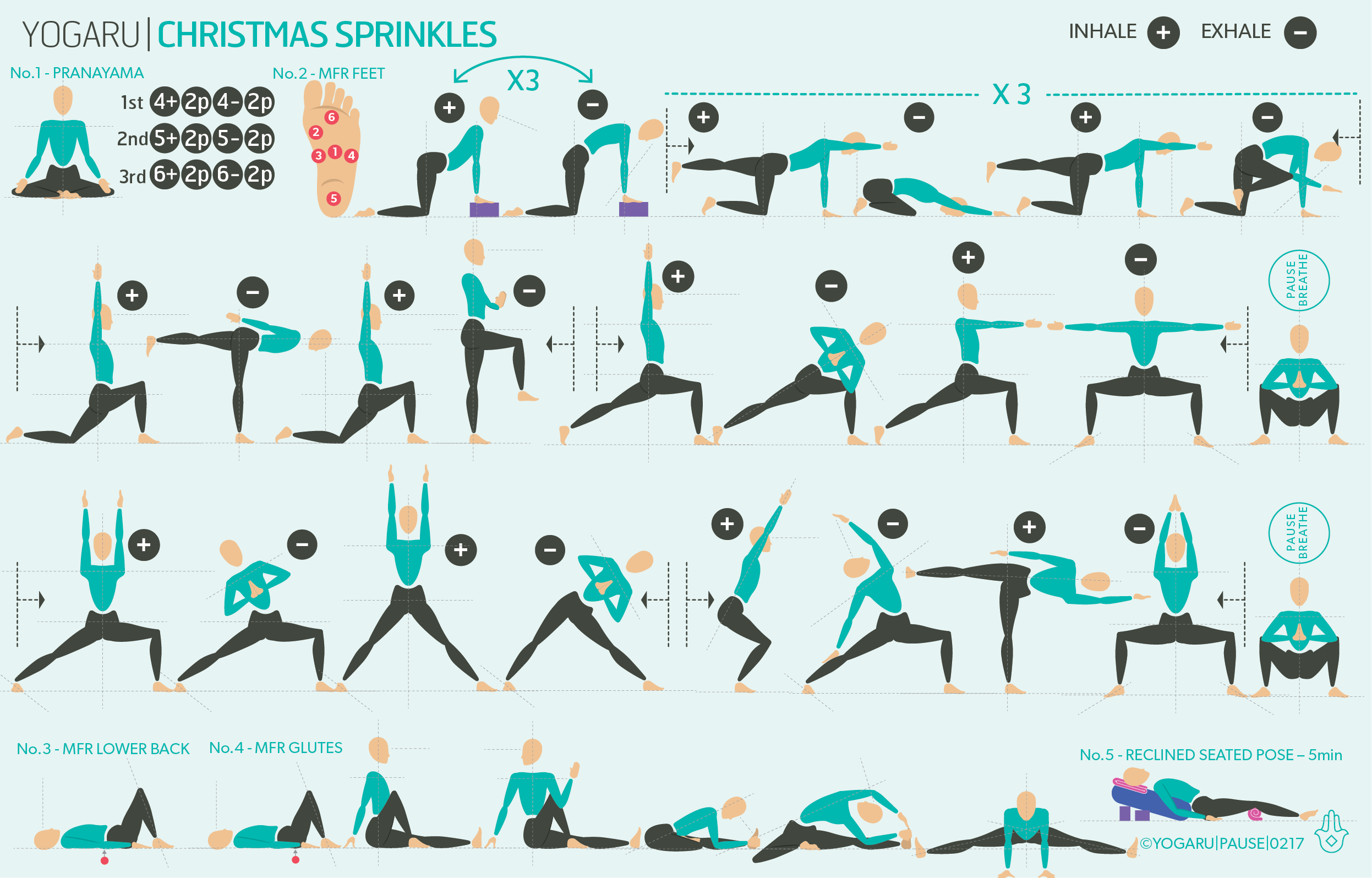
This sequence starts with some pranayama. You can use this simple breathwork practice on its own anytime of day – morning wake up, during the day for a quick reset, or an evening wind down. Next up is some MFR – rolling the feet is by far the most popular MFR technique in my public and private classes. You will wonder how you ever practised yoga, exercised, or went through your day, without waking up your feet first!

The second and third rows are your four pose mini-flows. Go through each of them with the right leg forward first and then the left leg forward, repeat 2-3 times. You can choose to practice all three for a longer practice, or pick one or two to flow through for a shorter practice. Move slowly, with control and use the ‘+’ and ‘-’ in the sequence as a guide for your inhale and exhale.

Your final row is a luxurious lower back and hip MFR session which will really help with stiffness from extended periods of sitting. You’ll finish with a lovely supported restorative pose – as with the pranayama and standing flows you can choose to just do the restorative pose to balance the festive period with some calming ‘me time’.

ALIGNMENT CUES
Below are the pranayama, MFR and restorative techniques used in this sequence. The props you’ll need are:
2 x MFR balls - or 2 tennis balls.
2 x yoga bricks - or 2 thick similar sized dictionaries.
1 x bolster - or 2 towels, wrapped around a horizontally rolled pillow and tied to secure.
2 x yoga blankets - or any wool, thick cotton or fleece blanket with density.

Breathwork
No.1 - Pranayama

Sit in a comfortable seated position. Inhale for the count of 4, pause for the count of 2, exhale for the count of 4, pause for the count of 2 x 3 rounds. Inhale for the count of 5, pause for 2, exhale for the count of 5, pause for 2 x 3 rounds. Inhale for the count of 6, pause for 2, exhale for the count of 6, pause for 2 x 3 rounds. 

MFR
No.2 - Feet
Compression -
from standing or seated, place 1 x ball at position No.1, gently press down with an inhale and release on the exhale x 5 breaths and move on to No.2. Continue to No.5. 
Roll & cross fibre - with the toes on the ground place 1 x ball at No.5, roll the ball across your heel x 5. Place 1 x ball at No.6, roll the ball across the knuckles of your toes x 5. Place 1 x ball at No.6, roll in one direction from toes to heel x 5. 
Scribble - roll and scribble across the sole of the foot. Repeat all steps on the other foot.

No.3 - Lower back (quadratus lumborum & erectors)
Compression -
from supine with knees bent, place 2 x balls above the back of the hips either side of the spine, gently press down with an inhale and release on the exhale x 5 breaths.
Sheer - slowly lift and lower one knee at a time towards your chest x 5.
Roll & cross fibre - roll up and down the lower spine below the ribs.

No.4 - Glutes (gluteus maximus & piriformis)
Compression -
from supine with knees bent, place 2 x balls in the centre of each buttock muscle, gently press down with an inhale and release on the exhale x 5 breaths.
Sheer - slowly lift and lower one knee at a time towards your chest x 5. Place your right foot on your left knee and lower and lift your right knee.
Roll & cross fibre - roll around the whole buttocks area.

Restorative
No.5 - Reclined seated

Place two bricks horizontally at the top of your mat, One at its highest height and the other at its mid height. Lie your bolster over the bricks along the centre of your mat and place a folded blanket on the far end of your bolster where your head will rest. Sit with the back of your hips along the short end of the bolster. Roll up a folded blanket and place it under your knees. Gently lie back onto your bolster. Feel a gentle opening across the chest.

To save the images for personal use click and hold down the image until the ‘save image’ option appears; on Mac hold down ‘control’ and click the image to get the option box; on PC right click on the image to get the option box. Scroll down in the ‘option box’ and click ‘save image’.

Ruth Delahunty Yogaru
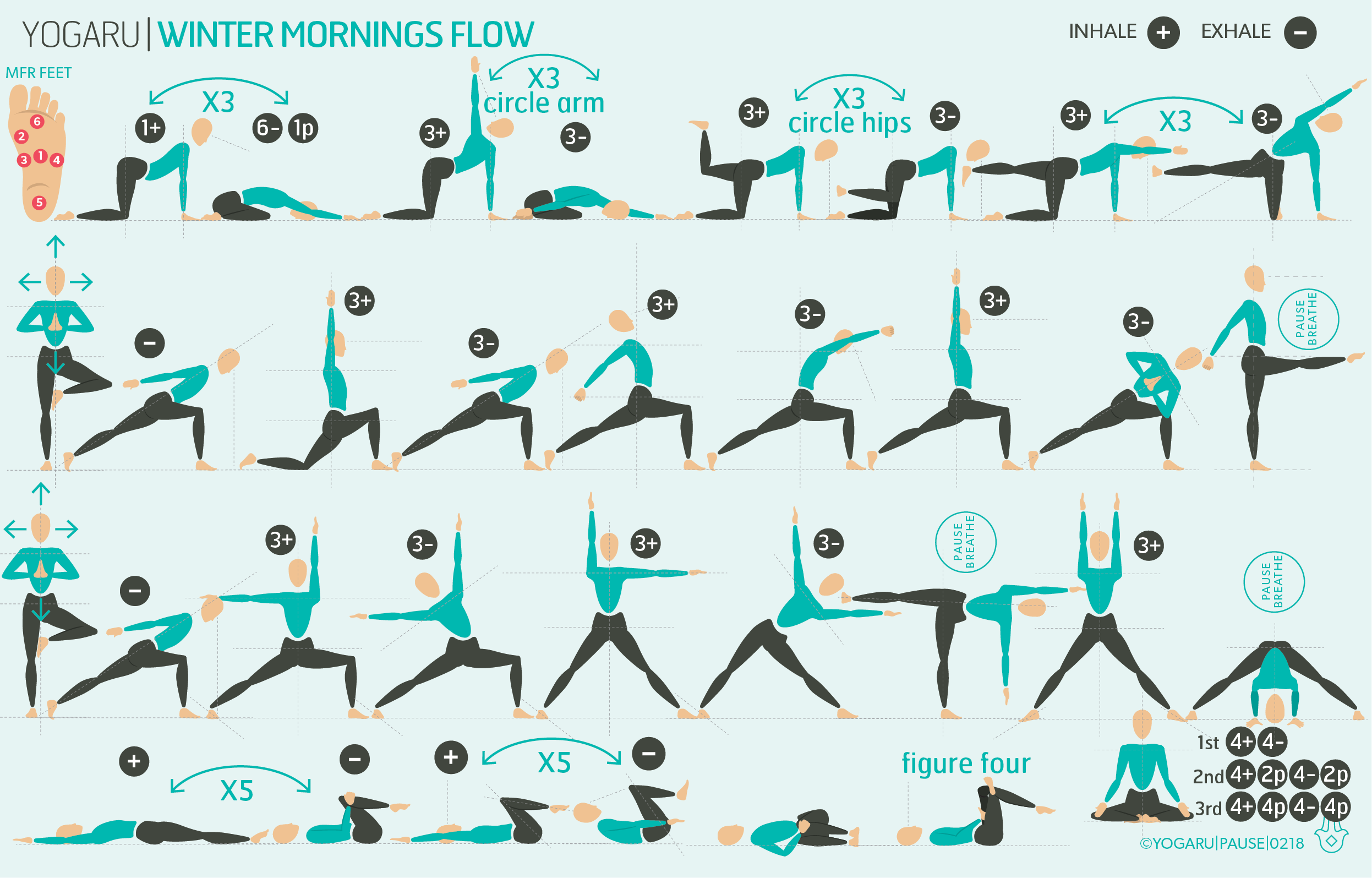
Summer mornings flow

YOUR MORNING RESET
After a night of rest, it’s common to wake up feeling a little stiff or sluggish. Gentle movement first thing in the morning helps shake off that heaviness, re-energise the body, and set the tone for a more grounded, vibrant day. Morning movement releases endorphins, increases oxygen flow, and boosts circulation – leaving you feeling more awake, clear-headed, and ready to meet the day.

Yoga is one of the most effective and accessible ways to get moving in the morning. It gently stretches and strengthens the entire body, mobilises the spine in all directions, and opens up the hips – especially helpful if you spend much of your day sitting. By focusing on key areas like the spine, hips, and shoulders, yoga helps relieve tension, improve posture, and support pain-free movement. This physical reset also uplifts your mood and cultivates a sense of emotional clarity and openness.

A consistent morning yoga practice does more than just wake you up. It supports digestion, balances hormones, boosts metabolism, and strengthens your immune system. Most importantly, it creates intentional space for self-care before the demands of the day begin – grounding your energy, aligning your body and mind, and helping you show up with more presence and resilience.

MORNING YOGA IN SUMMER
Summer brings an energetic, outward-moving rhythm to life – longer days, social activity, and increased momentum. Morning yoga helps balance that vibrancy with inner steadiness and mindful activation. Grounding standing poses build strength in the legs and core, helping you move through your day with a calm, steady foundation. Focusing on the inhale, and drawing breath deeply into the lungs, uplifts your energy and awakens the nervous system.

Summer mornings offer the perfect opportunity to build or refresh your yoga practice. The early light makes it easier to wake up, roll out your mat and get moving. The warmer weather means your muscles are more pliable, making it a great time to explore deeper backbends and heart-opening poses. These postures improve spinal mobility, encourage a more upright and open posture, and create a natural sense of expansion – physically and emotionally. Poses where the arms are lifted help circulate blood around warmer areas like the chest, armpits, and head – offering a cooling, revitalizing effect.

Increased heat and perspiration can slow digestion, especially after a night of sleep. Gentle morning twists stimulate the gut, enhance digestion, keep things moving and leave you feeling lighter and more comfortable. Follow your practice with a large glass of water to support hydration and amplify the digestive benefits of your movement.

Your summer morning practice will help you stay balanced, focused, and align with the day ahead. Start your day on the mat and step into summer with strength, clarity and ease.

EXPLORING SUMMER MORNINGS FLOW IN YOUR PRACTICE
This sequence starts in the first row with MFR on the feet to connect you with your foundation and gentle, breath-led movements to gradually build heat and warm all the muscles up. The second and third row are your standing flows, grounding through the legs shakes off any lingering sleepiness and helps you feel steady and confident in the day ahead. Complete each full line with the right leg forward and then repeat the line with the left leg forward – this is one full round of the flow. For a longer practice you can repeat these two standing flows. The final row brings you back down to the ground to absorb all the goodness of your time on your mat and get you ready for the day ahead.

Instead of ending in the traditional Savasana, the sequence closes with Samavritti Pranayama – equal breath – to focus the mind and regulate the nervous system. Morning breathwork is like a tall glass of cool water for the whole body: hydrating, energizing, and deeply restorative. It sets you up not just for movement, but for mindful presence throughout the day.

ALIGNMENT CUES
Below are the MFR and pranayama techniques used in this sequence. The props you’ll need are:
1 x MFR balls - or 1 tennis ball.

MFR Feet
Compression - from standing or seated, place 1 x ball at position No.1, gently press down with an inhale and release on the exhale x 5 breaths and move on to No.2. Continue to No.5. 
Roll & cross fibre - with the toes on the ground place 1 x ball at No.5, roll the ball across your heel x 5. Place 1 x ball at No.6, roll the ball across the knuckles of your toes x 5. Place 1 x ball at No.6, roll in one direction from toes to heel x 5. 
Scribble - roll and scribble across the sole of the foot. Repeat all steps on the other foot.

Pranayama
Sit in a comfortable position – cross legged, sitting up on a brick or straddling a bolster. Inhale for the count of 4, exhale for the count of 4 x 3 rounds. Inhale for the count of 4, pause for 2, exhale for the count of 4, pause for 2 x 3 rounds. Inhale for the count of 4, pause for 4, exhale for the count of 4, pause for 4 x 3 rounds. 

To save the images for personal use click and hold down the image until the ‘save image’ option appears; on Mac hold down ‘control’ and click the image to get the option box; on PC right click on the image to get the option box. Scroll down in the ‘option box’ and click ‘save image’.

Ruth Delahunty Yogaru

Building resilience

THE RESILIENCE FORMULA
Resilience isn’t just about pushing through a challenge – it’s about meeting them head-on and then being able to come back down after. It’s your ability to regulate your nervous system’s response to physical or mental stress. Stress is not all bad – it helps train the nervous system to adapt, motivates us to start our day, and drives productivity. While short periods of manageable stress are a natural part of life, chronic or unmanaged stress can lead to inflammation and disrupted sleep.

When stress takes over, the brain shifts into ‘bottom-up’ emotional regulation, where the amygdala – our internal alarm system – goes into overdrive, leading to impulsive decisions. In contrast, when we’re calmer, ‘top-down’ regulation takes the lead, allowing the prefrontal cortex – the thinking brain – to make more thoughtful choices. Just like a muscle, the nervous system can be trained through repetition to recover after stress and strengthen ‘top-down’ responses, fostering better emotional balance and decision-making

In the cycle of physical and mental stress, the recovery phase is where growth occurs – this is when you become stronger and more adaptable to life’s demands. As Tiffany Cruikshank of Yoga Medicine advises, “To feel and perform better, you must prioritise relaxation” . This balance between stress and recovery is the key to building resilience.

By applying this formula both in yoga and in daily life, we can train the nervous system to rise to a challenge and return to a state of calm. Just like a dimmer switch, learning to regulate between stimulation and relaxation prevents the body from getting stuck in a constant state of high stress or low energy, promoting long-term resilience and well-being.

The resilience formula: stress + recovery = positive adaptation.

BUILDING RESILIENCE WITH YOGA
Incorporating small doses of both stimulating and recovery practices into your yoga routine creates manageable cycles of stress and recovery. This not only builds resilience but also enhances your ability to handle stress in daily life.

You can introduce stimulating elements through strengthening poses, balance drills, eccentric movements, isometric holds, and slow, controlled flows. Then, balance these with recovery practices such as gentle flow, exhale-focused breathwork, myofascial release (MFR) self-massage, meditation, and yin or restorative poses. By alternating between stimulating and relaxation, you train your nervous system to adapt more effectively, fostering long-term resilience and well-being.

In daily life, it’s essential to have a personal toolkit of recovery practices to support resilience. Your active recovery might include restorative yoga, meditation, myofascial release (MFR), gentle stretching, breathwork, short naps (before 3 PM), or spending time in nature. These intentional practices allow your nervous system to truly reset. On the other hand, inactive recovery – such as watching TV, reading, scrolling through social media, or other screen time – still involves some level of stimulation and doesn’t provide the same restorative benefits.

I encourage you to create your own resilience formula by identifying activities that challenge you and listing your favorite active recovery practices. True resilience comes from a well-rounded approach that includes quality sleep, proper nutrition, hydration, movement, time in nature, and meaningful social connections.

EXPLORING BUILDING RESILIENCE IN YOUR PRACTICE
This sequence combines challenging poses with recovery. It starts with one of the best MFR techniques for stress and tension relief – the shoulders. The first row has a progression of mini flows that gets more challenging followed by a propped Malasana/Squat to recover. Rows two and three are the two standing flows which incorporate core and balancing challenges. You will step your right leg forward first then repeat the flow with the left leg forward. You can repeat these flows two to three times depending on how challenging you want your practice to be and how long you want to practice for. Row four has two more core mini flows and a breather in Apanasana/Knee to Chest. This is followed by two more MFR techniques on the hips and glutes – the perfect way to recover the hips. Finally you will finish with a short seated pranayama practice.

ALIGNMENT CUES
Below are the MFR and pranayama techniques used in this sequence. The props you’ll need are:
2 x MFR balls - or 2 tennis balls.
2 x yoga bricks - or 2 thick similar sized dictionaries.

MFR
No.1 - Shoulders (trapezius & supraspinatus)
Compression - from supine with knees bent, place 2 x balls in the centre of each upper shoulder, gently press down with an inhale and release on the exhale x 5 breaths.
Sheer - slowly circle arms overhead and back to the ground x 5. 

No.2 - Hips (gluteus medius)
Compression - from side lying up on your forearm, stack  2 x balls behind your frontal hip bone on your outer hip, gently press down with an inhale and release on the exhale x 5 breaths.
Sheer - slowly lift and lower your leg x 5.
Roll & cross fibre - roll up and down on your outer hip.

No.3 - Glutes (gluteus maximus & piriformis)
Compression - from supine with knees bent, place 2 x balls in the centre of each buttock muscle, gently press down with an inhale and release on the exhale x 5 breaths.
Sheer - slowly lift and lower one knee at a time towards your chest x 5. Place your right foot on your left knee and lower and lift your right knee.
Roll & cross fibre - roll around the whole buttocks area.

Pranayama
Sit in supported Baddha Konasana/Bound Angle or your preferred seated position.  Inhale for the count of 4, exhale for the count of 4, pause for the count of 2 x 3 rounds. Inhale for the count of 5, exhale for the count of 5, pause for 4 x 3 rounds. Inhale for the count of 6, exhale for the count of 6, pause for 6 x 3 rounds. 

To save the images for personal use click and hold down the image until the ‘save image’ option appears; on Mac hold down ‘control’ and click the image to get the option box; on PC right click on the image to get the option box. Scroll down in the ‘option box’ and click ‘save image’.

Ruth Delahunty Yogaru