
Restorative yoga

Christmas sprinkles

SPRINKLE MOVEMENT INTO YOUR CHRISTMAS
Over the years, I’ve shared all kinds of Christmas and New Year practices – gentle December flows, grounding New Year resets, and quick mini-sequences you can squeeze in between festive plans. This year, I’m giving you a sequence you can dip in and out of whenever you need it, helping you sprinkle your festive period with just enough movement to keep you feeling good and fully able to enjoy the holidays.

The holidays have a rhythm of their own – busier days, richer food, more sitting, and routines that seem to shift depending on who’s visiting or what’s on the calendar. It’s easy to tell ourselves we’ll restart our practice after the holidays, only to reach that point feeling stiff and out of balance. This year, try the opposite approach!

LITTLE + OFTEN
Instead of waiting until you feel uncomfortable, weave movement into your Christmas before sluggishness creeps in. You can practice the full sequence or, when time is tight, sprinkle it throughout your day. “Little and often” goes a long way to keep you feeling energised and ready for all the festive fun.

Gentle movement and MFR help keep your fascia hydrated, your joints gliding smoothly, your circulation flowing, and your digestion supported. Pranayama and restorative yoga regulate your energy, lift your mood, and offer a supportive reset for your nervous system.

Think of these practices as tiny, intentional investments in your body that prevent the holiday slump before it starts.

This sequence is designed to meet you wherever you are and however much time you have. Your Christmas Sprinkles might include some or all of:

  • Begin your day with some grounding breathwork.

  • Take some standing mini-flows after a winter walk.

  • Roll out with some MFR once the house settles in the evening.

  • Unwind with a restorative pose before bed.

Or:

  • Wake up your fascia and muscles with some morning MFR.

  • Followed by some energising standing mini-flows.

  • Sneak in a restorative pose to recharge your battery before evening festivities.

  • Optimise recovery with some light breathwork in bed to help you sleep.

Even five minutes can make a huge difference in how you feel – in your body and your mood. Personally, I love starting my day with breathwork and book-ending it with a few minutes of MFR in the evening to help me wind down.

THE CHRISTMAS TOOLKIT
This year’s sequence is built from the four tools I’ve been using most with students and in my own practice – movement, breathwork, MFR, and restorative yoga.

The standing section has a slightly different flavour from my usual flow – four mini-flows, each made up of four poses, linked with the breath. You can practice all four together when you have time for a longer practice, or pick one or two when you need a little “movement snack” to decompress, melt stiffness, or gently support digestion. These mini-flows are designed to stretch, strengthen and be easy to return to.

Alongside these mini-flows, I have weaved in breathwork to reset the nervous system, MFR to soften tension, and restorative yoga to help you truly switch off. Together, these four elements create a simple, well-rounded, time-efficient way to look after yourself – taking the guesswork out of what to do to feel your best over Christmas.

  • Movement - Hydrates fascia, prevents stiffness, wakes up sleepy muscles and supports the natural movement of the gut.

  • Breathwork - Faster breaths and longer inhales lift you up; slowing the breath and lengthening your exhale brings calm and can help soothe the digestive system.

  • MFR - Eases aches, increases range of motion and helps release abdominal and back tension that can affect digestion.

  • Restorative yoga - Down-regulates the nervous system and supports immunity, digestion, hormone balance and deep rest.

Your Christmas sprinkles sequence blends all of these elements into one simple, nourishing practice – a little holiday toolkit you can return to whenever you need it.

The Christmas sprinkles formula: movement + breathwork + MFR + restorative yoga.

EXPLORING CHRISTMAS SPRINKLES IN YOUR PRACTICE
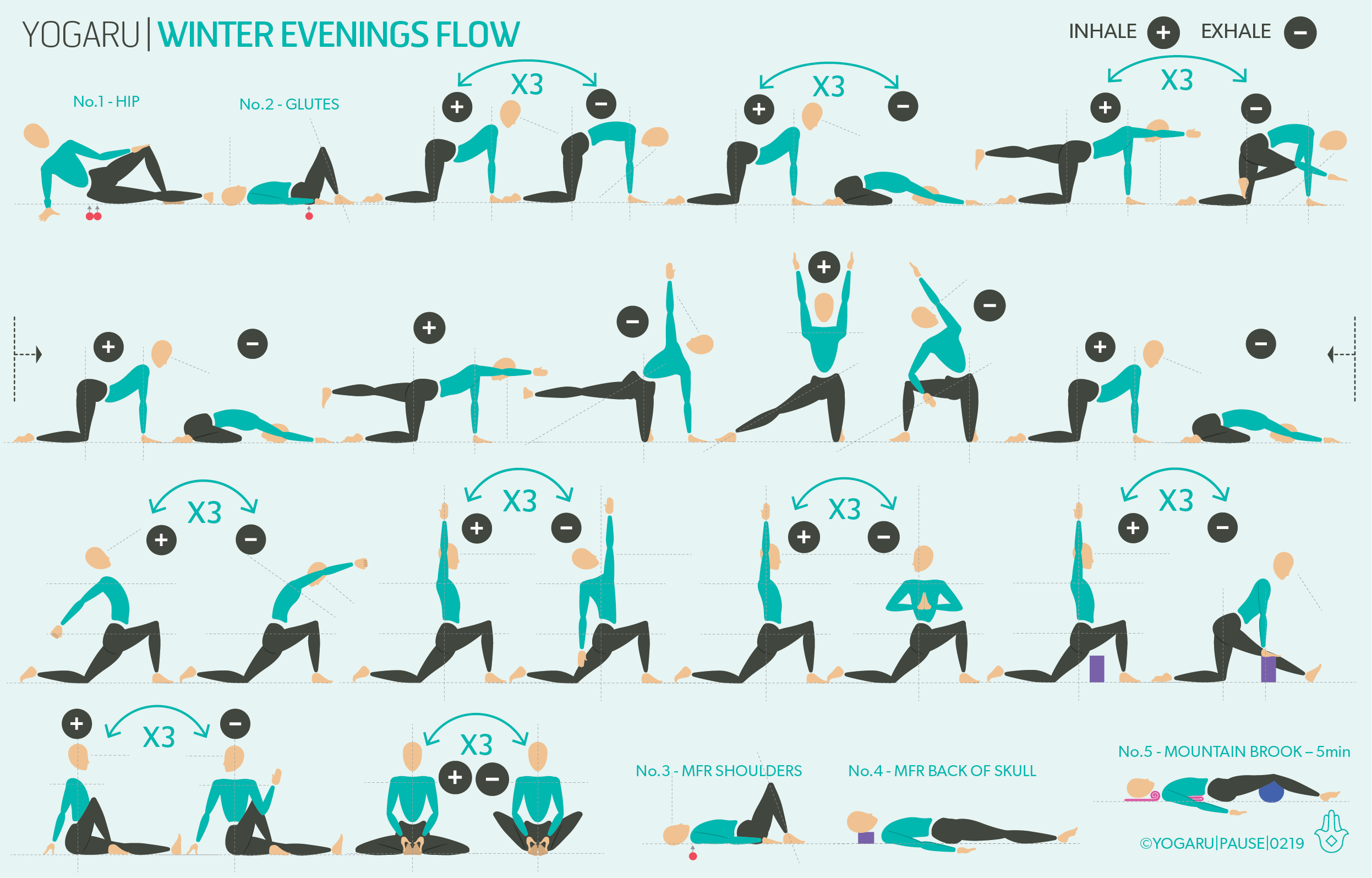
This sequence starts with some pranayama. You can use this simple breathwork practice on its own anytime of day – morning wake up, during the day for a quick reset, or an evening wind down. Next up is some MFR – rolling the feet is by far the most popular MFR technique in my public and private classes. You will wonder how you ever practised yoga, exercised, or went through your day, without waking up your feet first!

The second and third rows are your four pose mini-flows. Go through each of them with the right leg forward first and then the left leg forward, repeat 2-3 times. You can choose to practice all three for a longer practice, or pick one or two to flow through for a shorter practice. Move slowly, with control and use the ‘+’ and ‘-’ in the sequence as a guide for your inhale and exhale.

Your final row is a luxurious lower back and hip MFR session which will really help with stiffness from extended periods of sitting. You’ll finish with a lovely supported restorative pose – as with the pranayama and standing flows you can choose to just do the restorative pose to balance the festive period with some calming ‘me time’.

ALIGNMENT CUES
Below are the pranayama, MFR and restorative techniques used in this sequence. The props you’ll need are:
2 x MFR balls - or 2 tennis balls.
2 x yoga bricks - or 2 thick similar sized dictionaries.
1 x bolster - or 2 towels, wrapped around a horizontally rolled pillow and tied to secure.
2 x yoga blankets - or any wool, thick cotton or fleece blanket with density.

Breathwork
No.1 - Pranayama

Sit in a comfortable seated position. Inhale for the count of 4, pause for the count of 2, exhale for the count of 4, pause for the count of 2 x 3 rounds. Inhale for the count of 5, pause for 2, exhale for the count of 5, pause for 2 x 3 rounds. Inhale for the count of 6, pause for 2, exhale for the count of 6, pause for 2 x 3 rounds. 

MFR
No.2 - Feet
Compression -
from standing or seated, place 1 x ball at position No.1, gently press down with an inhale and release on the exhale x 5 breaths and move on to No.2. Continue to No.5. 
Roll & cross fibre - with the toes on the ground place 1 x ball at No.5, roll the ball across your heel x 5. Place 1 x ball at No.6, roll the ball across the knuckles of your toes x 5. Place 1 x ball at No.6, roll in one direction from toes to heel x 5. 
Scribble - roll and scribble across the sole of the foot. Repeat all steps on the other foot.

No.3 - Lower back (quadratus lumborum & erectors)
Compression -
from supine with knees bent, place 2 x balls above the back of the hips either side of the spine, gently press down with an inhale and release on the exhale x 5 breaths.
Sheer - slowly lift and lower one knee at a time towards your chest x 5.
Roll & cross fibre - roll up and down the lower spine below the ribs.

No.4 - Glutes (gluteus maximus & piriformis)
Compression -
from supine with knees bent, place 2 x balls in the centre of each buttock muscle, gently press down with an inhale and release on the exhale x 5 breaths.
Sheer - slowly lift and lower one knee at a time towards your chest x 5. Place your right foot on your left knee and lower and lift your right knee.
Roll & cross fibre - roll around the whole buttocks area.

Restorative
No.5 - Reclined seated

Place two bricks horizontally at the top of your mat, One at its highest height and the other at its mid height. Lie your bolster over the bricks along the centre of your mat and place a folded blanket on the far end of your bolster where your head will rest. Sit with the back of your hips along the short end of the bolster. Roll up a folded blanket and place it under your knees. Gently lie back onto your bolster. Feel a gentle opening across the chest.

To save the images for personal use click and hold down the image until the ‘save image’ option appears; on Mac hold down ‘control’ and click the image to get the option box; on PC right click on the image to get the option box. Scroll down in the ‘option box’ and click ‘save image’.

Ruth Delahunty Yogaru
Stress proof your day

HOW STRESS WORKS
The word stress has become shorthand for modern life. It can mean both mental and physical strain. To understand mental stress, it helps to first look at how physical stress works.

When you lift weights, you stress your muscles. They develop tiny tears, and in recovery your body repairs and strengthens them. The right amount of stress builds resilience. But lift too much, and you strain the muscle – causing injury and requiring longer recovery.

The same applies to mental stress. A challenge within your capability sharpens your focus, helps you perform, and then subsides in recovery, leaving you stronger. But if the challenge feels too big, stress spikes. You may feel overwhelmed, stuck in the stress cycle, and unable to recover – eventually leading to chronic stress. That’s like walking around all day carrying a heavy weight!

The key isn’t eliminating stress, but balancing it with recovery. Growth happens in the recovery phase: stress + recovery = resilience. By weaving in morning rituals, breath reminders, and mindful movement, you train your nervous system to shift smoothly between effort and ease. Once you feel the restorative effects of recovery, it quickly becomes the best part of your day.

WHY YOGA HELPS
Yoga shines as a recovery practice because it works on many levels: 

  • Resilience – teaches your nervous system to move smoothly from stimulation to relaxation.

  • Breath – conscious breathing stimulates the vagus nerve, quieting the fight-or-flight response.

  • Movement – gentle stretching and joint mobilization soothe the nervous system and release stored tension.

  • Presence – focusing on postures and transitions anchors the mind in the moment, breaking cycles of worry.

The stress proof formula: diaphragmatic breathing + extended exhale + hip & shoulder release + breath linked standing flow.

A STRESS PROOF ROUTINE
My current routine to balance out stress and relax in the evening is 10 mins of MFR. Routines and rituals help embed recovery into daily life. How you start your morning sets the tone, mini check-ins throughout the day create buffers between you and stress, and evening rituals set you up for a good recovery nights sleep.

  • Morning wake-up – a few stretches such as Cat-Cow, Child’s Pose, and Forward Fold release stiffness from sleep.

  • Breath reset – take three slow breaths, lengthening the exhale to activate calm.

  • Midday pause – stand, move, and repeat three slow breaths when sitting for long periods.

  • Before a meeting – try a cyclic sigh: inhale deeply into the belly, take an extra sip of air, then exhale slowly and completely.

  • Transitions – as you move from work to chores or evening rest, notice your breath for a few moments. These micro-pauses help you shift gears smoothly.

  • Evening wind down – finish your day with some screen free time to breathe and reflect on your day.

With just a handful of mindful routines, you can move through your day with more clarity, calm, and resilience.

EXPLORING STRESS PROOF YOUR DAY IN YOUR PRACTICE
This sequence gently releases physical and mental tension, and shifts your focus from your worries. Helping you feel strong, resilient and present.

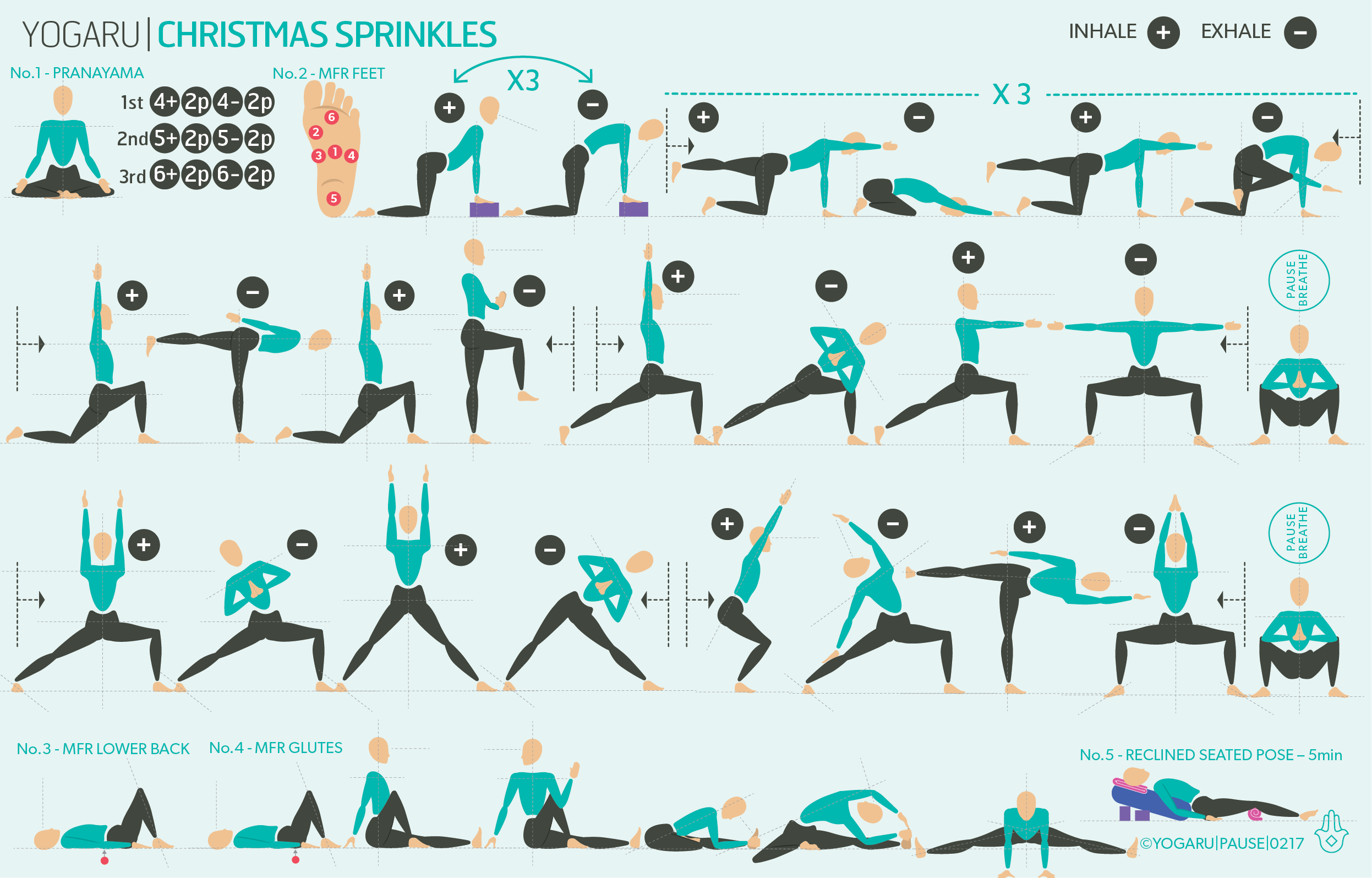
This sequence starts with some MFR on the feet to give you instant stress relief and help you find your grounding as you flow. The second and third rows are your two standing flows. Go through each of them with the right leg forward first and then the left leg forward. For a longer practice you can repeat these flows as often as you’d like. Move slow, with control and with an extended breath. Aim for at least a four count inhale and a four count exhale. Your final row washes out hip tension and finishes with shoulder, head MFR and a lovely supported restorative pose with optional breathwork.

ALIGNMENT CUES
Below are the MFR and restorative poses used in this sequence. The props you’ll need are:
2 x MFR balls - or 1 tennis ball.
2 x yoga bricks - or 2 thick similar sized dictionaries.
1 x bolster - or 2 towels, wrapped around a horizontally rolled pillow and tied to secure.
2 x yoga blankets - or any wool, thick cotton or fleece blanket with density.

MFR
No.1 - Feet

Compression - from standing or seated, place 1 x ball at position No.1, gently press down with an inhale and release on the exhale x 5 breaths and move on to No.2. Continue to No.5. 
Roll & cross fibre - with the toes on the ground place 1 x ball at No.5, roll the ball across your heel x 5. Place 1 x ball at No.6, roll the ball across the knuckles of your toes x 5. Place 1 x ball at No.6, roll in one direction from toes to heel x 5. 
Scribble - roll and scribble across the sole of the foot. Repeat all steps on the other foot.

No.2 - Shoulders (trapezius & supraspinatus)
Compression - from supine with knees bent, place 2 x balls in the centre of each upper shoulder, gently press down with an inhale and release on the exhale x 5 breaths.
Sheer - slowly circle arms overhead and back to the ground x 5. 

No.3 - Back of skull 
Lie on your back and place a brick on its lowest high just below the curve at the back of your skull (occipital ridge). Extend your legs out, arms slightly away from your body, palms facing up. Legs slightly apart and feet fall out to the side, soften your shoulder, back of the neck long. Gently roll your head from side to side to ease out tension in the muscles at the back of the skull. Roll your head mid way to your right, pause and make small circles, repeat on the left side. Remove the brick, soften the muscles across your forehead, your temples, the back of your skull. Let the whole body become heavy and melt into the support of the ground.

Restorative
No.4 - Mountain brook
Half roll a four fold blanket and place it at the top of your mat. Accordion fold the other blanket and place it below your top blanket where your shoulder blades will lie. Place the bolster towards the bottom of your mat where your knees will be. Lie supine on your back, nestle the rolled part of the top blanket in the curve of your neck, place the accordion folded blanket under the lower tips of your shoulder blades and the bolster under the creases of your knees. Legs and arms extended, palms facing up, feet fall out to the side. Feel the rise and fall of the props supporting your back body.

To save the images for personal use click and hold down the image until the ‘save image’ option appears; on Mac hold down ‘control’ and click the image to get the option box; on PC right click on the image to get the option box. Scroll down in the ‘option box’ and click ‘save image’.

Ruth Delahunty Yogaru

The digestive system

THE SECOND BRAIN
The digestive system – often called the enteric nervous system or the second brain – does far more than just process food. It breaks down what we eat, absorbs essential nutrients, eliminates waste, and plays a central role in overall health and emotional well-being.

A remarkable 80% of the immune system resides in the gut, and about 95% of the body’s serotonin – commonly known as the “happy hormone” – is produced in the bowels. This deep connection between the gut and the brain explains why stress can disrupt digestion, and why gut imbalances can contribute to anxiety, depression, and mood disorders.

Emerging research is exploring how optimising gut health may support mental health and how therapies focused on the digestive system could complement treatment for emotional and psychological conditions. A healthy digestive system is not just about physical wellness – it’s also key to emotional balance and resilience.

TWISTS, FORWARD BENDS, BACKBENDS & THE DIGESTIVE SYSTEM
While many forms of movement support digestion, yoga is especially effective – particularly twists, forward bends and backbends, which stimulate the abdominal organs, boost circulation, and enhance both digestion and detoxification.

Twisting and forward bend poses gently compress the abdominal area, stimulating the digestive tract and encouraging peristalsis – the wave-like muscle movement that moves food and waste through the intestines. Upon releasing a twist or forward bend, a surge of oxygenated blood revitalises the organs, enhancing their function. Backbends lengthen and open the front of the body, including the abdomen and chest. This expansion stimulates internal organs, improves posture, and creates space for fuller breathing. While they don’t compress the digestive organs as much as twists or forward bends, backbends still improve circulation and promote digestive vitality. Twists, forward bends and backbends help support digestion by:

  • Nutrient Absorption - activate the gut to improve the absorption of nutrients.

  • Constipation Relief - compression and release help move waste through the colon, easing bloating and sluggishness.

  • Detoxification - restricted blood flow during a twist followed by a flush of circulation supports the natural detox process.

  • Stress relief - reduced stress related gut issues and constipation.

BREATH & THE DIGESTIVE SYSTEM
The diaphragm, a muscle that separates the chest cavity from the abdomen, moves down during inhalation, creating negative pressure in the chest and positive pressure in the abdomen. This pressure change helps massage the digestive organs, aiding in the movement of food through the digestive tract. Restricted diaphragm movement, due to tight muscles or improper breathing, can disrupt this process and contribute to digestive issues like constipation, bloating, and acid reflux. Proper breathing, particularly diaphragmatic breathing, can also help regulate the nervous system and reduce stress by activating the parasympathetic nervous system, also known as the ‘rest and digest’ response, which can positively impact digestion.

By caring for your “second brain,” you support both your physical vitality and emotional balance – leaving you feeling lighter, clearer, and more energized from the inside out.

The digestive system formula: diaphragmatic breath + twists + side + backbends + gentle abdominal compression + increases internal pressure.

EXPLORING THE DIGESTIVE SYSTEM IN YOUR PRACTICE
This sequence mirrors the natural flow of digestion and encourages regular elimination. When practicing we twist to the right first to stimulate the ascending colon and then to the left to stimulate the descending colon. There are lots of opportunities to maximise the effects of twists, forward bends and backbends. With a gentle reminder to breathe throughout with the ‘+’ and ‘-’ breath cues throughout.

The first row starts with some supine squeezing of the digestive system, followed by a childs pose version of cat cow and tabletop crunches which continues to rhythmically press the abdominal region, using the breath to maximise its effect. The second and third row are your two standing flows which are continuous flows linked with the breath. Pause and breath for two or three breaths as indicated at the start and the end of each flow. You can extend your practice by repeating these two standing flows two or three times per side. To enhance the twist, forward bend and backbend effects on digestion pause at any of these poses and take a few more breaths than indicated in the sequence. Happy baby in the last row is the ultimate pose for moving digestion and wind along. Come into a gentle twist after and then move into your two restorative poses to finish your practice following the restorative pose guide below.

ALIGNMENT CUES
Below are the restorative techniques used in this sequence. The props you’ll need are:
1 x bolster - or 2 towels, wrapped around a horizontally rolled pillow and tied to secure.
1 x yoga bricks - or 1 thick similar sized dictionaries.
2 x yoga blankets - or any wool, thick cotton or fleece blanket with density.

No.1 - Reclined bound angle
Place a rolled up blanket in the centre of your mat and a folded blanket at the top of your mat. Lie down over the rolled up blanket with the roll under your belly and your head on the rolled up blanket. Inhale, press your belly into the blanket roll, exhale, let the blanket press up into the abdominal area.

No.2 - Reclined bound angle
Place your bolster vertically along the top centre of your mat. Place a brick at its lowest height under the far end of the bolster. Sit with the back of your hips against the short end of the bolster. Bring the soles of your feet together and let your knees drop out to the sides. Prop your legs with a rolled blanket under each thigh or use a yoga belt to secure your feet and support the legs. Gently lie back onto your bolster.

To save the images for personal use click and hold down the image until the ‘save image’ option appears; on Mac hold down ‘control’ and click the image to get the option box; on PC right click on the image to get the option box. Scroll down in the ‘option box’ and click ‘save image’.

Ruth Delahunty Yogaru