
Restorative yoga

Restorative sleepy flow

This sequence is available on YouTube.

YOGA AND SLEEP
Sleep has been a hot topic of conversation for the last few years and is part of ‘the four pillars of health’ – nutrition, exercise, relaxation and sleep. Sleep is essential to our physical and mental wellbeing. Good sleeping habits help with focus and concentration, mental health, a strong immune system, lower inflammation, a healthy metabolism, weight maintenance, and muscle repair. The body works on a 24hr sleep-wake cycle, known as the circadian rhythm. When the sun rises, we are exposed to light and the body releases cortisol to give us energy for the day ahead. As the sun goes down, we are exposed to darkness and the body releases melatonin to make us drowsy and ready for sleep. Screen use, caffeine and alcohol inhibit this evening melatonin production and stop us from falling or staying asleep. To help you establish a healthy circadian rhythm, aim to get the sun in your eye within an hour after you wake and reduce stimulants, including light, for 4-6hrs before bed.

10 TIPS FOR GOOD SLEEP
Building good sleep habits will give you the best chance possible of establishing a good sleep routine. Below are 10 tips to help you along the way:

  • Establish a regular sleep routine, sleep-wake times, even at weekends!

  • Get some fresh air everyday.

  • Get morning sunlight exposure within an hour after you wake.

  • If you like strong exercise, schedule it in the morning or afternoon.

  • Avoid caffeine (6hrs) before bedtime.

  • Avoid alcohol (3hrs) before bedtime.

  • Avoid screen (4hrs) use before bedtime.

  • Avoid big or heavy meals (4hrs) before bedtime.

  • Introduce relaxation techniques (warm bath, essential oils, gentle yoga) before bed.

  • Keep your bedroom dark and cool (18o).

YOGA AND SLEEP
Yoga is perfect if you are looking for ways to support good sleep cycles and wake up feeling refreshed. It settles the mind and body, helping you fall and stay asleep. It also reduces stress which is one of the main causes of insomnia. Yoga calms the body and mind, relieving physical and mental tension. Yoga is a practice built on breath, movement and meditation. The breath is one of the fastest and most accessible ways to bring the body into a state of rest and tap into the parasympathetic ‘rest and restore’ nervous system response. The gentle movement of yoga releases muscle tension and relieves stiffness from long periods of sitting or standing. Yoga also creates a meditative, mindfulness flow which gives the brain a chance to shift gears away from work mode and increases levels of the sleep hormone melatonin. The perfect formula to gently nudge the body towards a good night sleep and to wake up feeling refreshed.

RESTORATIVE YOGA
While a gentle yoga practice is very calming, restorative yoga is the king of all yoga when it comes to helping you sleep better. Restorative is a healing practice of passive poses that targets the parasympathetic ‘rest and restore’ nervous system, and consciously relaxes the body to bring you into a deep state of rest. Practising restorative early in the day will help you feel refreshed and ready for the day ahead, while practising in the evening will help you prepare the nervous system for a good night's sleep. The poses are held for longer periods of time and are supported with props to create effortless comfort. The aim is to feel gentle opening sensations, which stimulate the parasympathetic ‘rest and restore’ response, rather than active and strong stretches, which stimulate the sympathetic ‘flight and flight’ response.

As we consciously breathe in our restorative practice the breath stimulates the vagus nerve, which travels to and from the brainstem straight to the throat, heart, diaphragm, stomach, kidneys, liver, pancreas, gallbladder, sphincter and reproductive organs. The vagus nerve is associated with 75% of the parasympathetic, rest and restore, nerve fibres. When it is stimulated it slows heart rate, reduces blood pressure, relaxes our airways, stimulates digestion and reproductive organs, inhibits the stress hormones cortisol and adrenaline production, stimulates happy hormone endorphin productions and relaxes the muscles. This helps create optimal conditions for sleep.

THE BENEFITS OF RESTORATIVE
Aids digestion, aids fertility, aids pain management, aids relaxation, balances emotions, balances hormones, balances nervous system, boosts immune system, boosts healing capacity, eases constipation & bloating, eases back pain, eases fatigue, eases headaches, eases insomnia, eases menstrual & menopause symptoms, eases muscle tension, eases neck pain, eases stress, tension & anxiety, improves healing capacity, improves posture, improves sleep, increases circulation, increases mindfulness, massages abdominal organs, reduces blood pressure, reduces inflammation, strengthens lungs, strengthens spine.

EXPLORING SLEEPY FLOW IN YOUR PRACTICE
After a busy day this sequence of gentle movement and restorative yoga will help your body and mind let go of the day's activities and prepare to flick the switch from doing to non-doing. The sequence starts with gentle movement using the breath to create a meditative flow by linking an inhale and an exhale with each pose. This stimulates the vagus nerve in the diaphragm and initiates the ‘rest and restore’ process. You will then transition into the king of all yoga for the nervous system – restorative yoga. It is important to make sure you are completely comfortable and adjust to find comfort if required. You will see the suggested hold times in the sequence for each pose. Props needed and alignment cues for your restorative poses are below:

ALIGNMENT CUES
Below are the restorative techniques used in this sequence. The props you’ll need are:
1 x bolster - or 2 towels, wrapped around a horizontally rolled pillow and tied to secure.
2 x yoga bricks - or 2 two thick similar sized dictionaries.
2 x yoga blankets - or any wool, thick cotton or fleece blanket with density.

No.1 - Chest opener
Quarter roll a four fold blanket and place it at the top of your mat with the roll towards you. Lie supine on your back, with the tip of your shoulder blades on the roll end of the blanket. Extend your arms overhead in cactus position or in a ‘T’ shape if your shoulders don’t comfortably reach the ground in the cactus position. Feel a gentle opening across the chest and shoulders.

No.2 - Supported bridge
Lie supine on your back, lift your hips up and place a bolster horizontally under your hips. Settle your hips down onto the support of the bolster. Knees bent, feet hip distance apart. Arms extended either side of the body, palms facing up. Feel a gentle opening in the front of the hips and across the chest.

No.3 - Reclined seated
Place two bricks horizontally at the top of your mat, One at its highest height and the other at its mid height. Lie your bolster over the bricks along the centre of your mat and place a folded blanket on the far end of your bolster where your head will rest. Sit with the back of your hips along the short end of the bolster. Roll up a folded blanket and place it under your knees. Gently lie back onto your bolster. Feel a gentle opening across the chest.

No.4 - Prone twist
Place your bolster vertically along the top centre of your mat. Sit with your right hip along the short end of the bolster. Place a folded blanket between your knees. Turn to face your bolster and place your hands on the ground either side. With an inhale lengthen through the whole spine and on an exhale gently place your front spine along the centre of the bolster. Place your right cheek on the bolster. Shift your elbows away slightly from the bolster to allow the arms to gently hang out of the shoulder sockets. Feel the gentle twist in the spine and abdominal region. Repeat on the left side.

No.5 - Supported childs
Come into a kneeling position with your hips on your heels. Nestle a bolster between your knees, vertically along your mat with a folded blanket on the far end. Place your hands either side of the bolster. With an inhale lengthen through the whole spine and on an exhale gently place your front spine along the centre of the bolster. Place your right cheek on the bolster. Feel the breath in the back of the ribs and lungs. Swap to your left cheek half way through the pose.

No.6 - Elevated legs up the wall or chair
Bring your mat to a wall or in front of a chair. Smooth out a two fold blanket along your mat and place a bolster about 5“ away from the wall. Sit on the right edge of your bolster with your left side up against the wall. Slowly recline over the bolster and swing your legs up along the wall or on the chair. Make sure there is space between the back of your hips and the wall or chair, so that your legs are at a slight angle to allow gravity to hold your legs in place.

No.7 - Mountain brook
Half roll a four fold blanket and place it at the top of your mat. Accordion fold the other blanket and place it below your top blanket where your shoulder blades will lie. Place the bolster towards the bottom of your mat where your knees will be. Lie supine on your back, nestle the rolled part of the top blanket in the curve of your neck, place the accordion folded blanket under the lower tips of your shoulder blades and the bolster under the creases of your knees. Legs and arms extended, palms facing up, feet fall out to the side. Feel the rise and fall of the props supporting your back body.

No.8 - Savasana
End your practice with at least 10 minutes of Savasana or Resting Pose. Lie supine on your back, legs stretched out, arms slightly away from your body, palms facing up. Legs slightly apart, feet fall out to the sides, soften your shoulder, back of the neck long. Gently close your eyes, let the body become heavy and melt into the support of the ground. Soften the muscles across your forehead, releasing all tension, gaze inwards. Let all the muscles and bones of your body release.

If you are enjoying restorative yoga you will find more restorative sequences here.

To save the images for personal use click and hold down the image until the ‘save image’ option appears; on Mac hold down ‘control’ and click the image to get the option box; on PC right click on the image to get the option box. Scroll down in the ‘option box’ and click ‘save image’.

Ruth Delahunty Yogaru
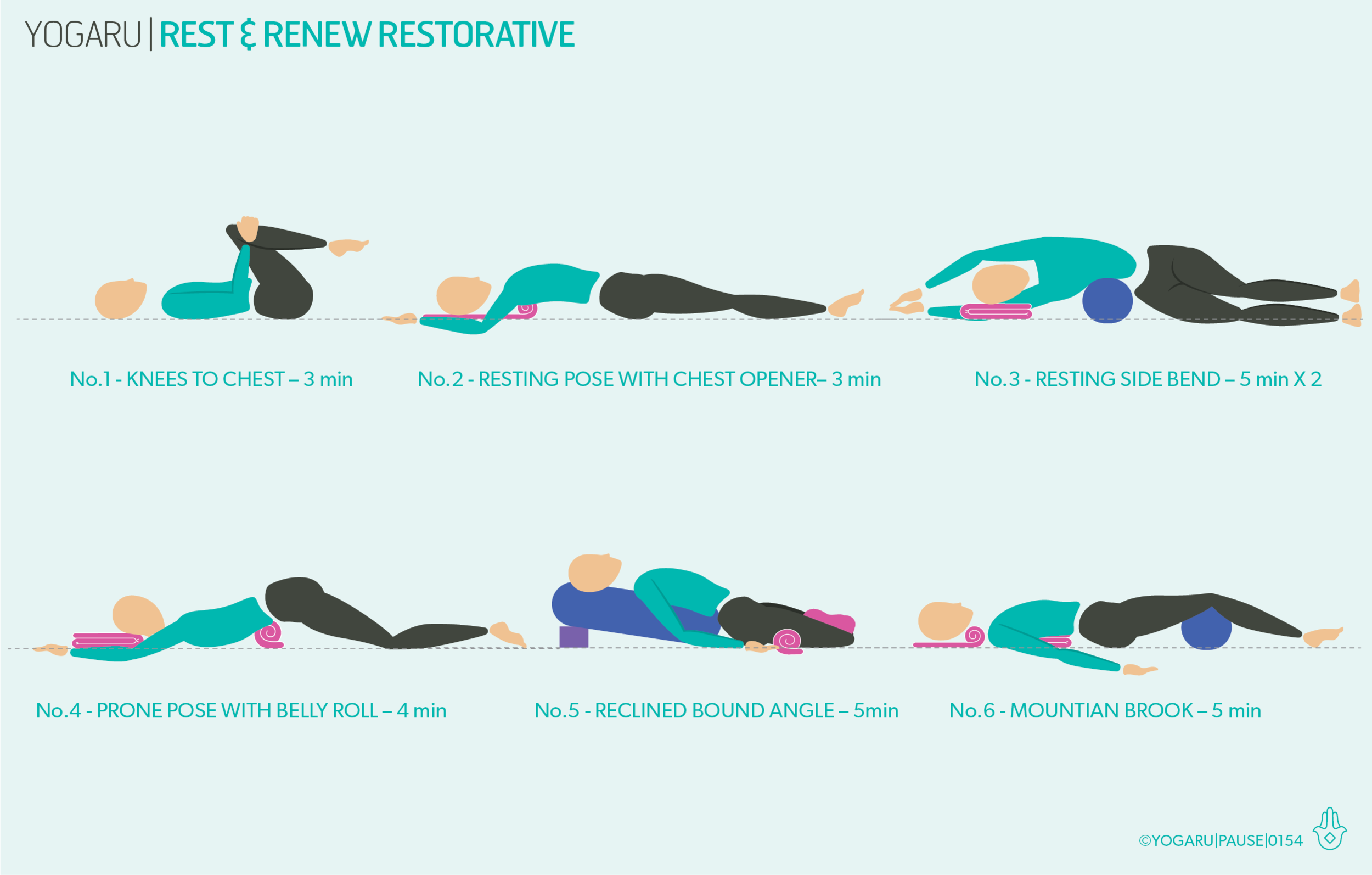
Rest & renew restorative

rest and renew restorative

RELEARN HOW TO REST
Why is it that we use every excuse in the book to put off taking time for ourselves? Looking after ourselves is not just an act of self care, it ensures that we are able to function in the world, and with the people around us. Learning how to self soothe and self prioritise has become a lost art, but thankfully it is now being highlighted as an essential part of our physical and mental wellness. Learning how to relax helps you appreciate the value of downtime and cultivating a malleable nervous system with the ability to swap easily from activity to relaxation and appreciate the value of both. It rewires the brain's response to stress by tapping into the parasympathetic nervous system (rest and restore) rather than your sympathetic nervous system (fight and flight) and help build mental resilience. It also reduces production of the stress hormones adrenaline and cortisol, and increases production of the ‘feel good’ hormone endorphin. By cultivating the parasympathetic nervous system pathways the neuroplasticity of the brain changes, and in times of stress or decision making this more discerning pathway is more available to us.

THE NERVOUS SYSTEM
The parasympathetic nervous system is considered the ‘top down’ response controlled by the anterior cingulate cortex (ACC) in the prefrontal cortex, which is our logical and thinking mind. The sympathetic nervous system is considered the ‘bottom up’ response controlled by the amygdala in the limbic brain which is our internal risk assessment bodyguard. When we encounter a perceived threat the brain processes the information through these two pathways. In the ‘bottom up’ sympathetic path the perceived threat is processed in the hippocampus (past memories) to check for a record of previous experience, it sends this information to the amygdala (emotional alarm system) and decides the level of threat and action needed. A message is then sent to the thalamus (the switchboard) and on to the hypothalamus (hormone response) and a reaction to the situation is carried out. In the ‘top down’ parasympathetic path the perceived threat is processed in the anterior cingulate cortex (ACC) in the prefrontal cortex, the thinking mind works out if this is really a dangerous situation or something that can logically be worked out. It sends its decision to the hypothalamus (hormone response) to cause a reaction as required. When we work with building tone in the parasympathetic nervous system it helps slow down the amygdalas fast firing reaction and the prefrontal cortex steps in with a more rational, considered slant to the scenario.

RESTORATIVE YOGA
Restorative yoga is a healing practice that targets the parasympathetic nervous system and consciously relaxes the body to bring you into a deep state of rest while the body refreshes and renews. It supports you physically, mentally and emotionally and is used for both therapeutic and preventative measures. It restores the body's natural inclination towards balance or homeostasis by enhancing its capacity to heal, resetting pain patterns, balancing hormones, and optimising the functionality of the organs. This balance gives the immune system a better environment to work efficiently in. Restorative is a practice of passive poses which consciously relaxes the body. The poses are held for longer periods of time and are supported with props to help you feel effortless comfort. In this practice we look for gentle openings rather than strong stretches. The nervous system responds better to gentle stimuli, less is more!

THE BENEFITS OF RESTORATIVE
Aids digestion, aids fertility, aids pain management, aids relaxation, balances emotions, balances hormones, balances nervous system, boosts immune system, boosts healing capacity, eases constipation & bloating, eases back pain, eases fatigue, eases headaches, eases insomnia, eases menstrual & menopause symptoms, eases muscle tension, eases neck pain, eases stress, tension & anxiety, improves healing capacity, improves posture, improves sleep, increases circulation, increases mindfulness, massages abdominal organs, reduces blood pressure, reduces inflammation, strengthens lungs, strengthens spine.

EXPLORING THE SEQUENCE
Use this simple restorative sequence to help you rest and renew your body and mind. Consider the four pillars of restorative yoga when you are setting up your space – quiet, dark, safe, warmth. The body will cool down quickly so layer up and stay warm. Hold the poses for the suggested times on the accompanying illustrated sequence. Remember to do both sides in an asymmetrical pose. Stay warm and be completely comfortable throughout your practice. Discomfort will reduce your ability to rest your nervous system. If a pose isn’t working for you just move onto the next one. Use a phone on a low volume to time your holds. As you settle into the pose, scan down from head to toe to make sure everything is happy. Use the gentle rise and fall of your breath if you find your mind wandering. Remember to take 10 minutes of resting pose at the end of your practice to let everything settle in a symmetrical pose before you reintegrate into your day.

PROPS SETUP
Props are king in restorative yoga. They bring the ground up to meet you allowing your body to melt into the practice and help you find complete comfort and support in each pose. Blankets are the most versatile of all the props – they can be rolled or folded, used for support or to keep you warm.

ALIGNMENT CUES
Below are the restorative techniques used in this sequence.. The props you’ll need are:
1 x bolster - or 2 towels, wrapped around a horizontally rolled pillow and tied to secure.
2 x yoga bricks - or 2 two thick similar sized dictionaries.
2 x yoga blankets - or any wool, thick cotton or fleece blanket with density.

No.1 - Knee to chest
Lie supine on your back, bend your knees and draw them towards your chest. Wrap your arms around your knees, reach your sit bones away and your sacrum down, lumbar spine lifts to a natural curve. Hug your knees to your chest, lengthen your neck, broaden through the collarbones. Feel a gentle stretch on the back of your hips and lower spine.

No.2 - Resting pose with chest opener
Quarter roll a four fold blanket and place it at the top of your mat. Lie supine on your back, with the tip of your shoulder blades at the roll of the blanket. Extend your arms overhead in cactus position. Feel a gentle opening across the chest and shoulders.

No.3 -Resting side bend
Place a folded blanket at the top of your mat. Place your bolster horizontally on your mat with a space between your bolster and pillow. Sit with your right hip along the long edge of the bolster, knees bent. Lengthen your right side along the mat and nestle the bolster into the curve of your waist. Place your head on the blanket and reach your arms overhead. Feel a gentle opening all along the top side of your body. Repeat on the left side.

No.4 - Prone pose with belly roll
Place a rolled blanket horizontally along the centre of your mat. Lie prone on your front with your belly on the rolled up blanket. Make a pillow with your stacked hands and place your forehead on your hands. Feel a gentle opening at the back of your lower spine and a gentle pressure on your abdominal region.

No.5 - Reclined bound angle with knee rolls & foot wrap
Place a brick horizontally at the top of your mat, lie your bolster vertically along the top centre of your mat with the brick propping up the far end. Sit with the back of your hips along the short end of the bolster. Roll up two folded blankets and place them under each thigh. Bring the soles of your feet together and let your knees drop out to the sides. Place your feet inside a folded blanket, wrap the outer edges through your inner ankles and tuck the ends around your ankles. When your legs are secure gently lie back onto your bolster. Feel a gentle opening in the inner groins and hips.

No.6 - Mountain brook
Half roll a four fold blanket and place it at the top of your mat. Accordion fold the other blanket and place it below your top blanket where your shoulder blades will lie. Place the bolster towards the bottom of your mat where your knees will be. Lie supine on your back, nestle the rolled part of the top blanket in the curve of your neck, place the accordion folded blanket under the lower tips of your shoulder blades and the bolster under the creases of your knees. Legs and arms extended, palms facing up, feet fall out to the side. Feel the rise and fall of the props supporting your back body.

To save the images for personal use click and hold down the image until the ‘save image’ option appears; on Mac hold down ‘control’ and click the image to get the option box; on PC right click on the image to get the option box. Scroll down in the ‘option box’ and click ‘save image’.

Ruth Delahunty Yogaru
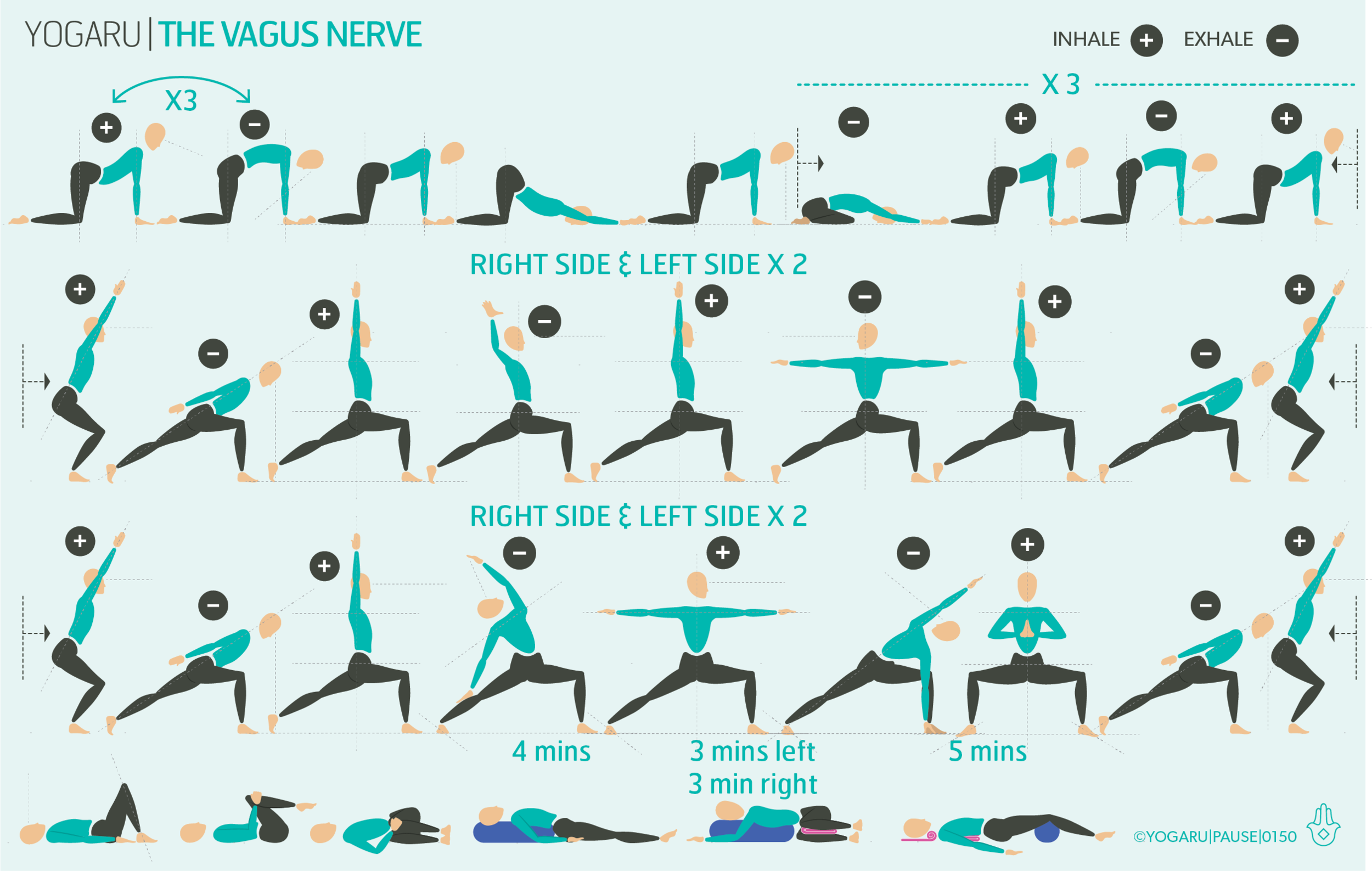
The vagus nerve

THE WANDERING NERVE
Our nervous system is responsible for how our body reacts to external and internal stimuli. It sends ‘sensory’ messages to the brain which sends ‘motor’ messages to the glands and muscles of the body to cause a chain of reactions to the stimuli. The nervous system has two responses to this information – the sympathetic ‘fight or flight’ response and the parasympathetic ‘rest and restore’ response. Throughout our day the nervous system shifts gear from one to the other without us even noticing. We rise to challenges with the sympathetic nervous system and we settle and reset with the parasympathetic nervous system.

The sympathetic nervous system is the bodies ‘on’ switch. When the sympathetic nervous system, or the fight or flight response, is triggered the nervous system sends ‘sensory’ signals to the brain and the brain sends ‘motor’ signals to the body to increase heart rate and blood pressure, open our airways, inhibit digestion and reproductive organs, stimulate adrenaline production, open our sweat glands and tense the muscles ready for action. It helps you get jobs done, stay focused, productive and energised. When you get stuck with the switch ‘on’ the body becomes physically and menatlly exhausted and gradually starts to break down.

The parasympathetic nervous system is the bodies ‘off’ switch. When the parasympathetic nervous system, or the rest and restore response, is triggered the nervous system sends ‘sensory’ signals to the brain and the brain sends ‘motor’ signals to the body to reduce heart rate and blood pressure, relax our airways, stimulate digestion and reproductive organs, inhibit adrenaline production, stimulate endorphin productions and relax the muscles. It helps you stay calm when you are stressed, make more informed decisions and wind down after your working day is over. When you are able to flick the switch ‘off’ the body has space to create optimal conditions for the functionality of the organs, strengthen the immune system to regenerate and heal, and relieve symptoms of stress, tension and anxiety.

These two nervous system responses are autonomic which means they are involuntary and are not within our control. But we can create favourable conditions to influence which response we are in. When balanced these two responses work together and shift smoothly from one to the other. The body strives for homeostasis, it thrives with a balance of activity and rest; doing and nondoing; mental stimulation and mental space.

There are many nerves responsible for the parasympathetic ‘rest and restore’ nervous response. Most of them come from the cranial nerves with just three coming from spinal nerves. The main cranial nerve associated with 75% of the parasympathetic nerve fibres, and for regulating the parasympathetic response, is the vagus nerve. The vagus nerve is the longest nerve in the body and travels from the brainstem straight to the throat, heart, diaphragm, stomach, kidneys, liver, pancreas, gallbladder, sphincter and reproductive organs. Which is why it is often referred to as the ‘wandering nerve’. It is the only nerve that influences such a wide variety of bodily functions including our mental health, immune system, digestive system and cardiovascular system. The vagus nerve can be stimulated with deep breathing, gentle movement, meditation, singing, chanting and laughing, cold water therapy and gut health. The breath-linked, meditative flowing movement of yoga is one of the best ways to combine three of the above methods for helping your body find this delicate balance between the two nervous systems and stimulate the vagus nerve.

VAGAL TONE
When we breathe in our heart rate increases slightly and when we breathe out it decreases. The difference between your inhale rate and exhale rate is called respiratory sinus arrhythmia (RSA) and, along with heart rate variability (HRV), it is used as a way to access vagal tone. A higher measurement indicates an adaptable nervous system and high vagal tone. High vagal tone is associated with good sleep, better moods, mentally resilient, less risk of cardiovascular diseases, good gut health and less risk of inflammatory conditions. While low vagal tone is associated with poor sleep, anxiety, stress, depression, cognitive decline, cardiovascular disease, gut issues and inflammation.

YOGA BREATH, MOVEMENT & MEDITATION
The breath is part of the autonomic nervous system, which means it works automatically. But what makes the breath unique, and one of the fastest routes to the vagus nerve, is that we can also control the breath. We can extend, shorten and hold the breath depending on our desired outcomes. When we breathe, in particular an extended exhale, the diaphragm stimulates the vagus nerve which causes a chemical reaction that activates the nerve fibres and sends messages to the brain and initiates the parasympathetic response in all the parts of the body which this ‘wandering nerve’ travels to. Yjjayi breath vibrates the vocal cords and stimulates the vagus nerve in the throat.

The gentle movement of yoga encourages a calm and introspective mindset and helps us stay present on our mat in meditative mindfulness. Yoga postures, which innervate the regions of the body which the vagus nerve travels to, stimulate the nerve and influence vagal tone. For example chest opening and backbend poses stimulate the vagus nerve in the throat, heart and diaphragm; twists stimulate the diaphragm, stomach and reproductive organs; forward bends stimulate the stomach and heart; and inversions stimulate the heart and stomach.

EXPLORING THE VAGUS NERVE IN YOUR PRACTICE
This blended yoga sequence trains both sides of the nervous system to help you become more skilled at tapping into your energy stores when you need them and being able to switch off and relax at the appropriate time to manage our energy bank. The sequence combines breath with movement to create a meditative flow by linking an inhale and an exhale with each pose. This little trick not only stimulates the vagus nerve in the diaphragm but gives you something simple to focus on and put aside all the unwanted chattering in the mind. You will then transition into the king of all yoga for the nervous system – restorative yoga. In restorative you consciously relax, become aware of your breath and absorb the benefits of your practice. It is important to make sure you are completely comfortable and adjust to find comfort if needed. Staying in a restorative pose when you are not totally comfortable is counterproductive to the process. The poses are held for longer periods (you will see the suggested hold times in the sequence) with the support of your blankets to help you to feel effortless comfort. You will need a bolster and two blankets for this practice.

ALIGNMENT CUES
Below are the restorative techniques used in this sequence. The props you’ll need are:
1 x bolster - or 2 towels, wrapped around a horizontally rolled pillow and tied to secure.
2 x yoga bricks - or 2 two thick similar sized dictionaries.
2 x yoga blankets - or any wool, thick cotton or fleece blanket with density.

No.1 - Elevated resting pose with chest opening
Place your bolster vertically along the top of your mat. Sit with the back of your hips against the short end of the bolster. Gently lie back onto your bolster and let your arms hang down either side of the bolster.

No.2 - Prone twist with leg support
Place your bolster vertically along the top centre of your mat with a folded blanket at the top. Sit with your right hip against the short end of the bolster. Place your hands on the mat either side of the bolster, with an inhale lengthen through the whole spine and on your exhale gently place your front spine along the length of the bolster. Place your right cheek on the folded blanket and let your arms gently hang either side of the bolster. Repeat on the left side.

No.3 - Mountain brook
Place a neck roll at the top of your mat, a narrow folded blanket under that and a bolster towards the end of your mat. Lie down on your back and adjust your three props to nestle under the curve of your neck, under your shoulder blade and under your knees.

To save the images for personal use click and hold down the image until the ‘save image’ option appears; on Mac hold down ‘control’ and click the image to get the option box; on PC right click on the image to get the option box. Scroll down in the ‘option box’ and click ‘save image’.

Ruth Delahunty Yogaru