
Restorative yoga

Summer evenings flow

YOUR EVENING RESET
After a full day of activity, decision-making, and stimulation, it’s normal to feel mentally wired or physically tense. A gentle evening ritual helps release the day’s buildup and prepare your body and mind for rest. Moving with intention slows the nervous system, supports deeper sleep, and creates space to ease into relaxation.

Yoga is one of the most effective ways to wind down in the evening. Gentle movement, paired with conscious breathing, activates the parasympathetic nervous system – your body’s “rest and restore” mode. This response helps lower stress hormones, eases muscle tension, and creates a sense of calm that prepares you for sleep. Evening yoga often targets areas where stress accumulates, such as the spine, hips, shoulders, and jaw, gently encouraging release.

A consistent evening yoga practice supports your body’s natural circadian rhythm. It can enhance melatonin production, aid digestion, reduce inflammation, and ease you into a more restful and regenerative sleep. Even just 15 minutes of slow, mindful movement can become a powerful signal that your day is ending and it's time to relax and reset.

EVENING YOGA IN SUMMER
Evenings offer a unique opportunity to tune inward and honour your body’s need to slow down. This is your time to let go of effort, disconnect from screens and stimulation, and shift into rest. In the warmer Summer months, evenings can be the perfect time to cool down and rebalance. With longer daylight hours and more social commitments, summer evenings may still carry a sense of stimulation well into the night. Evening yoga can help you step back from that momentum and prepare for a good night's sleep. Gentle breathing, especially with extended exhales or deep belly breathing, is especially effective in calming the nervous system.

Cooling poses – such as forward folds, hip openers and reclined poses – support relaxation and release heat from the body. These poses also support digestion and detoxification, which can be disrupted by summer’s shifting routines. Gentle twists are especially helpful after summer meals or travel fatigue, and supported poses with the arms open encourage both stillness and a sense of cool spaciousness.

Your summer evening practice offers a grounding pause in an otherwise energetic season. Roll out your mat, dim the lights, and soften into the gentle rhythms of your evening wind down – your body and mind will thank you by morning.

EXPLORING SUMMER EVENINGS FLOW IN YOUR PRACTICE
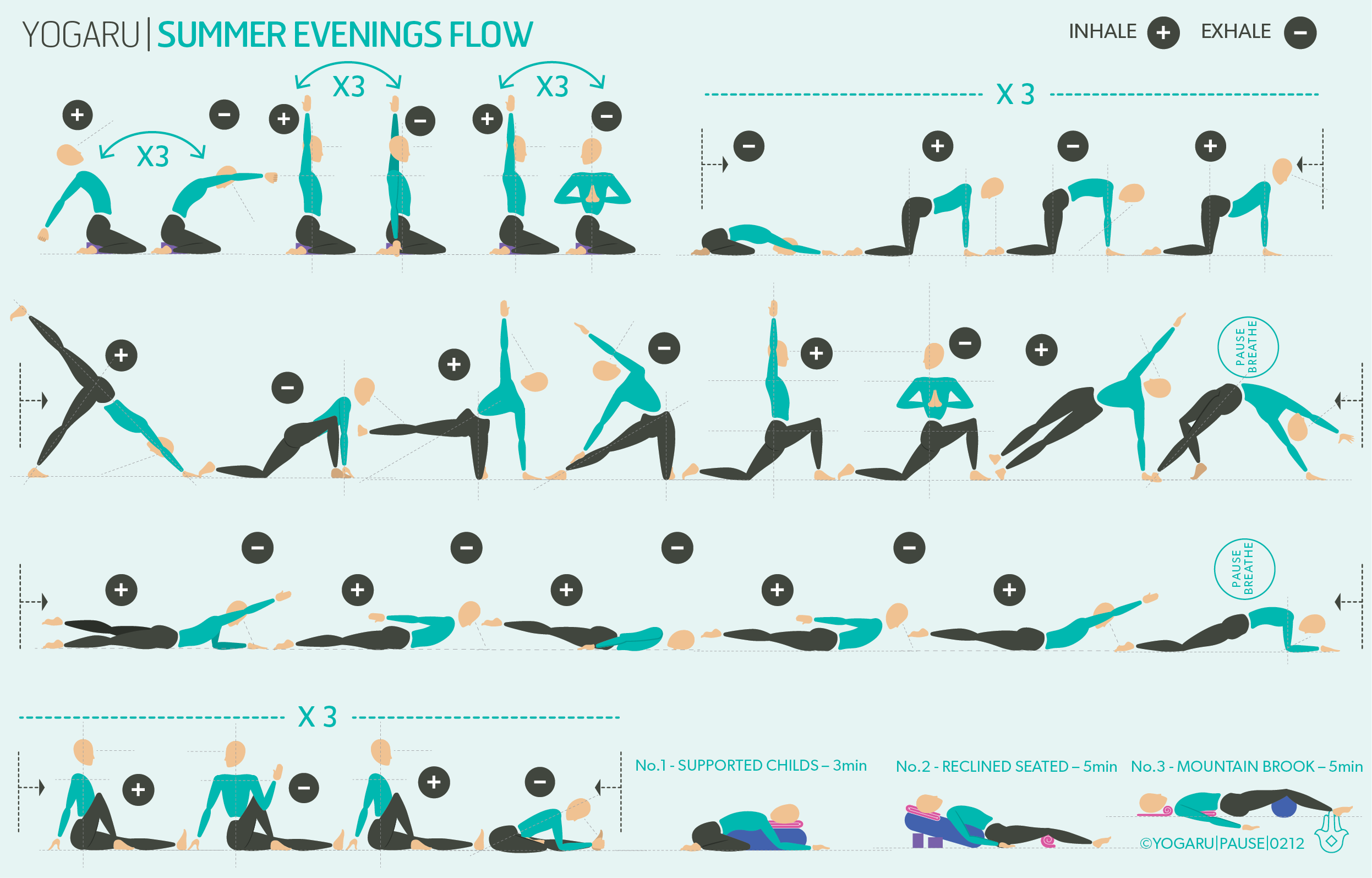
This full sequence focuses on staying lower to the ground than our regular practices to purposefully prepare for lying down in bed. This sequence starts in the first row with seated breath-led movement and child pose flow to stimulate the vagus nerve, regulate your heart rate, and ease the body into a restful state. The second row is a continuous flow to help you ease out any tension and fidgets from a busy day. The third gives the opportunity to realign the spine, stretch the front body and strengthen the back body. The final row has a four pose seated flow and three restorative poses. You can either pick one of the restorative poses or if you need more time to unwind you can do all three.

ALIGNMENT CUES
Below are the restorative techniques used in this sequence. The props you’ll need are:
1 x bolster - or 2 towels, wrapped around a horizontally rolled pillow and tied to secure.
2 x yoga blankets - or any wool, thick cotton or fleece blanket with density.
2 x yoga bricks - or two thick similar sized dictionaries

Restorative
No.1 - Supported childs
Come into a kneeling position with your hips on your heels. Nestle a bolster between your knees, vertically along your mat with a folded blanket on the far end. Place your hands either side of the bolster. With an inhale lengthen through the whole spine and on an exhale gently place your front spine along the centre of the bolster. Place your right cheek on the bolster. Feel the breath in the back of the ribs and lungs. Swap to your left cheek half way through the pose.

No.2 - Reclined seated
Place two bricks horizontally at the top of your mat, One at its highest height and the other at its mid height. Lie your bolster over the bricks along the centre of your mat and place a folded blanket on the far end of your bolster where your head will rest. Sit with the back of your hips along the short end of the bolster. Roll up a folded blanket and place it under your knees. Gently lie back onto your bolster. Feel a gentle opening across the chest.

No.3 - Mountain brook
Half roll a four fold blanket and place it at the top of your mat. Accordion fold the other blanket and place it below your top blanket where your shoulder blades will lie. Place the bolster towards the bottom of your mat where your knees will be. Lie supine on your back, nestle the rolled part of the top blanket in the curve of your neck, place the accordion folded blanket under the lower tips of your shoulder blades and the bolster under the creases of your knees. Legs and arms extended, palms facing up, feet fall out to the side. Feel the rise and fall of the props supporting your back body.

To save the images for personal use click and hold down the image until the ‘save image’ option appears; on Mac hold down ‘control’ and click the image to get the option box; on PC right click on the image to get the option box. Scroll down in the ‘option box’ and click ‘save image’.

Ruth Delahunty Yogaru

Christmas hols flow

SIMPLE AND ACTIONABLE
I’ve written lots of articles with sequences for Chritsmas  and New Years over the years. From The ultimate Christmas flow and Christmas mini flows to Step gently into the New Year and Mini flows for 2020. This year I’m going to keep it really simple and give you a sequence which includes all my favourite techniques I’ve been using recently in my own practice, my classes and with my private students. I’ll keep it short and sweet and divide it into a few different sections to make it easier for you to proactively make time to step on your mat to do the full sequence or to pick and chooses some of the different techniques if you are short on time or just need an SOS moment to yourself before resuming your festivities. You could choose to practice the breath work first thing in the morning or the standing flow, some MFR or a restorative pose in the evening to help you relax. Catching a few minutes to yourself each day makes all the difference to help you continue to enjoy your Christmas hols. 

MY FAVOURITE TECHNIQUES
We know that doing yoga makes us feel good physically and mentally. It increases our mobility and strength, helps with good posture and balance and even reminds us to breathe better. Along with yoga poses I love to add MFR (myofascial release), pranayama (breathwork) & restorative poses (relaxation) to my practice. By using this multi faceted approach I ensure that I am optimising my time on my mat in a holistic way. Pranayama and MFR are quick and potent tools for stress relief while restorative yoga can be used to build an adaptable nervous system and rewire the brain's response to stress. Pranayama breathwork is the fastest way to reduce stress. It has an immediate effect on mood and energy – increased breath rate is invigorating and energising, while decreasing breath rate is calming and relaxing. It can also be used to manage pain by stimulating the relaxation response and pain signals. MFR has many benefits but is used mainly to increase range of movement and ease aches and pains. It also stimulates receptors under the skin called ruffinis that initiate our relaxation response and can be used at the end of the day to help switch off in preparation for sleep. Restorative is considered the king of all yoga when it comes to stress resilience. It is a relaxation practice that turns down the dial on the stress response and helps you consciously relax. By practising restorative poses you teach the nervous system to recognise and deal with stress in everyday life. When stress is reduced the body can focus on the functionality of the immune, respiratory, cardiovascular and endocrine systems. Helping the body as it strives for balance.

EXPLORING CHRISTMAS HOLS FLOW IN YOUR PRACTICE
This sequence starts with a pranayama practice as described below. You can also do the pranayama at the end of your practice if you prefer. This sequence has an outer hip focus so you will start with MFR on the outer hips and the glutes, as detailed below, to prepare the area and allow you to access its strength as you flow through the standing flows. The second and third row are the two main standing flows. In row two you will step the right leg forward first, do the full flow and then repeat it with the left leg forward. Do the same for the second flow in row three. The final row starts with MFR on the shoulders as detailed below to help initiate the relaxation part of your practice. Followed by two gentle two pose flows and two restorative poses. Practice the whole sequence or mix and match sections to meet your changing demands over the festive period.

ALIGNMENT CUES
Below are the pranayama, MFR and restorative techniques used in this sequence. The props you’ll need are:
2 x MFR balls - or 2 tennis balls.
1 x bolster - or 2 towels, wrapped around a horizontally rolled pillow and tied to secure.
2 x yoga blankets - or any wool, thick cotton or fleece blanket with density.

Pranayama
Sit in a comfortable position – cross legged, sitting up on a brick or straddling a bolster.  Inhale for the count of 4, exhale for the count of 4 x 3 rounds. Inhale for the count of 4, pause for 2, exhale for the count of 4, pause for 2 x 3 rounds. Inhale for the count of 4, pause for 4, exhale for the count of 4, pause for 4 x 3 rounds. 

MFR
No.1 - Hips (gluteus medius)
Compression
- from side lying up on your forearm, stack  2 x balls behind your frontal hip bone on your outer hip, gently press down with an inhale and release on the exhale x 5 breaths.
Sheer - slowly lift and lower your leg x 5.
Roll & cross fibre - roll up and down on your outer hip.

No.2 - Glutes (gluteus maximus & piriformis)
Compression
- from supine with knees bent, place 2 x balls in the centre of each buttock muscle, gently press down with an inhale and release on the exhale x 5 breaths.
Sheer - slowly lift and lower one knee at a time towards your chest x 5. Place your right foot on your left knee and lower and lift your right knee.
Roll & cross fibre - roll around the whole buttocks area.

No.3 - Shoulders (trapezius & supraspinatus)
Compression
- from supine with knees bent, place 2 x balls in the centre of each upper shoulder, gently press down with an inhale and release on the exhale x 5 breaths.
Sheer - slowly circle arms overhead and back to the ground x 5. 

Restorative
No.1 - Supported childs
Come into a kneeling position with your hips on your heels. Nestle a bolster between your knees, vertically along your mat with a folded blanket on the far end. Place your hands either side of the bolster. With an inhale lengthen through the whole spine and on an exhale gently place your front spine along the centre of the bolster. Place your right cheek on the bolster. Feel the breath in the back of the ribs and lungs. Swap to your left cheek half way through the pose.

No.2 - Mountain brook
Half roll a four fold blanket and place it at the top of your mat. Accordion fold the other blanket and place it below your top blanket where your shoulder blades will lie. Place the bolster towards the bottom of your mat where your knees will be. Lie supine on your back, nestle the rolled part of the top blanket in the curve of your neck, place the accordion folded blanket under the lower tips of your shoulder blades and the bolster under the creases of your knees. Legs and arms extended, palms facing up, feet fall out to the side. Feel the rise and fall of the props supporting your back body.

To save the images for personal use click and hold down the image until the ‘save image’ option appears; on Mac hold down ‘control’ and click the image to get the option box; on PC right click on the image to get the option box. Scroll down in the ‘option box’ and click ‘save image’.
Ruth Delahunty Yogaru

Yoga Therapeutics stress relief

YOGA THERAPEUTICS
Resolve pain, restore function & build strength
As a RYT500hr certified yoga teacher and a 300hr certified Yoga Medicine ® Therapeutic Specialist I offer private in person or online therapeutic programmes to students with ongoing conditions, injury recovery and injury prevention.

WHAT IS YOGA THERAPEUTICS?
Yoga Therapeutics uses a range of techniques and practises to create a prescriptive programme to support all aspects of physical and mental health. Each individualised programme includes a combination of movement practices, myofascial release, breath work and relaxation. It also looks at posture awareness in standing, sitting, while moving and balancing to help prevent recurrence of injuries or other issues arising. I work closely with students to support their progress as they integrate these holistic whole body practises into their everyday life to maintain and optimise their future health.

THE BENEFITS OF YOGA THERAPEUTICS
If you suffer from any of the following Yoga Therapeutics can help you:

- Chronic pain.
- Back pain.
- Neck & shoulder pain.
- Injury rehabilitation.
- Injury prevention.
- Sports performance.
- Balance & coordination.
- Poor posture.
- Stress & anxiety.
- Sleep management.
- Headaches & migraines.
- Menstrual & menopause symptoms.
- Supports nervous, respiratory, digestive, immune and circulatory system conditions.

THERAPEUTIC CLASS ENQUIRY

YOGA THERAPEUTICS V’S PHYSIOTHERAPY
Yoga Therapeutics and Physiotherapy are complementary and have a shared goal of helping you on your road to full health. Physiotherapy focuses on the physical body whereas Yoga Therapeutics looks at the body and mind. While physiotherapy is your first port of call if you have an acute injury, studies have shown that a combination of Physiotherapy and Yoga Therapeutics significantly improves the recovery outcome.

HOW DOES YOGA THERAPEUTICS WORK?
The process starts with an intake evaluation to identify areas of concern and set goals. An individualised therapeutic programme is then created from this intake information. This prescriptive programme is built specifically for your needs and is checked regularly to ensure you are getting the best out of it. Each session includes a private class and a small home self practice to continue your progress between sessions.

EXPLORING YOGA THERAPEUTICS IN YOUR PRACTICE
While Yoga Therapeutics are delivered as a one to one personalised programme this sequence, dealing with stress, gives you a small sample of my Yoga Therapeutics multi faceted approach. It uses movement practices, myofascial release, breath work and relaxation. You will start off with myofascial release or MFR on your feet, as detailed below, then you will move through a series of gentle mini flows, linking breath with movement, to ease physical and mental tension. You can repeat the standing flow on row three as many times as you like to lengthen your practice or you can leave it out for a more soothing grounding practice. You will end with a lovely restorative twist and a supported Savasana, with the option of a 4 inhale, 6 exhale, stress reduction breath work. 

ALIGNMENT CUES
Below are the MFR and restorative techniques used in this sequence. The props you’ll need are:
2 x MFR balls - or 2 tennis balls.
1 x bolster - or 2 towels, wrapped around a horizontally rolled pillow and tied to secure.
1 x yoga bricks - or 1 thick similar sized dictionary.
2 x yoga blankets - or any wool, thick cotton or fleece blanket with density.

MFR Feet
Compression - from standing or seated, place 1 x ball at position No.1, gently press down with an inhale and release on the exhale x 5 breaths and move on to No.2. Continue to No.5. 
Roll & cross fibre - with the toes on the ground place 1 x ball at No.5, roll the ball across your heel x 5. Place 1 x ball at No.6, roll the ball across the knuckles of your toes x 5. Place 1 x ball at No.6, roll in one direction from toes to heel x 5. 
Scribble - roll and scribble across the sole of the foot. Repeat all steps on the other foot.

No.1 - Shoulders (trapezius & supraspinatus)
Compression - from supine with knees bent, place 2 x balls in the centre of each upper shoulder, gently press down with an inhale and release on the exhale x 5 breaths. 
Sheer - slowly circle arms overhead and back to the ground x 5. 

No.2 - Back of skull 
Lie on your back and place a brick on its lowest high just below the curve at the back of your skull (occipital ridge). Extend your legs out, arms slightly away from your body, palms facing up. Legs slightly apart and feet fall out to the side, soften your shoulder, back of the neck long. Gently roll your head from side to side to ease out tension in the muscles at the back of the skull. Roll your head mid way to your right, pause and make small circles, repeat on the left side. Remove the brick, soften the muscles across your forehead, your temples, the back of your skull. Let the whole body become heavy and melt into the support of the ground.

Restorative
No.3 - Prone twist

Place your bolster vertically along the top centre of your mat. Sit with your right hip up against the short end of the bolster. Place a folded blanket between your legs. Place your hands either side of the bolster. With an inhale lengthen through the whole spine and on your exhale gently place your front spine along the length of the bolster. Place your right cheek on the folded blanket and let your arms gently hang either side of the bolster. Repeat on the left side.

No.4 - Mountain brook
Half roll a four fold blanket and place it at the top of your mat. Accordion fold the other blanket and place it below your top blanket where your shoulder blades will lie. Place the bolster towards the bottom of your mat where your knees will be. Lie supine on your back, nestle the rolled part of the top blanket in the curve of your neck, place the accordion folded blanket under the lower tips of your shoulder blades and the bolster under the creases of your knees. Legs and arms extended, palms facing up, feet fall out to the side. Feel the rise and fall of the props supporting your back body.

Therapeutic class enquiry

To save the images for personal use click and hold down the image until the ‘save image’ option appears; on Mac hold down ‘control’ and click the image to get the option box; on PC right click on the image to get the option box. Scroll down in the ‘option box’ and click ‘save image’.
Ruth Delahunty Yogaru