
Sequences

Energising flow

ENERGY = FUEL
We have two main sources of fuel to energise all functions in our bodies from movement to every metabolic chemical reaction in our cells. These two sources are food and oxygen. To get these two sources into all the cells of our bodies we need to supply them with fuel in the form of good quality food as close to nature as possible and fresh air. Below I discuss what yoga tools we will use in this sequence to help build energy. But there is another very valuable tool that can be used on and off the mat to create energy. Challenging yourself brings oxygen to the brain and wakes you up. Challenging yourself on your mat can be as simple as staying an extra breath in a strong standing pose or really focusing in a standing balancing pose. Challenging yourself off your mat might mean being comfortable with occasionally stepping out of your comfort zone and trying new things, waking yourself up and not spending your days on autopilot.

HOW TO BUILD ENERGY
In our practice we can assist the two systems that are in charge of taking in food and oxygen – the digestive system and the respiratory system – and the system that helps distribute and transport it – the circulatory system.

The digestive system, or the enteric nervous system, processes food, absorbs nutrition, and removes toxins. Moving and massaging the digestive system with twists and backbends help to maximise absorption and detoxification – feeding the cells and removing toxins that will interfere with their efficient functionality. They also bring fresh blood flow to the blood vessels in the walls of the digestive system which helps the circulatory system distribute this fuel source around the whole body. Massaging the gut helps to keep you regular by encouraging peristalsis in the walls of the gut to move the waste food along. Once the body has taken what it needs from our food it is very important to remove the waste so that it doesn’t stagnate in our gut.

The respiratory system fuels our cells with oxygen so they can grow and replicate. Breathing feeds the cells and flushes out the by-product of carbon dioxide. In our practice, when we inhale our heart rate increases, the cells receive oxygen, and we feel energised. The circulatory system then takes over and helps to distribute the oxygen to our whole body. While backbends will help to expand the lungs and bring in more oxygen, the challenge of standing poses and standing balancing poses create heat and help boost circulation.

EXPLORING ENERGISING FLOW IN YOUR PRACTICE
This sequence is part of a series of sequences where I look at how yoga can help regulate our moods. Each of these sequences start with the same warm up that will move all the main joints of the body – the spine, shoulders and hips. This repetition gives you ‘comfort in familiarity’ as you can practice this series, while at the same time ensuring you are warmed up and ready for the themed mini flows that follow.

The sequence has lots of standing poses and standing balancing poses to boost circulation, expand the lungs and wake the thinking brain up. It also has plenty of poses that will massage the digestive system. Notice your energy levels before, during and after your practice. Be open to challenges and when you encounter one breath into it. .

ALIGNMENT CUES
There is no specific peak pose in this easy going flow. Use the cues below to help you flow through the sequence with ease and fluidity.

Have a read of the tips below and either print out the sequence or save it onto your device:

  • Use the breath guide in the sequence to help you link breath with movement in the flow. Inhale is indicated with a ‘+’, exhale is a ‘-”.

  • In the warm up focus your attention on the area you are warming up as indicated by the sequence.

  • If there are specific poses that you would like to stay longer in, give yourself three deep breaths in those poses and pick up the next pose with the allocated inhale or exhale as indicated by the sequence.

  • For a longer practice, linger in each of the poses of the three mini flows for the first round and then move with the breath for the second and third round.

To save the images for personal use click and hold down the image until the ‘save image’ option appears; on Mac hold down ‘control’ and click the image to get the option box; on PC right click on the image to get the option box. Scroll down in the ‘option box’ and click ‘save image’.

Ruth Delahunty Yogaru

Everyday mobility

MOBILITY V’S FLEXIBILITY
Before we explore ‘everyday mobility’, let's have a look at what mobility is; the difference between mobility v’s flexibility; and where stability fits into the equation. Mobility is our ability to move a body part or joint with control, without force (also called active range of movement – AROM). Whereas flexibility is our ability to move a body part or joint to its full range of movement without control, with the aid of force or gravity (passive range of movement – PROM). Lastly, stability is our ability to resist against forces and keep the body part or joint stable in static poses or transitions. Mobility increases tissue health, while excessive flexibility causes connective tissue deterioration. Flexibility does have its place, if there are areas of tightness it will help to recapture good mobility by gently working into flexibility first. Often what we are striving for is a small difference between the extent of your passive movement (flexibility) and your active movement (mobility). If the gap is too wide it means that you have good flexibility but not enough muscle control to protect the joints and muscles in their extended position.

EVERYDAY MOBILITY
Adding another layer to that equation, what is ‘everyday’ mobility? Everyday mobility is our ability to move a body part or joint within the range of movement that you, as an individual, require in your everyday life – ranging from easily getting up from a seated position to enjoying your sporting endeavours. To move fluidly in your everyday life your mobility is not dependent on being able to wrap your leg around your head or hold a handstand for 10 minutes. When you are striving for a ‘big pose’ in your practice, ask yourself if this pose serves me in my everyday life, what will I benefit from achieving this shape? Instead, concentrate on building a variety of movements into your practice as your goal, and actively mobilising all your body parts or joints with stability and control.

EXPLORING EVERYDAY MOBILITY IN YOUR PRACTICE
This sequence starts with a warm up that will move your spine, hips and shoulders. Take your time and focus on these three areas as you flow. The two standing flows start with some core work and bring you through a series of mini flows that all start from my current favourite pose, Viparita Virabhadrasana/Reverse Warrior. Remember that in Viparita Virabhadrasana/Reverse Warrior the hips stay level and the spine facilitates the side bend, whereas in Trikonasana/Triangle the pelvis tilt over the front leg with minimum side bending in the spine. Pay particular attention to your transitions in this sequence. Move slowly and focus on stability and control in your main joints – your knees, hips, spine and shoulders.

ALIGNMENT CUES
There is no specific peak pose in this everyday mobility sequence. Use the cues below to help you flow through the sequence with ease and fluidity.

Have a read of the tips below and either print out the sequence or save it onto your device:

  • Use the breath guide in the sequence to help you link breath with movement in the flow. Inhale is indicated with a ‘+’, exhale is a ‘-”.

  • If there are specific poses that you would like to stay longer in, give yourself three deep breaths in those poses and pick up the next pose with the allocated inhale or exhale as indicated by the sequence.

  • For a longer practice repeat the warm up flow on the first line at the start of each of the three standing flows or repeat each of the standing mini flows three times.

To save the images for personal use click and hold down the image until the ‘save image’ option appears; on Mac hold down ‘control’ and click the image to get the option box; on PC right click on the image to get the option box. Scroll down in the ‘option box’ and click ‘save image’.

Ruth Delahunty Yogaru
Happiness flow

THE HAPPINESS BUZZ
We have all experienced that post yoga pep to your step – where you step on your mat in a bit of a funk and finish wondering what it was that had you out of sorts in the first place. Sometimes when I find my head is not in the right place before I practice, I remind myself to trust in the process of yoga and, even though I might have a very valid reason to be stressed, know that I will feel much better after I practise. As we practise, our worries about the past and the future ease and our minds feel a little less cluttered. Yoga is not a cure all but it certainly helps smooth out the bumps along the way.

One of the steps to living a good life is living with a yoga principle called Santosa – or to be content with life. Happiness comes from our attitude to life, not from our life circumstances. The first step to being happy is to be content with what you have in life, no matter how good or bad it is. When we go through rough patches our attitude to this difficult situation has the power to make the situation easier to navigate or much more difficult.

THE SCIENCE BEHIND IT
Yoga is more than just a movement practice, it connects the body and brain through the nervous system. The breath is the main gateway to the power of the practice of yoga. When we consciously breathe the diaphragm stimulates one of the cranial nerves which is responsible for 75% or our ‘rest and restore’ nervous system response – the vagus nerve. When it is stimulated it sends chemical signals that reduce heart rate, blood pressure, and inhibits the stress hormones adrenaline and cortisol. Practising yoga improves vagal tone which is the body's ability to regulate through the vagus nerve. A study was done comparing the effects of yoga and cardiovascular exercise on the level of the neurotransmitter GABA, the hormone responsible for reducing anxiety. The study found that while GABA increases in both groups, there was a higher increase in the yoga group and greater improvement in mood and decreased anxiety. Yoga also increases levels of dopamine (the feel good hormone), serotonin ( the happy hormone) and endorphins (the runner's high hormone).

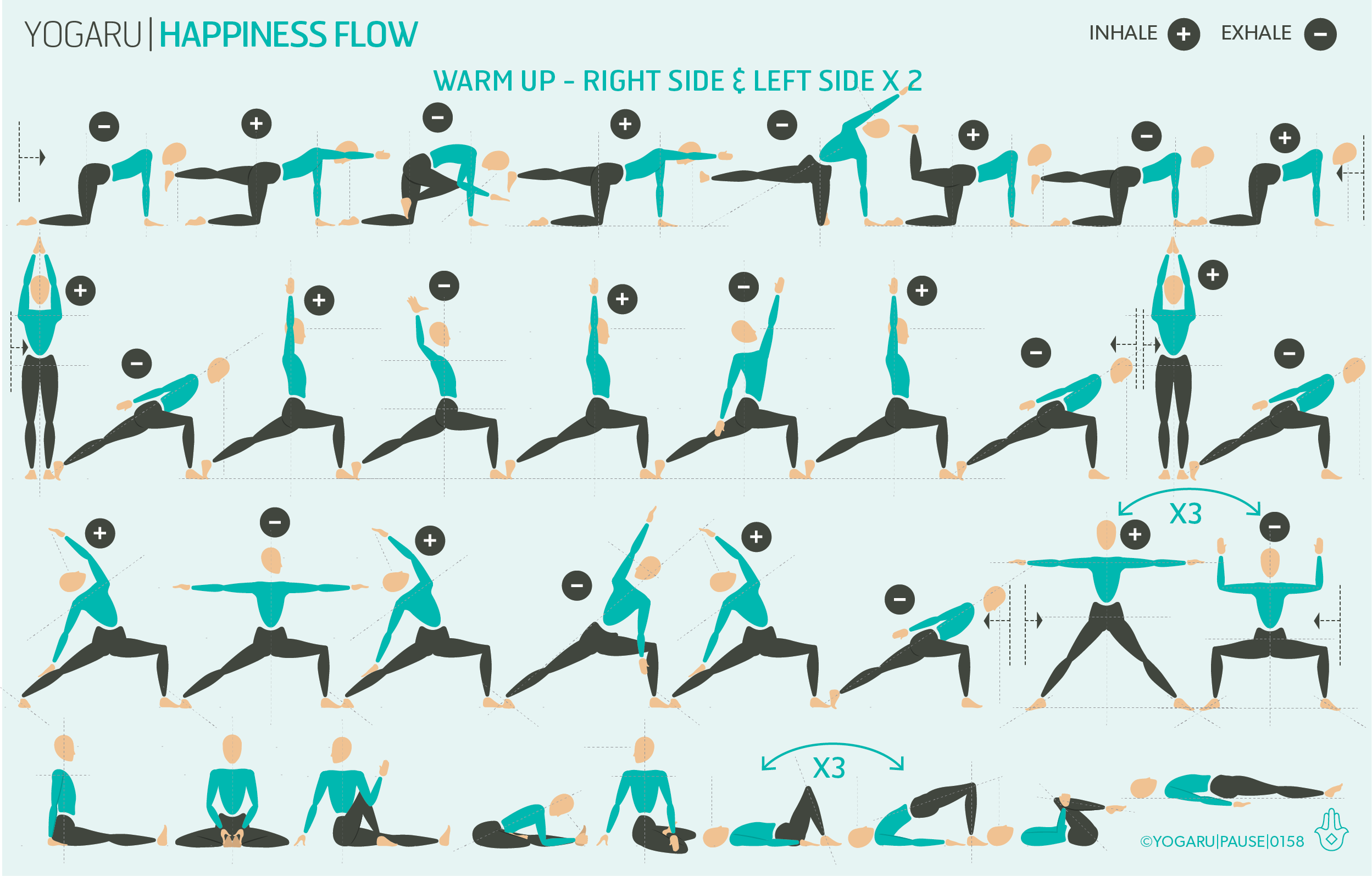
EXPLORING HAPPINESS FLOW IN YOUR PRACTICE
This sequence is part of a series of sequences where I look at how yoga can help regulate our moods. Each of these sequences start with the same warm up that will move all the main joints of the body – the spine, shoulders and hips. This repetition gives you ‘comfort in familiarity’ as you can practice this series, while at the same time ensuring you are warmed up and ready for the themed mini flows that follow.

The sequence has plenty of heart opening poses that are known for their uplifting quality. It also has plenty of hip opening poses to help you move with ease after you practice. As you flow through the sequence use the breath ‘inhale’ and ‘exhale’ cues to help you move fluidly and freely. You will also repeat the mini flows three times until you are moving fluidly without having to think too much. Let your body go into autopilot while you focus all your attention on your inhale and exhale. You will notice the three main standing flows have the same framework and the centre part changes. Similar to the warm up principle this will help you flow more easily and own your practice. You will finish with some simple seated poses and a backbend to round up your happiness flow.

ALIGNMENT CUES
There is no specific peak pose in this happiness flow sequence. Use the cues below to help you flow through the sequence with ease and fluidity.

Have a read of the tips below and either print out the sequence or save it onto your device:

  • Use the breath guide in the sequence to help you link breath with movement in the flow. Inhale is indicated with a ‘+’, exhale is a ‘-”.

  • In the warm up focus your attention on the area you are warming up as indicated by the sequence.

  • If there are specific poses that you would like to stay longer in, give yourself three deep breaths in those poses and pick up the next pose with the allocated inhale or exhale as indicated by the sequence.

  • For a longer practice, linger in each of the poses of the three mini flows for the first round and then move with the breath for the second and third round.

To save the images for personal use click and hold down the image until the ‘save image’ option appears; on Mac hold down ‘control’ and click the image to get the option box; on PC right click on the image to get the option box. Scroll down in the ‘option box’ and click ‘save image’.

Ruth Delahunty Yogaru