
Posture stacking

WHY POSTURE MATTERS
Poor posture doesn’t just affect how we look – it influences how we breathe, move, balance, and age. Over time, it can contribute to back pain, neck tension, reduced mobility, and even low energy levels.

Modern life often works against good posture. Hours spent sitting, driving, scrolling, and working at desks can reinforce poor movement habits without us even realising it.

Poor posture exists on a spectrum – from subtle asymmetries that may never cause problems to more noticeable misalignments that can lead to pain and dysfunction over time.

Posture plays an important role in overall wellbeing, and awareness is the first step toward improving it. To observe your own posture, try catching yourself before you automatically correct it. Notice whether you tend to have forward head carriage, rounded shoulders, a rounded upper back, an overly arched or flattened lower back, or knees and feet that turn excessively inward or outward.

It can be difficult to assess ourselves objectively, so ask a friend or partner to observe how you move throughout your normal day and share any patterns they notice. That feedback can be incredibly valuable. Once you identify where your body feels tight, weak, or compensating, you can begin addressing what you specifically need to improve your posture.

POSTURE BRICKS
Good posture doesn’t come naturally to most people – it’s a skill built through awareness, mobility, strength and consistent practice.

Think of posture as the architecture of your body. Gravity places constant load on this structure and, over time, it will often find weak points. Our goal is to maintain this architecture so it stays resilient, strong and capable for years to come.

A concept I teach all of my students is posture stacking. Imagine your body is made up of bricks: feet, ankles, knees, pelvis, shoulders and head. When these bricks stack efficiently on top of one another, your body distributes load properly and moves with ease.

When one brick shifts out of place, everything above and below it must compensate. If the pelvis tips forward, the spine loses its natural curves and load gets pushed into areas that weren’t designed to carry it. If the shoulders round forward, the head often follows – placing extra strain on the neck and upper back.

I encourage my students to observe their posture stacking throughout class so they can bring that awareness into daily life – how they sit at their desk, walk, climb stairs, carry shopping and move through their day.

Posture stacking isn’t limited to standing still. You can explore it throughout yoga poses and dynamic transitions too. In High Lunge check whether the pelvis is upright and steady. In Warrior II notice whether one shoulder is drifting forward. During transitions, use strength and control to move slowly and with awareness. Yoga gives us endless opportunities to practise better alignment in motion.

YOGA FOR GOOD POSTURE 
One of yoga’s greatest benefits is that it strengthens the muscles that support posture while improving body awareness. This awareness – known as proprioception – is your ability to sense where your body is in space, and it plays a huge role in how efficiently you move.

Strong posture requires a balance of mobility, stability and strength – and yoga develops all three. While many muscles contribute to good posture, some of the key players include the gluteus medius and gluteus maximus, which stabilise the hips; the transverse abdominis (TVA), which supports the lower back; the erectors, which help keep the spine upright; and the lower trapezius and rhomboids, which support the upper back and shoulders.

Many yoga poses – particularly standing poses like Virabhadrasana II (Warrior II) and Ashta Chandrasana (High Lunge) – play an important role in strengthening the hips and glutes, helping the pelvis stay stable so the spine doesn’t have to compensate.

Backbends against gravity, such as Salabhasana (Locust Pose) and Ardha Uttanasana (Half Forward Fold), strengthen the muscles along the spine and upper back, helping to counteract the rounded posture many of us develop from desk work and looking down at phones.

Yoga also offers a wide variety of arm positions that help open the front of the chest while strengthening the back of the shoulders. This helps anchor the shoulder blades more effectively onto the ribcage – an essential component of maintaining an upright, supported upper-body posture.

The feet are often overlooked, yet they’re the foundation of posture. Each foot contains 26 bones and over 100 muscles, tendons and ligaments that absorb force, create stability and keep us balanced. That’s why I include balance work in many of my sequences – so your body becomes better at adapting to everyday challenges like uneven ground, sudden movement or simply moving through life with more confidence.

Stress affects posture too. When we feel overwhelmed, we often collapse forward, breathe shallowly and physically shrink. Yoga helps interrupt that pattern through movement, breath and nervous system regulation. Sometimes simply opening the chest and standing taller can shift both your posture and your mindset.

POSTURE CHECK INS
Throughout your day, check in with your posture using these simple cues.

Think of your pelvis as a bowl carrying precious liquid that you don’t want to spill. If you feel your pelvis tipping backward while sitting or standing, gently rock forward on your sit bones to restack it.

Then notice your chest. If it feels collapsed, imagine a string attached to the centre of your chest gently lifting it forward and upward, helping your ribs and shoulders stack back over your pelvis.

Small corrections repeated consistently can create lasting change.

Good posture helps you move with less pain, breathe more efficiently, maintain independence as you age, improve athletic performance, reduce tension headaches, support joint health and feel stronger and more confident. Most importantly, it helps you move through life with greater ease.

Good posture = mobility + stability + strength + balance + body awareness.

That’s exactly what we work on in my sequences and yoga classes – helping you build better posture for life, not just for the yoga mat.

Join me in class, use the code YOGARU50, and start strengthening your posture from the ground up.

EXPLORING POSTURE STACKING IN YOUR PRACTICE
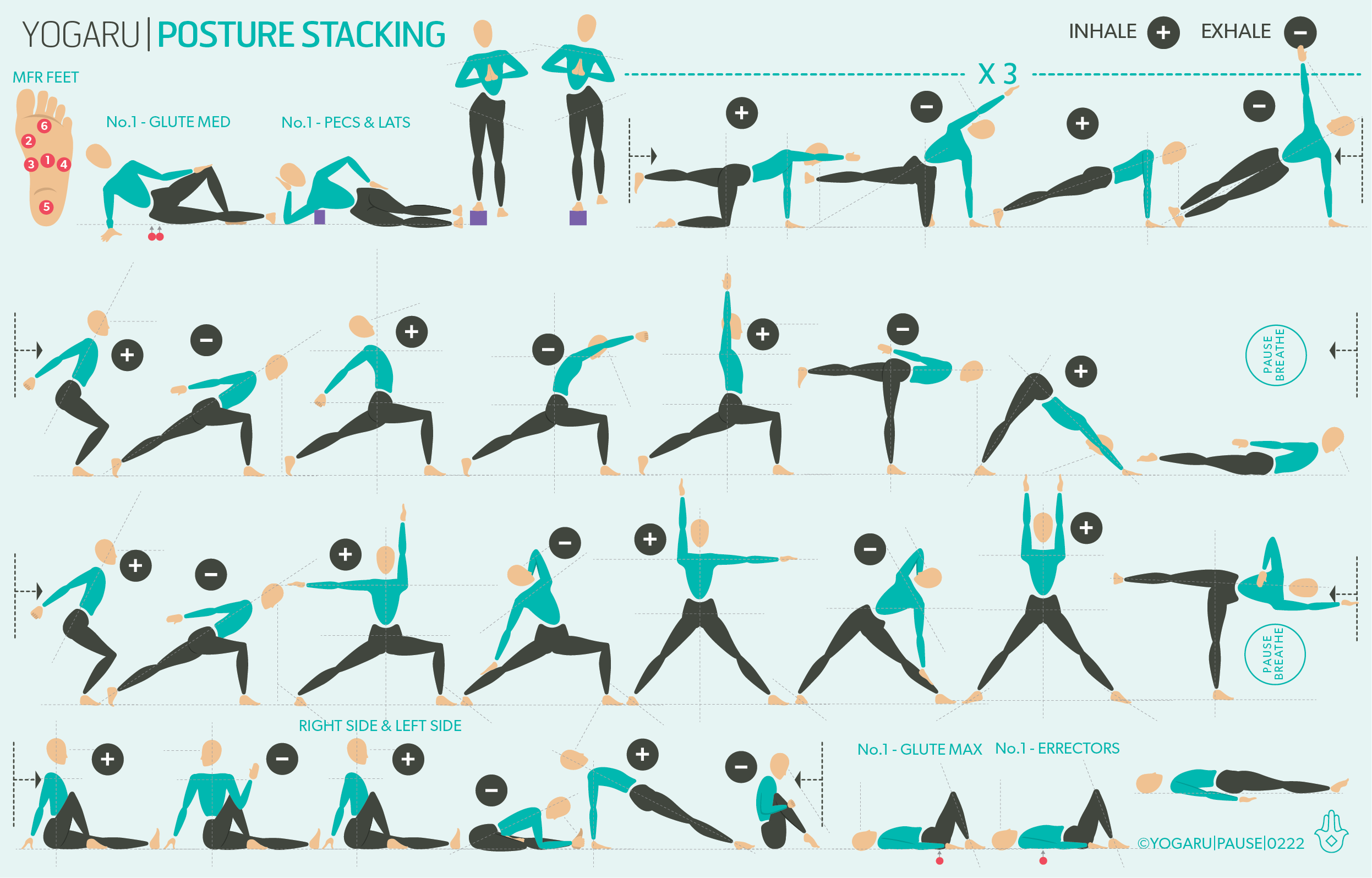
This sequence focuses on stretching the pecs, upper trapezius, hip flexors, quads and lats; and strengthening the glutes, TVA, erectors, lower trapezius and rhomboids. It gets started with MFR to wake up some of the postural muscles and some standing balance drills which will immediately wake up all the balancing and postural muscles. As you are doing your balance drills check in with your posture stacking. 

The second and third rows are your two main standing fires. I recommend you flow through them once with a few breaths per pose and then flow through them another 1-3 times depending on your time with the breath count indicated in the sequence. As you flow through the standing flow check your posture bricks and notice your main postural muscles listed above switching on as you work on strengthening your posture.

Finally, the sequence brings you down to the ground for your cool-down and a final opportunity to try out posture stacking from a seated position.

ALIGNMENT CUES
Have a read of the tips below and either print out the sequence or save it onto your device:

  • Use your breath to slow down your movement and squeeze every bit of goodness out of each pose. Inhale is indicated with a ‘+’, exhale is a ‘-”.

  • As you move through the sequence keep bringing your attention back to your posture stacking.

  • Repeat the two standing flows for two or three rounds per side, stepping right leg forward first then left leg.

  • Give yourself at least 5 mins in Savasana to transition back into your day.

To save the images for personal use click and hold down the image until the ‘save image’ option appears; on Mac hold down ‘control’ and click the image to get the option box; on PC right click on the image to get the option box. Scroll down in the ‘option box’ and click ‘save image’.

Ruth Delahunty Yogaru
Mobility & stability

WHY MOBILITY MATTERS
It feels good to move well – with control, ease, and access to your full range of motion. When range of movement decreases, it doesn’t just affect exercise – it impacts the quality of daily life and your ability to do the things you love. Mobility allows your body to keep functioning well as you age, so you can stay active and continue to enjoy a full, capable life.

Mobility plays a central role in joint health, tissue resilience, and overall strength. When joints aren’t regularly taken through their full range, they gradually lose function. Over time, the body compensates for these restrictions, which often leads to chronic pain or discomfort. Maintaining range of movement is also key for injury prevention, as limited movement makes joints more vulnerable to strain. Keeping the body moving fluidly supports everyday actions like getting up, sitting down, and moving with ease.

WHY STABILITY MATTERS
To fully support the body, mobility needs to work in partnership with stability. Strength provides stability. While mobility allows you to access your full range of movement, stability protects the joints, and distributes load evenly. When the body encounters stress, it will always look for the weakest link, so building strength helps prevent overload in more vulnerable areas. At the same time, flexibility without strength leaves joints unsupported, which is why range with control is so important.

THE BALANCE OF BOTH
Flexibility, mobility, strength, and stability are all interconnected. Too much focus on strength without mobility reduces range of motion, while too much mobility without strength leads to a lack of control. When both are developed together, the result is functional strength, greater resilience, and a reduced risk of injury. Posture is a simple example of this relationship: mobility allows you to move into good alignment, while strength allows you to maintain it. The body works more efficiently when both are present.

STRENGTH TRAINING + FLEXIBILITY
There’s a common misconception that strength training reduces flexibility, but when done well and balanced with yoga, it actually improves it. Strength training helps you control your range of motion rather than limit it, creating more stable and supported movement both in yoga and in daily life.

The more you actively move through, and control, range of motion the more your nervous system maps new motion territory. When you are more active, mobile and strong in these ranges your nervous system feels supported and allows for muscle stretch. Which is why mobility work and strength training go hand in hand.

I’ve been practising yoga for over 30 years, and in the past three years I introduced strength training into my weekly routine to support my regular practice. It has completely changed how my body feels. My practice is now stronger and more controlled, and I’m injury-free in areas that used to be problematic, like my hamstrings and glutes. This has allowed me to safely work on my range of motion again, and enjoy my yoga practice with far more confidence and resilience. Strength training should not replace yoga, and yoga should not replace strength training. Doing both is the key to mobility, stability and longevity.

Mobility + stability = the formula for life

EXPLORING STABILITY & MOBILITY IN YOUR PRACTICE
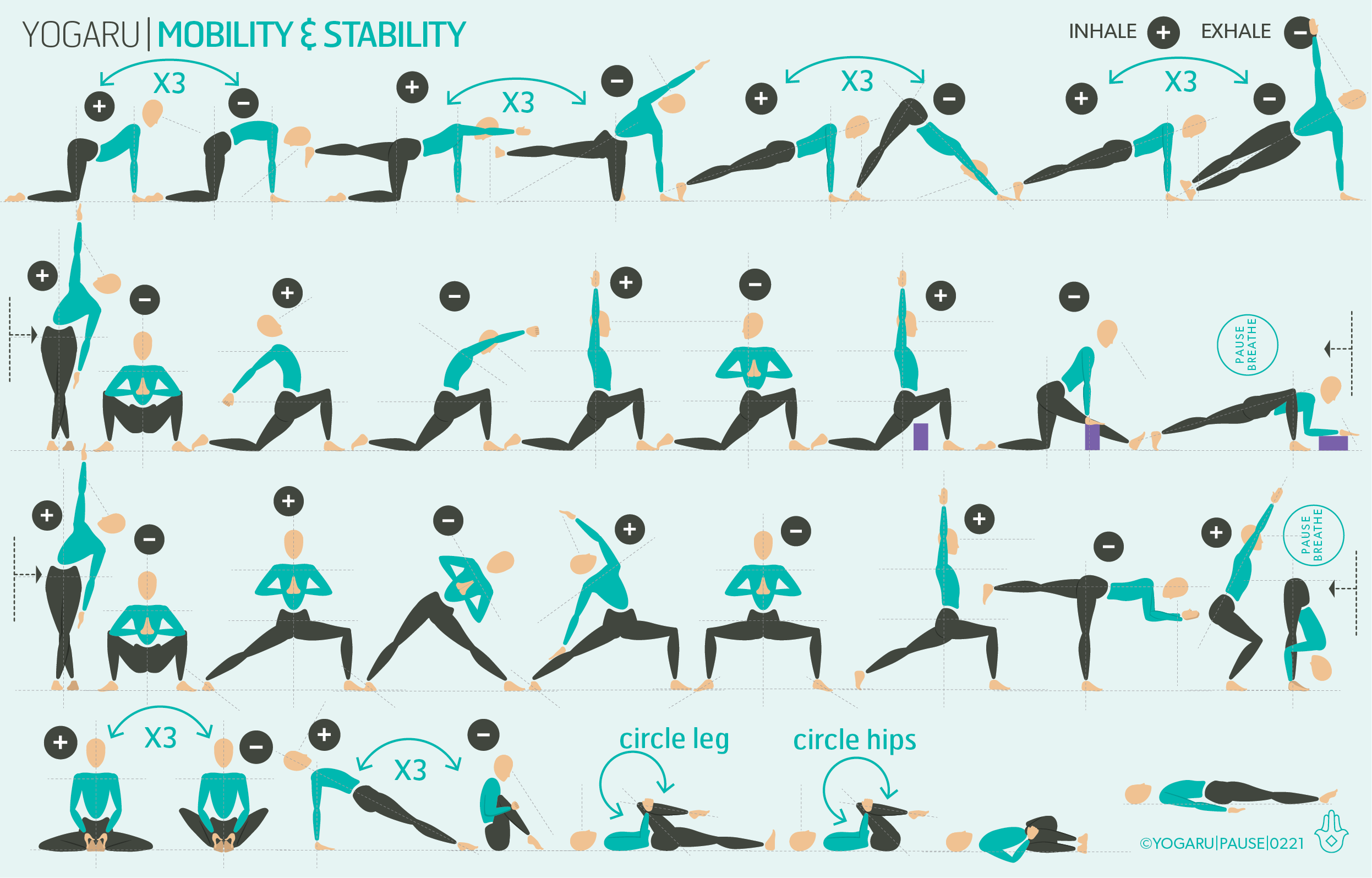
This sequence begins in the first row with a full-body warm-up close to the ground, giving your hips, shoulders, and spine plenty of opportunities to gradually warm up and access optimal active range of motion.

The second and third rows introduce two standing flows. The first begins from a low lunge, helping to anchor the hips and create more access to spinal movement. The second-last pose, Runner’s Lunge, can be challenging for those with tight hamstrings. You can stack extra props under your hands, or keep your hands on your hips and gently lean forward until you feel a light stretch along the hamstrings. The second standing flow in row three offers plenty of challenges to build full-body strength and stability.

Finally, the sequence brings you back down to the ground for some cool-down mobility work to help ease out any remaining tension.

ALIGNMENT CUES
Have a read of the tips below and either print out the sequence or save it onto your device:

  • Use your breath to slow down your movement and squeeze every bit of goodness out of each pose. Inhale is indicated with a ‘+’, exhale is a ‘-”.

  • Pause and squeeze your working muscles at your end ranges to access your active range of movement and build strength.

  • Repeat the two standing flows for two or three rounds per side, stepping right leg forward first then left leg.

  • Give yourself at least 5 mins in Savasana to transition back into your day.

To save the images for personal use click and hold down the image until the ‘save image’ option appears; on Mac hold down ‘control’ and click the image to get the option box; on PC right click on the image to get the option box. Scroll down in the ‘option box’ and click ‘save image’.

Ruth Delahunty Yogaru
Hit refresh

Join me on Stronger You For Life to practice my new HIT REFRESH sequences. For 50% off your first month use YOGARU50.

WHEN YOU NEED IT ALL
There are days when the body doesn’t need intensity or extremes – it simply needs attention. A chance to move, to breathe, and to reconnect. This sequence is designed for exactly that kind of day: when you want to hit the reset button and give yourself a little bit of everything.

Rather than focusing on one area in isolation, this practice weaves together full-body mobility and stability, with particular care given to the hips, shoulders, and spine. These are the regions that so often carry the residue of modern life – long hours sitting, repetitive movement patterns, and the subtle build-up of tension. By moving them in a thoughtful, integrated way, we create space not just physically, but mentally too.

The sequence is intentionally “jam packed,” but not in a rushed or overwhelming sense. Each element has a purpose. Each transition builds on the last. The flow invites you to explore range of motion, while also asking for control and support. This balance between mobility and stability is where meaningful change happens – where the body feels both freer and more capable.

As you move through it, you may notice a shift. Stiffness softens. Breath deepens. The mind becomes a little quieter, a little clearer. This is the power of a well-rounded practice: it doesn’t just stretch or strengthen, it restores.

By the end, the goal isn’t exhaustion – it’s renewal. A sense of being more awake in your body, more connected to your movement, and ready to step back into your day feeling energised, supple, and refreshed.

EXPLORING HIT REFRESH IN YOUR PRACTICE
As with many of my sequences, we begin with standing balance work – one of my absolute favourites for building stability and creating a steady foundation for the rest of your practice.

From there, you’ll move into gentle hip and shoulder circles to mobilise the joints and invite ease into the body.

The second and third rows offer your two standing flows. The first is a simple two-pose flow, while the second builds into a continuous six-pose sequence. A rhythm I’m really enjoying at the moment – both in my own practice and in teaching – is taking two breaths in each pose as you learn the flow, and then repeating it two or three times with just half a breath per pose, as indicated in the sequence. It creates a lovely balance of control and fluidity.

The final row brings you down to the floor, beginning with supine hip tilts to release any tension through the spine. This is followed by bridge lifts and a gentle knee hug stretch to round things out. In Savasana, there’s the option to add a subtle hip opening by placing a rolled blanket under your hip crease. Settle in, soften, and enjoy the sense of bliss and full-body refresh that comes at the end of your practice.

ALIGNMENT CUES
Have a read of the tips below and either print out the sequence or save it onto your device:

  • Use your breath to slow down your movement and squeeze every bit of goodness out of each pose. Inhale is indicated with a ‘+’, exhale is a ‘-”.

  • Pause and squeeze your working muscles at your end ranges to access your active range of movement and build strength.

  • Repeat the two standing flows for two or three rounds per side, stepping right leg forward first then left leg.

  • Give yourself at least 5 mins in Savasana to transition back into your day.

To save the images for personal use click and hold down the image until the ‘save image’ option appears; on Mac hold down ‘control’ and click the image to get the option box; on PC right click on the image to get the option box. Scroll down in the ‘option box’ and click ‘save image’.

Ruth Delahunty Yogaru