
Sequences

What nourishes you?

PAUSE_0138_A.png

This sequence is also available on YouTube.

YOUR NOURISHMENT LIST
Self care and nourishment go hand in hand. Taking time to look after ourselves nourishes us physically and mentally. Nourishment can be found in lots of different ways. My nourishment list includes yoga, meditation, fresh air, long walks, short walks, mountain walks, sea swims, reading for knowledge, reading for pleasure, being creative, connecting with others and best of all a good night's sleep after a restorative yoga session! Sitting down and writing your nourishment list is time well spent. Sometimes when you’re in a bit of a spin or feeling low it is hard to believe that there is a way out of it. Just take out your list and pick one of your guaranteed nourishment ‘pick me ups’.

WHAT YOGA POSES NOURISH YOU?
You can do the same with your yoga practice by building a list of poses that feel just right for you and nourish every part of your body and mind. They don’t need to be big statement poses. They are the poses that feel like you have arrived to a familiar place. Favourite poses are very personal and highlight how amazingly different we all are physically and mentally. Some days my nourishing pose might be Bakasana/Crow to help boost my energy and other days I will come back to Tadasana/Mountain throughout my practice to help me focus and notice how my practice is sitting me that day.

Most of us have poses that are our favourite, and similarly poses that challenge us. Some days meeting yourself on your mat with one of your challenging poses can help you overcome everyday challenges in life and give you the lift you need. Alternatively it can teach you to sit with discomfort and that not everything in life is to be conquered.

One of the benefits of a personal practice is that you are addressing your needs and tailoring your practice to meet them. Investing a little bit of time to work out which poses nourish you, and how they help you, will make your time on your mat more productive. Keep your list beside you as you practice and add some of your favourite poses into your practice regardless of what sequence you are following. Below are some of the poses that nourish me and how they help me. Some of the poses tick more than one box, but to give a variety examples I have picked all different poses for each list.

PAUSE_0138.png

EXPLORING WHAT NOURISHES YOU IN YOUR PRACTICE
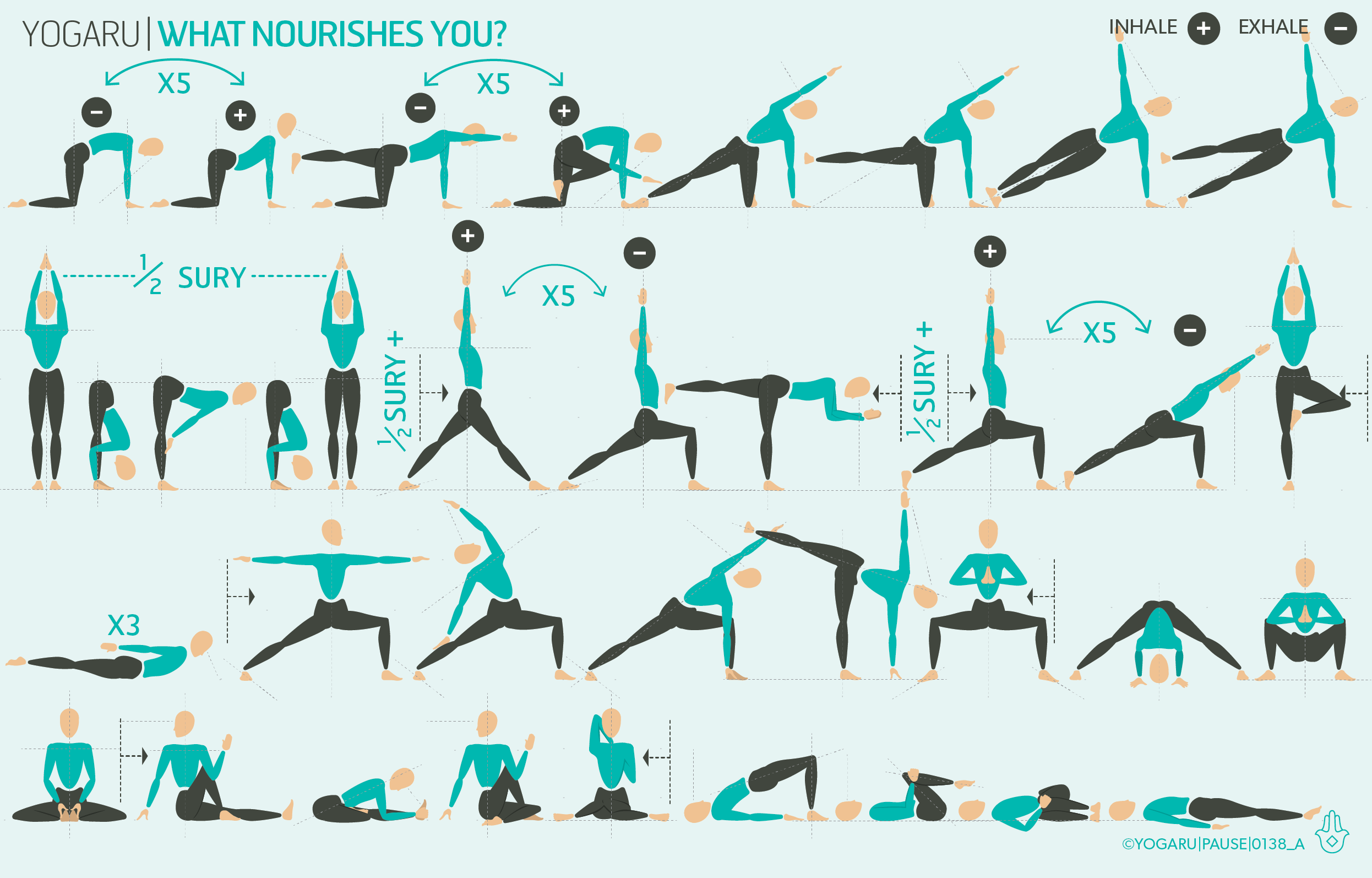
This sequence is a collection of some of my nourishing poses which I regularly add to my practice. You can add your nourishing poses into the mini flows in the sequence or add them as stand alone poses. If your pose is a standing pose add it into the standing section, if your pose is a seated pose add it into the end of the sequence etc. As you are running through the sequence notice how the poses are sitting with you. See what effect the poses I have picked have on you.

ALIGNMENT CUES
The peak pose of this sequence is Ardha Chandrasana/Half Moon, one of my favourite poses that helps me feel strong, focused and energised.

Have a read of the tips below and either print out the sequence or save it onto your device:

  • From Trikonasana with your right leg forward, bend your front knee. Place your right hand a foot forward to the little toe side of your right foot, on a brick, or the ground, left hand on your hip.

  • Step your left foot forward a little, press down through the three points of your right foot.

  • Inhale, float your left leg up to hip height or slightly above, toes facing forward. Flex your foot parallel to the ground, press out through the heel, firm your lifted leg.

  • Hips and shoulders stacked, reach your left arm up high, palm facing left, gaze down or to your left fingertips.

To save the images for personal use click and hold down the image until the ‘save image’ option appears; on Mac hold down ‘control’ and click the image to get the option box; on PC right click on the image to get the option box. Scroll down in the ‘option box’ and click ‘save image’.

Ruth Delahunty Yogaru

Calming flow

PAUSE_0136.png

This sequence is also available on YouTube.

THE NERVOUS SYSTEM
The nervous system is our body's method of reacting to ever changing situations inside and outside the body. It sends ‘sensory’ messages to the brain, which responds by sending ‘motor’ messages to the glands and muscles of the body to cause a chain of reactions to the situation.

When we are stressed the sympathetic nervous system, or the ‘fight or flight’ response, is firing. The nervous system sends signals to the brain and the brain decides the best action to take. In this stressed state it signals the body to increase heart rate and blood pressure, open our airways, inhibit digestion and reproductive organs, stimulate adrenaline production, open our sweat glands and tense the muscles ready for action. All with the purpose of dealing with the perceived stressful situation. When the stress has eases the body clears out the stress hormones and resets the organs and systems. But when we are constantly being triggered by stress the body gets stuck in this cycle and the systems get flooded by stress hormones it can’t flush out quick enough. In an ongoing state of chronic stress the organs of the body are not working optimally – reducing the functionality of the immune system, causing inflammation and eventually leading to health issues.

When the parasympathetic nervous system, or ‘rest and restore’ response, is triggered the nervous system sends signals to the body to reduce heart rate and blood pressure, relax our airways, stimulate digestion and reproductive organs, inhibit adrenaline production and relax the muscles. This creates optimal conditions for the functionality of the organs of the body, strengthens the immune system and relieves symptoms of stress, anxiety and tension.

These two reactions are autonomic nervous system responses which means they are involuntary and not something we can switch on and off. But we can create favourable conditions to influence which response we are in, depending on what we are looking for. They work hand in hand and when strong and malleable have the ability to shift smoothly from gear to gear throughout the day. To simplify it – our sympathetic nervous system gets us out of bed and helps us get our work done, and our parasympathetic nervous system help us rest and restore at the end of the day and gets us ready for a good night sleep. The body strives for balance and will always look to come back to homeostasis. Yoga is one of the best methods for helping your body find this delicate balance between the two nervous systems.

WHY IS YOGA CALMING?
What is it about yoga that makes it so calming? A question I frequently asked and was never completely satisfied with the answer ‘because it balances the nervous system’.

There are many nerves responsible for the parasympathetic response, most of them come from the cranial nerves with just three coming from spinal nerves. The main cranial nerve associated with 75% of the parasympathetic nerve fibres, and for regulating the parasympathetic response, is the vagus nerve. It travels to and from the brainstem straight to the throat, heart, diaphragm, stomach, kidneys, liver, pancreas, gallbladder, sphincter and reproductive organs. It initiates the parasympathetic responses to slow heart rate and reduce blood pressure, relax our airways, stimulate digestion and reproductive organs, inhibit adrenaline production, stimulate endorphin productions and relax the muscles.

BREATH, MOVEMENT AND CONSCIOUSNESS
There are three pathways to tapping into the vagus nerves – the way we breathe, how we move and how present on our mat we are during our practice. The vagus nerve runs through the centre of the diaphragm. When we breathe, in particular an extended exhale, the diaphragm stimulates the vagus nerve and causes a chemical reaction which activates the nerve fibres and sends messages to the brain. The brain processes this information from the vagus nerve and initiates the parasympathetic response in all the parts of the body which this ‘wandering nerve’ travels to. The breath is one of the fastest ways to stimulate the vagus nerve which is why it is so important in yoga.

Receptors called mechanoreceptors are found in the hips, knee, shoulders and spinal joints. We activate them by gently moving and stretching the connective tissue of these joints. They respond by sending signals to the brian to inhibit the sympathetic response. When the sympathetic nervous system is inhibited the parasympathetic nervous system kicks in.

Being present on our mat as we move also has a big impact in the effectiveness of our practice in terms of calming and soothing. When we consciously take the time to switch off and include some self care into your day it helps start a positive mindset. Sometimes stress can be managed by just consciously breaking the loop. This combined with the breath and movement allows the vagus nerve to communicate with the amygdala (emotional response) and reduces its inclination towards the sympathetic ‘fight or flight’ response and rewires it towards a parasympathetic response. Think of the vagus nerve as the steady minded peacekeeper at decision times.

EXPLORING FINDING CALM IN YOUR PRACTICE
This sequence starts with some gentle repetitive flows to link movement with breath, ease out any held tension and initiate the calming process. This will gently help the mind and body to accept the idea of clearing out stress, anxiety or tension and transform to a calmer state of being.

Start your practice with a few rounds of viloma breath to help you link with your breath and naturally lengthen the exhale. You can do this lying on your back or in a comfortable cross legged seated position. Viloma breath breaks the exhale into three. When you are ready take one full breath for nothing, then inhale completely, exhale, pause, exhale, pause, and exhale the full breath.

After your standing flows you will come down for some seated poses to bring you down to a grounded practice and continue to cultivate a calming practice.

ALIGNMENT CUES
The mini flow will help you connect breath with movement. You will see a ‘+’ for the inhale and a ‘-’ for the exhale to help you establish a nice smooth breath. If you are finding it hard to shift to a lower gear continue to repeat the mini flow until you notice you are starting to flow with ease and a sense of submission to the practice.

The peak pose of this sequence is Upavistha Konasana/Wide Leg Seated Forward Fold which is a calming seated forward fold.

Have a read of the tips below and either print out the sequence or save it onto your device:

  • From Dandasana, open your legs out wide, press out through the heels, thighs pressing into the ground, toes pointing up.

  • Place your hands either side of your hips, stack your pelvis.

  • Inhale, lengthen up through your spine, exhale, fold forward from the hip joint, stretch your arms out between your legs and lengthen through the front, sides and back body, draw your navel towards your spine. Sit bones reach back.

  • Lead with your sternum, inhale, lengthen the spine, exhale, release further forward, walk your hands forward a little as you fold forward, or hold onto your big toes, gaze down.

To save the images for personal use click and hold down the image until the ‘save image’ option appears; on Mac hold down ‘control’ and click the image to get the option box; on PC right click on the image to get the option box. Scroll down in the ‘option box’ and click ‘save image’.

Ruth Delahunty Yogaru
Remote working home flow

PAUSE_0134.png

REMOTE WORKING CHALLENGES
We have all been working from home for almost a year now and unless you were already set up with a home office you may be working from a less than ideal space which adds extra challenges to sitting for long periods of time. Kitchen tables were not designed for hours of working on a computer. If like me your table is too high you will end up with your shoulders very hunched and wrist strain. You might be sitting on a kitchen chair which most likely is not giving the back support you need. Over the course of the day you will start to feel progressively tighter and achy in the hips, shoulders, neck and lower back. A little bit of stretching during or after your working day can make all the difference.

WHAT IS GOOD SITTING POSTURE
We know that prolonged periods of sitting compromises our posture, spinal health and overall wellbeing. Taking breaks from sitting and ensuring your sitting posture is good will help. You might be limited by your workspace on some of the recommendations, but have a read of the below and see what you can improve on throughout your working day:

  • Rest your feet on the floor or if your chair is too high place a prop under your feet.

  • Have your knees at the same height or slightly lower than your hips.

  • Avoid crossing your legs or ankles to allow good blood flow through the legs.

  • Shoulders release away from your ears.

  • Lengthen through the spine to the tip of your crown.

  • Keep your back against the chair with a natural curve in your lower back.

  • Distribute your body weight evenly into both hips.

  • Height of your table should give you a natural L’ shape in your arms.

  • Height of your computer screen should be eye level.

  • Take a standing break every hour of sitting.

  • Stretch your gaze at something in the distance during your standing break.

WHY YOGA
With remote working we are all inclined to work longer hours into the evening. While you may feel you are getting lots of work done, you will most likely find when you finally hit the bed exhausted, your mind is processing away all the information and hasn’t had a chance to switch off. This leads to a disturbed night sleep, tiredness, poor focus and another day of working late. Sound familiar? Stepping away from your work and focusing on your wellness is completely acceptable. Especially in the current climate when we are all being encouraged to get plenty of fresh air and look after our mental health to counteract the unprecedented period in time we are currently living through.

Yoga has many benefits, many of which are listed below with a guide to which pose will help the most. With regards to the benefits of yoga to remote working yoga stretches and strengthens muscles that have been weakened by sitting , realigns the spine, improves posture, builds focus & concentration, eases headaches, insomnia, fatigue, stress tension & anxiety, increases circulation and boosts the immune system.

YOGARU_Benefits.png

EXPLORING REMOTE WORKING HOME FLOW IN YOUR PRACTICE
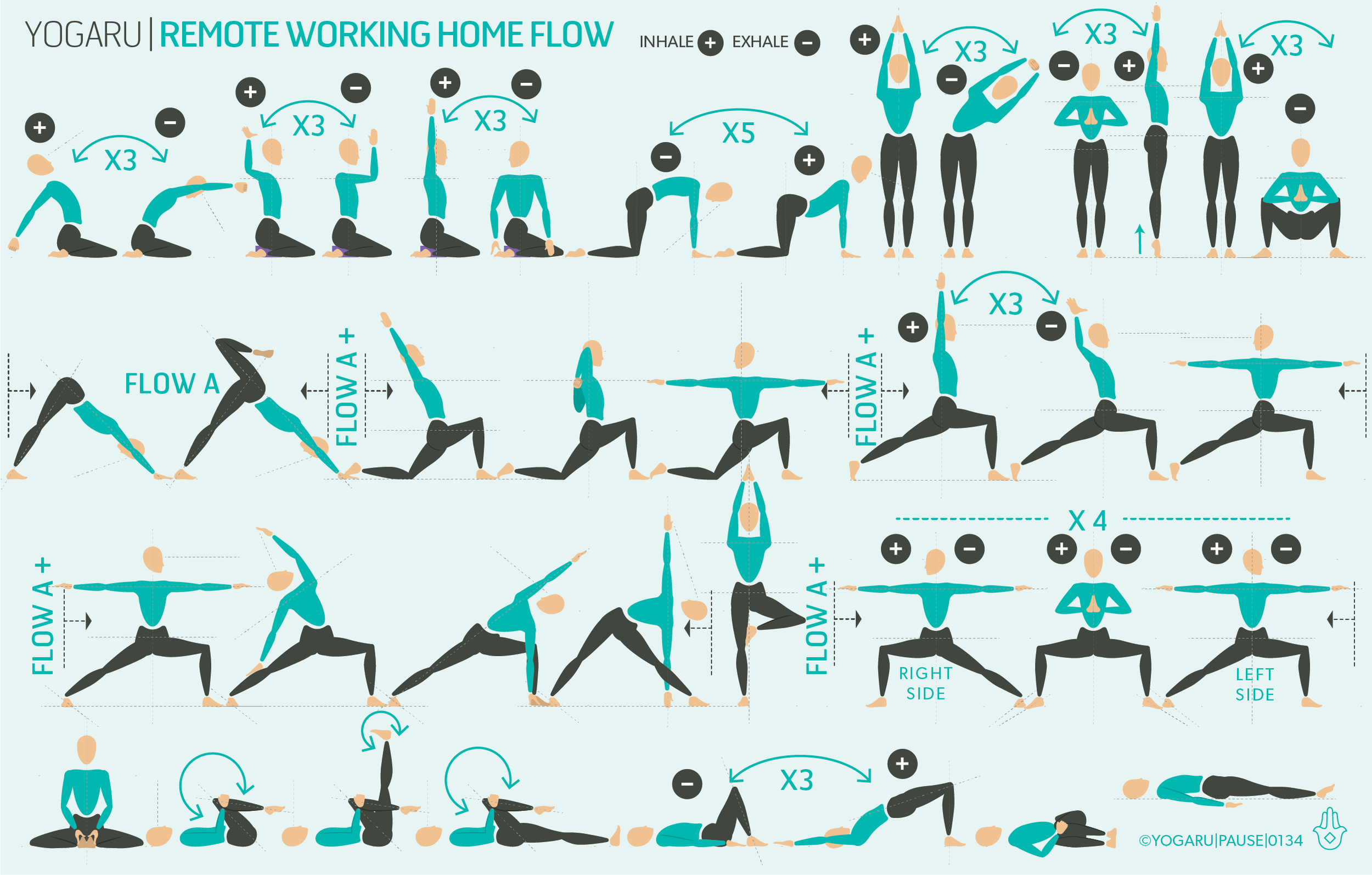
Remote working makes practising yoga from home even more accessible. Yoga is one of the easiest movement based practices to slot into your day, all you need is a yoga mat. This sequence focuses on simple poses to gently undo all the stiffness from long hours sitting. No need to change into yoga gear just take a break during your working day, roll out your mat and get started. You can break the sequence up throughout your day to keep moving or do the full sequences in one practice. Alternatively get into your comfies and use it as your switch off time at the end of your day to ease out any aches and pain in your hips, shoulders and neck, and realign your spine.

The first row of the sequence can be practiced at your desk, seated and standing, as a mini stretch break or on your mat to start the sequence off. A yoga mat is advised for the following two rows of standing poses to give you some grip. Socks off is always better to let the sticky mat do its job. The final row can be done either on your mat, lying on a blanket or whatever you find comfy. This last line can also be practised just before bedtime to get the spine and hips ready for a prolonged period of rest and restoring as you sleep. If you would like to practice for a bit longer you could also add in some Sun Salutation Cs just after the first row of poses and before each mini flow. Mini flows are the group of three to four poses between the arrowed lines. So for example add a Sun Salutation C before the two lunge mini flow on the second row and before the two warrior flows on the third row. You can also add in more side stretches and twists in any of the standing poses. They are very beneficial for spinal health and are great for getting the circulation going again.

ALIGNMENT CUES
As always, move nice and slow as you practice this sequence. Concentrate on any stiff areas you may have from sitting. There are a few two pose flows which will help you connect your breath with the movement. You will see a ‘+’ for the inhale and a ‘-’ for the exhale to help you establish a nice smooth breath for the suggested rounds. There is no particular peak pose in this sequence. Below are some tips and additional alignment cues for you to try as you practice.

  • Practice the first six poses throughout the day at your desk.

  • Take hourly breaks where you stand up and do one or two of the standing mini flows from row one.

  • Pause in a few poses and breath in for the count of 4 out for the count of 6.

  • Add a side stretch when you come to low lunge and again when you come to high lunge.

  • If you are looking for a shorter practice leave out one of the lunge flows and the warrior flows.

To save the images for personal use click and hold down the image until the ‘save image’ option appears; on Mac hold down ‘control’ and click the image to get the option box; on PC right click on the image to get the option box. Scroll down in the ‘option box’ and click ‘save image’.

Ruth Delahunty Yogaru