
WHY MOBILITY MATTERS
It feels good to move well – with control, ease, and access to your full range of motion. When range of movement decreases, it doesn’t just affect exercise – it impacts the quality of daily life and your ability to do the things you love. Mobility allows your body to keep functioning well as you age, so you can stay active and continue to enjoy a full, capable life.
Mobility plays a central role in joint health, tissue resilience, and overall strength. When joints aren’t regularly taken through their full range, they gradually lose function. Over time, the body compensates for these restrictions, which often leads to chronic pain or discomfort. Maintaining range of movement is also key for injury prevention, as limited movement makes joints more vulnerable to strain. Keeping the body moving fluidly supports everyday actions like getting up, sitting down, and moving with ease.
WHY STABILITY MATTERS
To fully support the body, mobility needs to work in partnership with stability. Strength provides stability. While mobility allows you to access your full range of movement, stability protects the joints, and distributes load evenly. When the body encounters stress, it will always look for the weakest link, so building strength helps prevent overload in more vulnerable areas. At the same time, flexibility without strength leaves joints unsupported, which is why range with control is so important.
THE BALANCE OF BOTH
Flexibility, mobility, strength, and stability are all interconnected. Too much focus on strength without mobility reduces range of motion, while too much mobility without strength leads to a lack of control. When both are developed together, the result is functional strength, greater resilience, and a reduced risk of injury. Posture is a simple example of this relationship: mobility allows you to move into good alignment, while strength allows you to maintain it. The body works more efficiently when both are present.
STRENGTH TRAINING + FLEXIBILITY
There’s a common misconception that strength training reduces flexibility, but when done well and balanced with yoga, it actually improves it. Strength training helps you control your range of motion rather than limit it, creating more stable and supported movement both in yoga and in daily life.
The more you actively move through, and control, range of motion the more your nervous system maps new motion territory. When you are more active, mobile and strong in these ranges your nervous system feels supported and allows for muscle stretch. Which is why mobility work and strength training go hand in hand.
I’ve been practising yoga for over 30 years, and in the past three years I introduced strength training into my weekly routine to support my regular practice. It has completely changed how my body feels. My practice is now stronger and more controlled, and I’m injury-free in areas that used to be problematic, like my hamstrings and glutes. This has allowed me to safely work on my range of motion again, and enjoy my yoga practice with far more confidence and resilience. Strength training should not replace yoga, and yoga should not replace strength training. Doing both is the key to mobility, stability and longevity.
Mobility + stability = the formula for life
EXPLORING STABILITY & MOBILITY IN YOUR PRACTICE
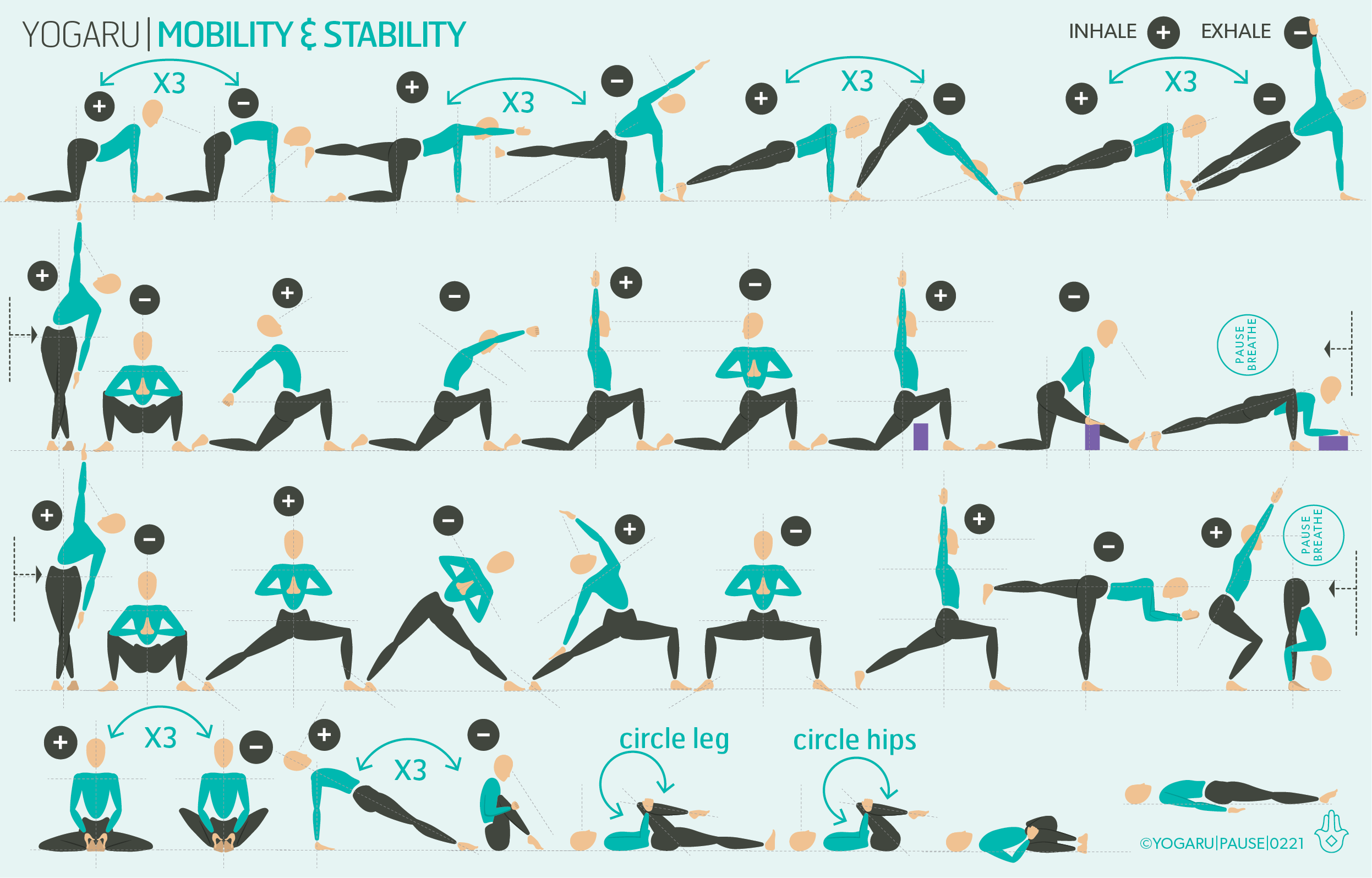
This sequence begins in the first row with a full-body warm-up close to the ground, giving your hips, shoulders, and spine plenty of opportunities to gradually warm up and access optimal active range of motion.
The second and third rows introduce two standing flows. The first begins from a low lunge, helping to anchor the hips and create more access to spinal movement. The second-last pose, Runner’s Lunge, can be challenging for those with tight hamstrings. You can stack extra props under your hands, or keep your hands on your hips and gently lean forward until you feel a light stretch along the hamstrings. The second standing flow in row three offers plenty of challenges to build full-body strength and stability.
Finally, the sequence brings you back down to the ground for some cool-down mobility work to help ease out any remaining tension.
ALIGNMENT CUES
Have a read of the tips below and either print out the sequence or save it onto your device:
Use your breath to slow down your movement and squeeze every bit of goodness out of each pose. Inhale is indicated with a ‘+’, exhale is a ‘-”.
Pause and squeeze your working muscles at your end ranges to access your active range of movement and build strength.
Repeat the two standing flows for two or three rounds per side, stepping right leg forward first then left leg.
Give yourself at least 5 mins in Savasana to transition back into your day.
To save the images for personal use click and hold down the image until the ‘save image’ option appears; on Mac hold down ‘control’ and click the image to get the option box; on PC right click on the image to get the option box. Scroll down in the ‘option box’ and click ‘save image’.
Ruth Delahunty Yogaru