
WHY POSTURE MATTERS
Poor posture doesn’t just affect how we look – it influences how we breathe, move, balance, and age. Over time, it can contribute to back pain, neck tension, reduced mobility, and even low energy levels.
Modern life often works against good posture. Hours spent sitting, driving, scrolling, and working at desks can reinforce poor movement habits without us even realising it.
Poor posture exists on a spectrum – from subtle asymmetries that may never cause problems to more noticeable misalignments that can lead to pain and dysfunction over time.
Posture plays an important role in overall wellbeing, and awareness is the first step toward improving it. To observe your own posture, try catching yourself before you automatically correct it. Notice whether you tend to have forward head carriage, rounded shoulders, a rounded upper back, an overly arched or flattened lower back, or knees and feet that turn excessively inward or outward.
It can be difficult to assess ourselves objectively, so ask a friend or partner to observe how you move throughout your normal day and share any patterns they notice. That feedback can be incredibly valuable. Once you identify where your body feels tight, weak, or compensating, you can begin addressing what you specifically need to improve your posture.
POSTURE BRICKS
Good posture doesn’t come naturally to most people – it’s a skill built through awareness, mobility, strength and consistent practice.
Think of posture as the architecture of your body. Gravity places constant load on this structure and, over time, it will often find weak points. Our goal is to maintain this architecture so it stays resilient, strong and capable for years to come.
A concept I teach all of my students is posture stacking. Imagine your body is made up of bricks: feet, ankles, knees, pelvis, shoulders and head. When these bricks stack efficiently on top of one another, your body distributes load properly and moves with ease.
When one brick shifts out of place, everything above and below it must compensate. If the pelvis tips forward, the spine loses its natural curves and load gets pushed into areas that weren’t designed to carry it. If the shoulders round forward, the head often follows – placing extra strain on the neck and upper back.
I encourage my students to observe their posture stacking throughout class so they can bring that awareness into daily life – how they sit at their desk, walk, climb stairs, carry shopping and move through their day.
Posture stacking isn’t limited to standing still. You can explore it throughout yoga poses and dynamic transitions too. In High Lunge check whether the pelvis is upright and steady. In Warrior II notice whether one shoulder is drifting forward. During transitions, use strength and control to move slowly and with awareness. Yoga gives us endless opportunities to practise better alignment in motion.
YOGA FOR GOOD POSTURE
One of yoga’s greatest benefits is that it strengthens the muscles that support posture while improving body awareness. This awareness – known as proprioception – is your ability to sense where your body is in space, and it plays a huge role in how efficiently you move.
Strong posture requires a balance of mobility, stability and strength – and yoga develops all three. While many muscles contribute to good posture, some of the key players include the gluteus medius and gluteus maximus, which stabilise the hips; the transverse abdominis (TVA), which supports the lower back; the erectors, which help keep the spine upright; and the lower trapezius and rhomboids, which support the upper back and shoulders.
Many yoga poses – particularly standing poses like Virabhadrasana II (Warrior II) and Ashta Chandrasana (High Lunge) – play an important role in strengthening the hips and glutes, helping the pelvis stay stable so the spine doesn’t have to compensate.
Backbends against gravity, such as Salabhasana (Locust Pose) and Ardha Uttanasana (Half Forward Fold), strengthen the muscles along the spine and upper back, helping to counteract the rounded posture many of us develop from desk work and looking down at phones.
Yoga also offers a wide variety of arm positions that help open the front of the chest while strengthening the back of the shoulders. This helps anchor the shoulder blades more effectively onto the ribcage – an essential component of maintaining an upright, supported upper-body posture.
The feet are often overlooked, yet they’re the foundation of posture. Each foot contains 26 bones and over 100 muscles, tendons and ligaments that absorb force, create stability and keep us balanced. That’s why I include balance work in many of my sequences – so your body becomes better at adapting to everyday challenges like uneven ground, sudden movement or simply moving through life with more confidence.
Stress affects posture too. When we feel overwhelmed, we often collapse forward, breathe shallowly and physically shrink. Yoga helps interrupt that pattern through movement, breath and nervous system regulation. Sometimes simply opening the chest and standing taller can shift both your posture and your mindset.
POSTURE CHECK INS
Throughout your day, check in with your posture using these simple cues.
Think of your pelvis as a bowl carrying precious liquid that you don’t want to spill. If you feel your pelvis tipping backward while sitting or standing, gently rock forward on your sit bones to restack it.
Then notice your chest. If it feels collapsed, imagine a string attached to the centre of your chest gently lifting it forward and upward, helping your ribs and shoulders stack back over your pelvis.
Small corrections repeated consistently can create lasting change.
Good posture helps you move with less pain, breathe more efficiently, maintain independence as you age, improve athletic performance, reduce tension headaches, support joint health and feel stronger and more confident. Most importantly, it helps you move through life with greater ease.
Good posture = mobility + stability + strength + balance + body awareness.
That’s exactly what we work on in my sequences and yoga classes – helping you build better posture for life, not just for the yoga mat.
Join me in class, use the code YOGARU50, and start strengthening your posture from the ground up.
EXPLORING POSTURE STACKING IN YOUR PRACTICE
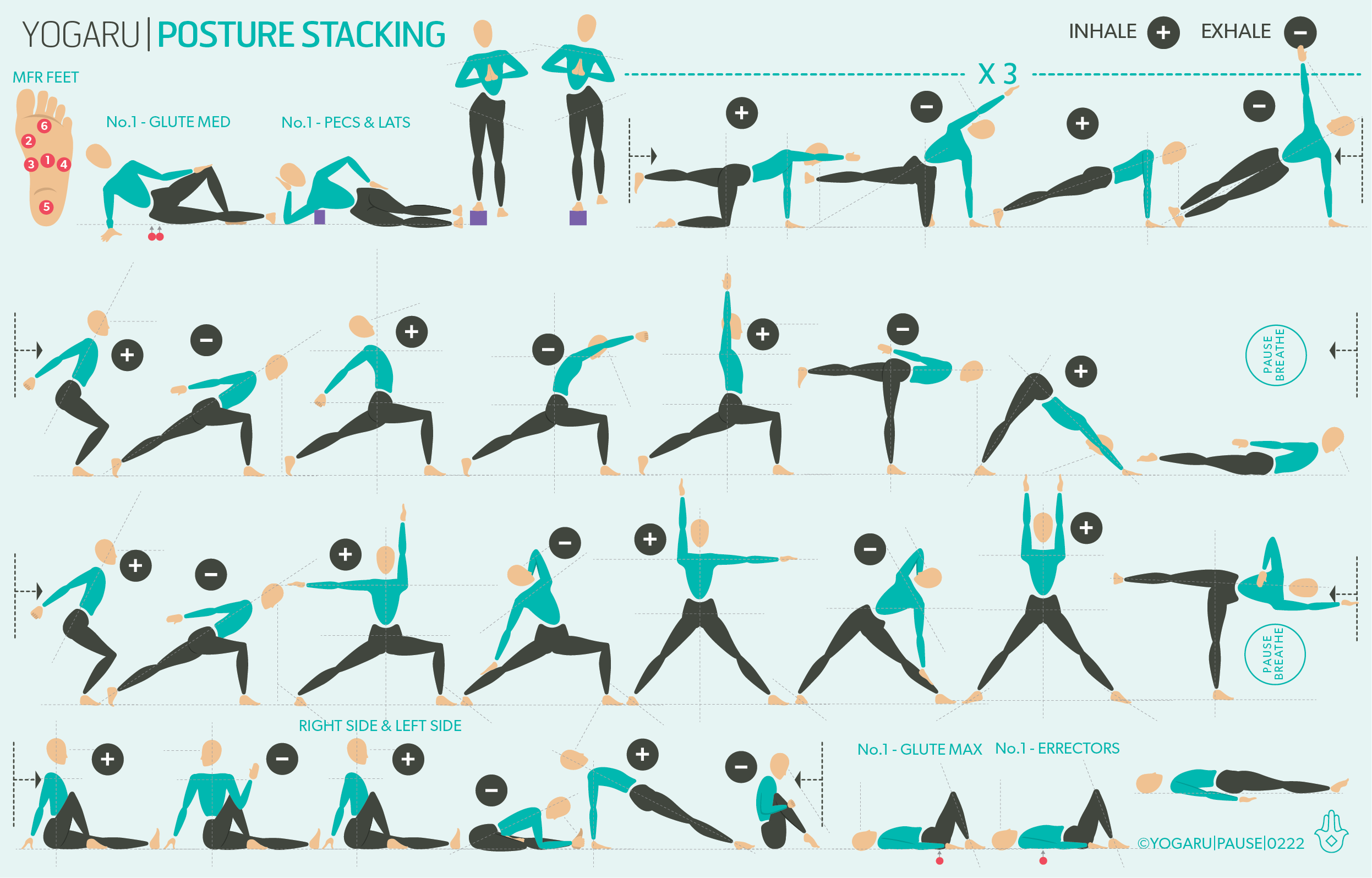
This sequence focuses on stretching the pecs, upper trapezius, hip flexors, quads and lats; and strengthening the glutes, TVA, erectors, lower trapezius and rhomboids. It gets started with MFR to wake up some of the postural muscles and some standing balance drills which will immediately wake up all the balancing and postural muscles. As you are doing your balance drills check in with your posture stacking.
The second and third rows are your two main standing fires. I recommend you flow through them once with a few breaths per pose and then flow through them another 1-3 times depending on your time with the breath count indicated in the sequence. As you flow through the standing flow check your posture bricks and notice your main postural muscles listed above switching on as you work on strengthening your posture.
Finally, the sequence brings you down to the ground for your cool-down and a final opportunity to try out posture stacking from a seated position.
ALIGNMENT CUES
Below are the MFR and stretching techniques used in this sequence. The props you’ll need are:
1 x yoga bricks - or two thick similar sized dictionaries.
2 x MFR balls - or 1 tennis ball.
MFR
No.1 - Glute med
Compression - from side lying up on your forearm, stack 2 x balls behind your frontal hip bone on your outer hip, gently press down with an inhale and release on the exhale x 5 breaths.
Sheer - slowly lift and lower your leg x 5.
Roll & cross fibre - roll up and down on your outer hip.
No.2 - Pecs & lats
Rocking - from side lying, place the brick on its mid height in the centre of the armpit. Rock your weight back and forward for the lats then pull the brick a little more forward and rock forward and back for the pecs.
No.3 - Glute max
Compression - from supine with knees bent, place 2 x balls in the centre of each buttock muscle, gently press down with an inhale and release on the exhale x 5 breaths.
Sheer - slowly lift and lower one knee at a time towards your chest x 5. Place your right foot on your left knee and lower and lift your right knee.
Roll & cross fibre - roll around the whole buttocks area.
No.3 - Erectors
Compression - from supine with knees bent, place 2 x balls above the back of the hips either side of the spine, gently press down with an inhale and release on the exhale x 5 breaths.
Sheer - slowly lift and lower one knee at a time towards your chest x 5.
Roll & cross fibre - roll up and down the lower spine below the ribs.
To save the images for personal use click and hold down the image until the ‘save image’ option appears; on Mac hold down ‘control’ and click the image to get the option box; on PC right click on the image to get the option box. Scroll down in the ‘option box’ and click ‘save image’.
Ruth Delahunty Yogaru