Sequences

Bricks & hips

PAUSE_0117.png

BRICK PARTY
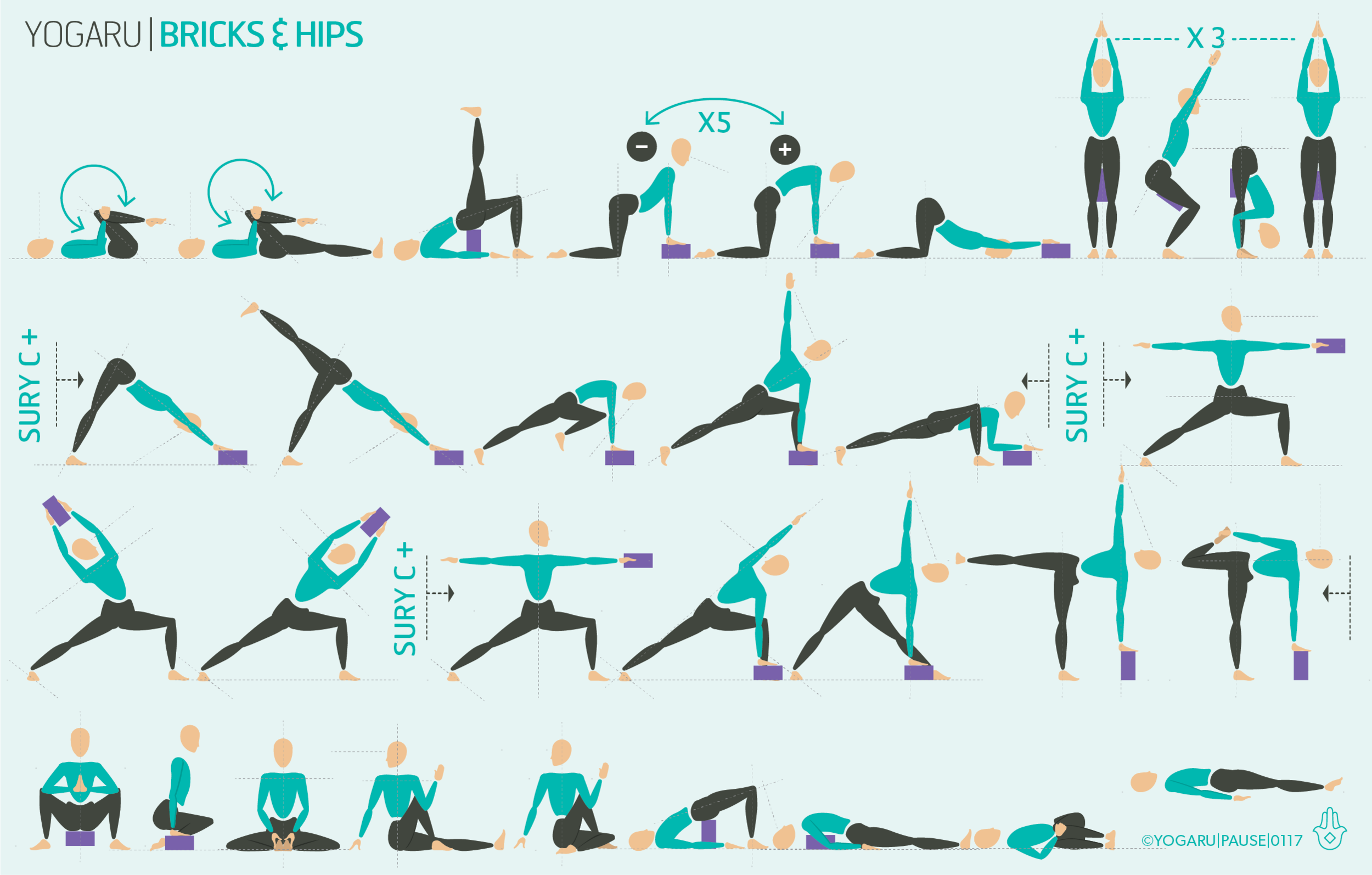
Props are incredibly versatile and can offer support where you need it, facilitate deepening a pose and reinvigorate your home practice when used creatively. Anatomy comes into play when finding your personal optimum alignment. Some poses ask for a position that doesn’t suit your skeletal structure. For some students better alignment comes from using props regardless of flexibility or strength. Aisling Conn took us through the benefits of adding bricks, blocks and belts into your practice, with lots of different ways to use them and some sample poses to try out. Here we look at a full sequence using bricks. Bricks are the most adaptable of all the yoga props. They have three different height options – stacked, on their side and flat. They come on cork which are more sturdy and used mainly in Iyengar Yoga, or floam which are a slightly softer while still very supportive, and better for sitting on and propping the hips in poses like Setu Bandha Sarvangasana/Bridge and Restorative Yoga. Adding props gives your practice variety which is the basis of a sustainable practice. The more you surprise your body and don’t let it get too complacent in its movement, the more you can maintain your long term mobility.

HOW TO USE BRICKS
Bricks are currently my favourite prop to use in my home practice. I keep them beside my mat ready to grab and get creative with while I flow. There are lots of ways to add bricks to your practice. The most traditional use being in standing poses to press your hand into when your arm doesn’t reach the ground, giving you extra space to expand the chest and reach the top arm up. You can also use them to work the muscles of the arm in standing poses by raising one above your head and squeezing it between your hands. I have started to play around with placing them under my hands in Marjaryasana/Cat & Bitilasana/Cow. This helps to open the chest as you move from Marjaryasana/Cat to Bitilasana/Cow and deepen the breath. I also sometimes use them in Adho Mukha Svanasana/Downward Facing Dog to help me press the back of the heel down towards the ground and reach my sit bones up high.

EXPLORING BRICKS & HIPS IN YOUR PRACTICE
This sequence will give you lots of opportunities to try out the poses with bricks. Get creative and try a few different versions yourself too, to see what suits you and how you can find different versions of the poses. Use the bricks as suggested even in poses where you don’t usually use them and notice where in the body it might feel different.

For your Sun Salutation try placing a brick between your thighs and work on keeping it there without it falling out as you move. You might need to remove the brick as you step back and forward if jumping back and forward isn’t part of your practice. When using the brick in Adho Mukha Svanasana/Downward Facing Dog make sure to have the heel of your hand pressing over the edge of your bricks to make sure your hands don’t slip forward on the bricks. Play around with the three different heights of the blocks too and see what suits you.

ALIGNMENT CUES
The peak pose of this sequence is Ardha Chandra Chapasana/Half Moon Sugarcane using a brick to ensure you stay up a bit higher and have space to open the chest. If your arm doesn’t reach your foot just reach your arm towards the foot without holding it. You may not get quite as deep into your backbend but this version is very strengthening for the hamstrings and the hip joint.

  • Have a read of the tips below and either print out the sequence or save it onto your device:

  • From Ardha Chandrasana, bend your left knee, reach your left hand back to hold the outside of your left foot.

  • Press your hand into your foot and your foot into your hand. Reach your left knee up, broaden through the collarbones, press down through your right foot.

  • Arch through your whole spine, lengthen your neck and softly reach your head back, gaze down or up.

To save the images for personal use click and hold down the image until the ‘save image’ option appears; on Mac hold down ‘control’ and click the image to get the option box; on PC right click on the image to get the option box. Scroll down in the ‘option box’ and click ‘save image’.

Ruth Delahunty Yogaru

Moon salutation

PAUSE_0115.png

MEDITATIVE FLOW
The Moon Salutation, also known in Sanskrit as Chandra Namaskara, is a mini sequence of poses similar to the more commonly practised Sun Salutation (Surya Namaskara). The Sun Salutation was originally designed for a morning practice to create heat and energy and the Moon Salutation was created to practice in the evening as a cooling and calming end to the day. Both can be practised anytime of the day depending on what you are looking for from your practice. They both stretch and strengthen all the muscle groups, increase circulation, build a strong respiratory, aid the digestive system, boost the immune system, unwind a busy mind and release physical and mental tension. But if you are in need of a more invigorating energy boost head to the Sun Salutation and if you are feeling stressed and depleted look to the more soothing version of the Moon Salutation.

The Moon Salutation is a very symmetrical and balanced flow. You move through the first half of the sequence focusing on the right side of the body, come to a central symmetrical pose and flow back to the starting position focusing on the left side of the body, reversing the order of the poses as you go. The repetitive and meditative quality of the sequence of movements relaxes the mind and body, reducing stress and anxiety. Each pose is linked with an in-breath or an out-breath, helping you to connect to the breath and its many benefits.

EXPLORING MOON SALUTATION IN YOUR PRACTICE
The Moon Salutation can be practiced as part of your practice or repeated as your full practice with as many rounds as feel good to you. As you move through the poses use the transitions from pose to pose as an opportunity to thread the poses together and cultivate a flowing breath. Move with fluidity and length through your limbs to make the transitions as beneficial as the poses themselves.

You can also practice this sequence with my on YouTube.

Start standing in the centre of your mat facing the long side. Hands in prayer position at your hearts and take a few slow meditative breaths.

Step 1 - Inhale, reach your arms up high. Palms together arms reaching. Lengthen through the whole spine.

Step 2 - Exhale, hinged to the right, press into your left foot and feel the stretch through the whole left side of the body.

Step 3 - Inhale back to centre and lengthen.

Step 4 - Exhale, hinge to the left, press into your right foot and feel the stretch through the whole right side of the body

Step 5 - Inhale, back to centre.

Step 6 - Exhale, step your feet wide apart, feet turned out, bend your knees and lower your hips down, stack your knees over your ankles, thighs working towards being parallel to the ground. Tailbone reaches down, hip bones reach up. Arms in cactus position.

Step 7 - Inhale, straighten your right leg and pivot your right foot forward and your left foot to a 45 degree angle. Reach the arms out at shoulder height.

Step 8 - Exhale, hinge to your right from the hip joint. Place your hand on your shin or the ground inside/outside your right foot. Bottom waist rolls forward, top waist rolls back, reach your left arm up, palm facing left, gaze to your left fingertips.

Step 9 - Inhale, pivot your hips round to the front of your mat, hinge forward from the hip joint over your right leg, hips level, right hip draws back, left hip draws forward. Reach the chest forward, fold forward, release your head towards the front leg, keep the legs firm.

Step 10 - Exhale, bend the right leg and lift the left heel up, firm your back leg, hug your outer hips to the midline, press into your feet and scissors them towards each other. Broaden through your collarbones, lengthen through your spine to the tip of your crown, draw your sternum forward and up.

Step 11 - Inhale, place the left knee on the ground, hug your outer hips to the midline, reach your arm up high palms pressing together. Draw your navel towards your spine, broaden through the collarbones, lengthen through your spine to the tip of your crown.

Step 12 - Exhale, place both hands on the ground inside your right leg and pivot your hips around to the side of your mat. Press into both feet, keep your right knee over your right ankle. Squeeze into the back of the hips to open your inner groin.

Step 13 - Inhale, bend both knees and sit your hips down into a deep squat. Press your elbows against your thighs, hug your outer hips to the midline, let your pelvis become heavy down towards the back of your heels. Lift your inner arches and inner ankles. Broaden through the collarbones, lengthen through your spine to the tip of your crown.

On your next exhale pivot around to the back of the mat with your hands on the ground inside your left leg for wide legged low lunge on the left side. Move through the steps on the left side in reverse from Step 12 to Step 1 until you reach Tadasana.

To save the images for personal use click and hold down the image until the ‘save image’ option appears; on Mac hold down ‘control’ and click the image to get the option box; on PC right click on the image to get the option box. Scroll down in the ‘option box’ and click ‘save image’.

Ruth Delahunty Yogaru

Restorative with home props

PAUSE_0114.png

This sequence is also available on YouTube

THE BENEFITS OF RESTORATIVE YOGA
Restorative yoga is the king of all yoga in terms of physical and mental wellbeing. It is particularly beneficial if you are feeling tired, stressed, anxious or have recently been ill. One of the main benefits of restorative yoga is that it triggers the rest, restore & digest nervous system response or the parasympathetic nervous system, through the cerebral cortex and the vagus nerve. This creates optimal conditions for the functionality of the organs of the body which supports the immune system, relieves symptoms of stress, anxiety and tension, rebalances hormones, releases muscle tension and aids the healing process.

The process of restorative yoga ‘takes a body that is feeling fragmented and puts it back together again in the kindest way possible’. In restorative we are consciously asking our muscles to release into the pose and gradually they submit. Even in sleep our muscles can be quite active, especially when we are dreaming. Restorative gives the whole body a chance to completely let go of held tension.

PROPS SWAPS
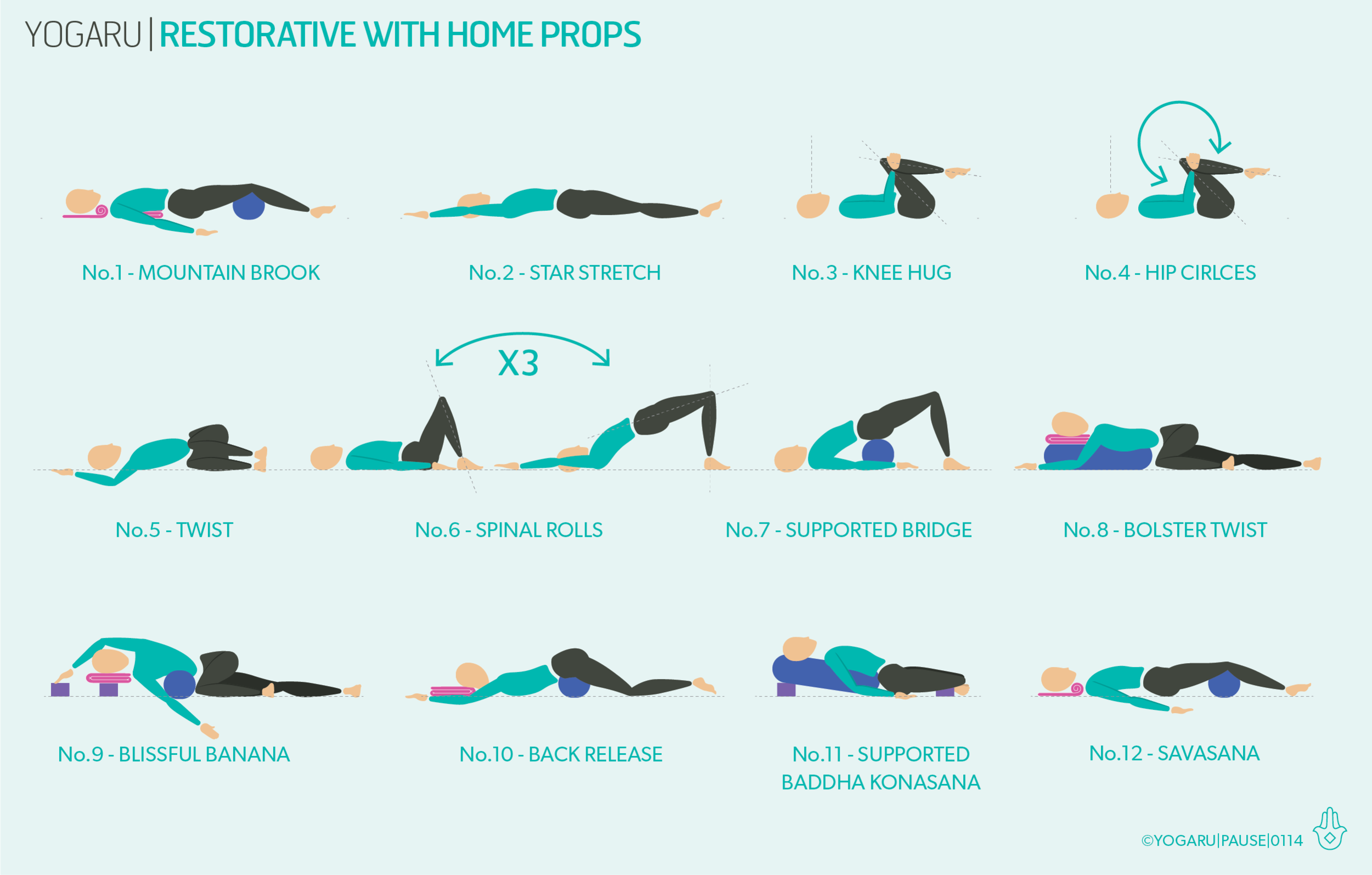
This sequence is for everybody, all you need is a yoga mat and some household prop swaps. Props bring restorative to another level. But you don't have to have a huge array of official yoga props to get started. You can improvise with household items that can do just as good a job. For this sequence I’ve used all household items as prop swaps as listed below:

Bolster - one large thick blanket & two bath size towels. Fold the blanket in four and place the two towels folded in half over the blanket. Roll them up and tie to secure with about four ribbon, strings or elastics.

Book bricks - two thick dictionaries or thick reading books per brick. Stack your two books and tie with string or elastic vertically and horizontally. Make two ‘book bricks’.

Tins prop - two tins & two thick socks. Place a tin in each sock, if the sock is long enough twist the top and fold it back down over the tin to seal it in.

Blankets - most blankets will do as a substitute for yoga blankets. Wool or thick cotton blankets are a better support than soft fleece blankets. Fleece blankets are good for keeping you warm and for a softer support.

EXPLORING THE SEQUENCE
Restorative is an accumulative practice. You might find it takes you a few poses to settle into the practice. The more restorative you practice the easier it will become to start the resting process. This sequence can be repeated as often as you like. You can practice it yourself or you can also practice this sequence with me on YouTube.

The body will cool down quickly so layer up and stay warm. Unlike regular yoga this is a socks on, stay cosy, practice! The poses and props are created to give you complete support. If possible have extra blankets and cushions beside you to add in if you need them. You will be holding the poses for between 3 minutes so scan down from head to toe and ensure every part of your body is happy. If after a few minutes you start to feel discomfort move to find comfort again. You are the boss of your practice!

If you are practicing this yourself you can use your phone to time when you need to move to the next pose, or you can use your instinct if you don’t like the idea of being disturbed with a sound. If you are using the YouTube video I will guide you in and out of the poses and do the timekeeping for you.

ALIGNMENT CUES
Below are the restorative techniques used in this sequence. The props you’ll need are:
1 x bolster - or 2 towels, wrapped around a horizontally rolled pillow and tied to secure.
2 x yoga bricks - or 2 two thick similar sized dictionaries.
2 x yoga blankets - or any wool, thick cotton or fleece blanket with density.

No.1 - Mountain brook
Start lying on your back with a half rolled blanket under your head, nestling the rolled part in the curve of your neck. Place a rolled up blanket under the lower tips of your shoulder blades and a bolster under the creases of your knees. If you have an additional blanket place it on top of you for warmth and for comfort. Legs and arms extended, palms facing up. Feet gently flop out to the sides. Shoulders melt to the floor. Eyeballs become heavy in their sockets, skin on the forehead smooth as silk. Soften the temples and find ease in the tiny lines around the eyes.

No.2-6 - Gentle warm ups
After Mountain Brook, take a series of stretches for the spine. Stretch your arms and legs out in a star shape then hug your knees into your chest. From your knee hug, cup a hand on each knee, take the knees wide with the toes touching. Circle both knees and gently roll around on your lower back, take three to 3-5 circles in both directions. Place your feet back down and gently let your knees drop to the left side of your mat. Extend your right knee away from you. Bring your arms to cactus position, with arms lifted and elbows bent either side of the body. Come back to center and repeat by dropping the knees to the right. Come back to lying with knees bent and arms by the side, take an exhale here, then inhale and lift your hips up and your arms overhead, exhale bring the hips back down and the arms back beside you. Repeat for 3-5 rounds moving with the breath.

No.7 - Supported bridge
From lying, lift your hips up and place the bolster horizontally under your hips. If your homemade bolster is too low add your two book bricks under the bolster. Settle your hips down onto the support of the bolster. Knees bent, feet hip distance apart or feet mat distance and knees together. Arms in cactus position or extended either side of your body, palms facing up.

No.8 - Bolster twist
Place your bolster vertically along the top centre of your mat with a folded blanket at the top. Sit with your right hip up against the end of the bolster. Place your hands on the mat either side of the bolster and with an inhale lengthen through the whole spine and on your exhale gently place your front spine along the length of the bolster. Place your right cheek on the folded blanket and let your arms gently hang either side of the bolster. Repeat on the left side.

No.9 - Blissful banana
Make a pillow with a book brick and a blanket on top of it at the top of the mat, place a tin prop above this at arms reach. Place your bolster horizontally on your mat with a space between your bolster and pillow. Sit with your right hip next to the long edge of the bolster, knees bent. Lengthen your right side along the mat and nestle the bolster into the curve of your waist. Place your head on your pillow, your shoulder in the space between your bolster and pillow and extend your right arm forward. Extend your left arm overhead and place hold onto the tin prop. If the raised arm doesn't suit you, bring your arm down and place it at your right arm. Repeat on the left side.

No.10 - Back release
Place the bolster horizontally along the centre of your mat with a rolled up blanket at the top of your mat. Come onto your front and lie with your belly on the bolster. Bring the arms to cactus position and place your forehead on the rolled up blanket. If this is uncomfortable on your neck you can flatten the blanket and lie on your cheek remembering to swap sides after a few minutes to even out your neck stretch.

No.11 - Supported Buddha konasana
Place your bolster vertically along the top of your mat with a rolled up blanket under the top. Make a head pillow with your second blanket to the top of your bolster. Have ready your book bricks and tin either side of you. Sit with the back of your hips up against the bolster. Bring the soles of your feet together and let your knees drop out to the sides. Prop your knees up with one book brick and tin each side. Gently lie back onto your bolster and place your head on the pillow at the top.

No.12 - Savasana
End your practice with at least 10 minutes of Resting Savasana. Lie on your back, legs stretched out, arms slightly away from your body, palms facing up. Legs slightly apart and feet fall out to the side, soften your shoulder, back of the neck long. Gently close your eyes, let the body become heavy and melt into the support of the ground. Soften the muscles across your forehead, releasing all tension, gaze inwards. Let all the muscles and bones of your body release. Bring your attention to the breath again, as you inhale think ‘this is me now’, and on your exhale tell yourself ‘this is the same me in the outside world’.

To save the images for personal use click and hold down the image until the ‘save image’ option appears; on Mac hold down ‘control’ and click the image to get the option box; on PC right click on the image to get the option box. Scroll down in the ‘option box’ and click ‘save image’.

Ruth Delahunty Yogaru