
Sequences

Happy hams

PAUSE_0097.png

YOGA BUTT
My practice is going on a journey of exploring the concept of sustainability and longevity. I recently wrote about it in my article on Strong glutes where I discussed the phenomenon called ‘yoga butt’ – where from many years of stretching the glutes and hamstring muscles and tendons can become inflamed and develop tendinopathy. We presume tight muscles need stretching but it is much more complicated than that. If you are an athlete in a specific discipline which continuously fires the hamstrings you may indeed have strong tight hamstrings, but for the majority of us they are tight and weak from prolonged periods of sitting and a general sedentary life. We get lulled into a false sense of security by convincing ourselves we are very active because we exercise everyday. But what are you doing for the other 23 hours of the day! Although we might feel a nice stretch will be the answer, stretching into a tight weak muscles is more likely to cause injury, because the connective tissue is not strong enough to withstand the load we are bringing to the muscles. We must tackle the weakness and strengthen the muscle up first.

YOUR INNATE WISDOM
In my experience injuries often come from failing to listen to the internal messages of the body and going into the mind frame of ‘I should’. In yoga philosophy there is a principle called ‘ahimsa’ or non harming. This non harming applies to ourselves as well as others. Practising with ahimsa means listening to your innate wisdom and acting appropriately. If your neighbour has managed to fold in two in a seated forward fold ask yourself first does this suit your body to follow suit and try to stay more present on your mat and your practice. We need to start considering our practice through the lens of a long term practice not something that is Instagram worthy.

EXPLORING YOUR STRONG HAMSTRINGS IN YOUR PRACTICE
The hamstrings are a group of muscles that run down the back of the leg starting at the back of the pelvis and the top of the femur and attach to the top of the tibia and fibula bones of the lower leg. They are responsible for walking running, jumping and any movement where the knee bends. In this sequence you are going to concentrate your effort on the eccentric movement which is the straightening of the leg and the hamstring fires to control this movement. Extend your exhale with the hamstring mini flows in the sequence and see how slow you can straighten the leg out, bringing your whole attention to what’s happening at the back of the upper leg.

ALIGNMENT CUES
This sequence is perfect if you have any instability going on in your hamstring. It gives lots of opportunity to find the strength in the hamstrings with minimal forward bends. If you use Downward Dog as a transition pose I suggest you don’t hang around in it for too long as essentially it is a forward fold and with further irritate tight hamstrings if they are feeling tender. The peak pose is one of my favourite poses for finding strength in the back chain of the body Salabhasana/Locust Pose. Take time in the pose, pause for three long breathes and repeat it at least three times.

  • Lie on your front, arms by your sides, palms facing your body, forehead resting on the ground.

  • Inhale, press into your pubic bone, lift your head, upper torso, arms and legs, lift with the whole back.

  • Reach your chest forward and up, extend your arms towards your feet, lift your legs up and press through the balls of your feet, roll your inner thighs up.

  • Broaden through the collarbones, firm your shoulder blades onto your back, back of the neck long, gaze slightly forward.

To save the images for personal use click and hold down the image until the ‘save image’ option appears; on Mac hold down ‘control’ and click the image to get the option box; on PC right click on the image to get the option box. Scroll down in the ‘option box’ and click ‘save image’.

Ruth Delahunty Yogaru
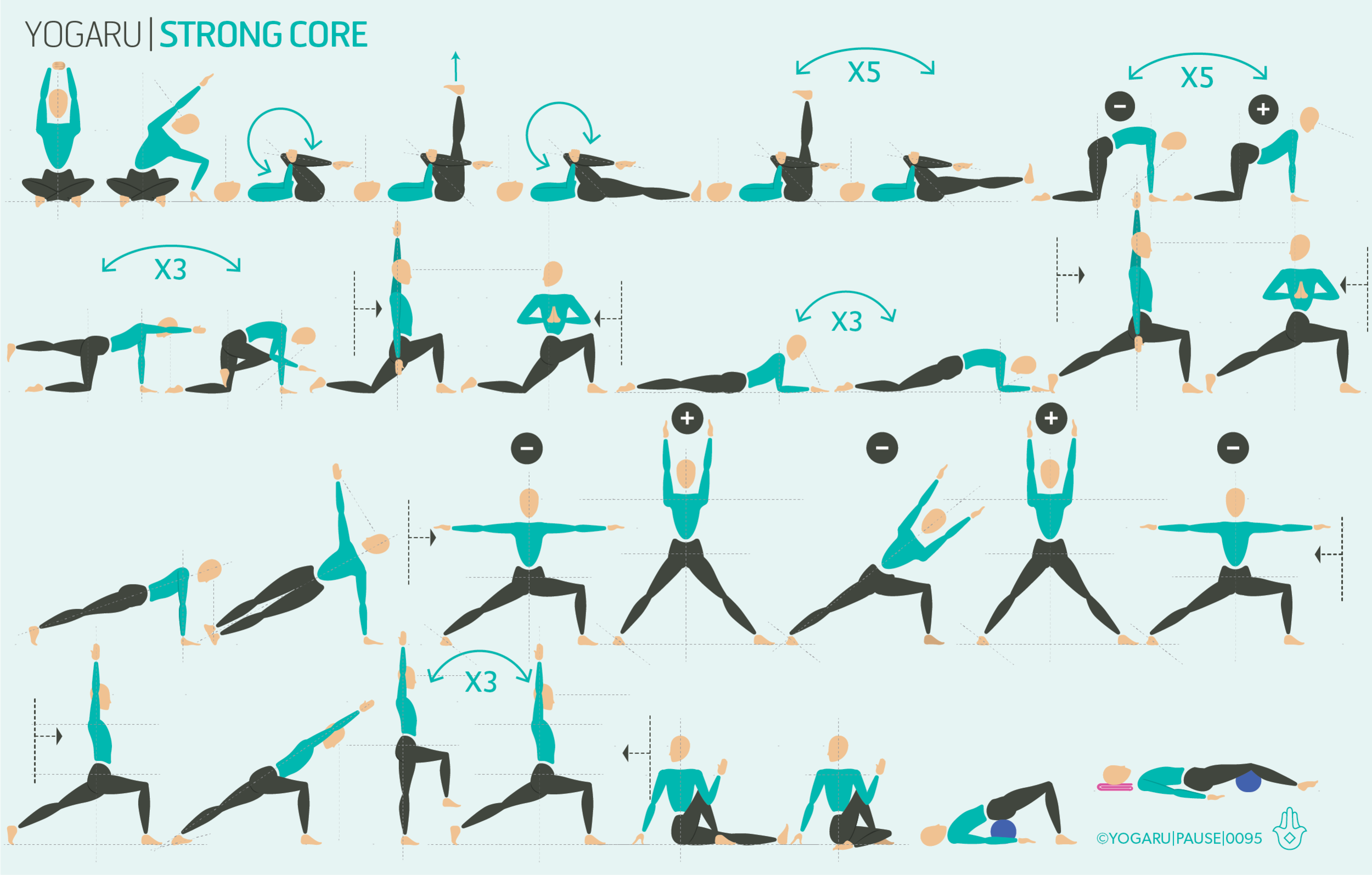
Strong core

PAUSE_0095.png

THE CORE OF THE ISSUE
Situated in the centre of our being is the core – ‘the most essential part of anything’. This fundamental part of the body supports the spine, facilitates movement, and contains the organs of the abdomen. It’s main role is to hold us upright against gravity, with only one bone structure to help it to do this important job – the spine – but for very good reasons. It’s multilayered muscle mass facilitates forward, backwards and side mobility. If we had more bone structure built into our core we would not be as fluid in our movements and move more like robots.

When combined with the spine the core gives us our unique upright posture. When the core is weak it can’t hold the upper body upright against gravity the spine suffers leading to back problems. Many people come to the practice of yoga as recommended by their doctor to build up their core strength to support the spine. This sequence will help to find the strength of your core by challenging strengthening poses and stability movements.

UNDERSTANDING THE CORE
The deepest layer, the transversus abdominis, is the containment sheath that wrap around the core like a corset to support the organs and assist in maintaining good posture. Next are the internal and external obliques which cross hatch diagonally along the side body and are responsible for lateral side bends and twists. The most external, and the one that gets the most attention, are the rectus abdominis, running from the pubis to the bottom of the sternum , which flex the spine and stabilise the pelvis. Finally the core is not just the front body, it also includes the quadratus lumborum and the erectors of the spine, which do the opposite of the rectus abdominis and extend the spine into backbends.

EXPLORING THE CORE IN YOUR PRACTICE
The challenge with core work is to maintain a soft expansive breath while you still draw the navel towards the spine. When you are moving into a pose that is directly working the core take a deep inhale first then exhale into the pose to activate all the supporting muscles of the the full 360 core.

ALIGNMENT CUES
This sequence works the core strengthening. The peak pose is Ashva Sanchalanasana/Galloping Horse. This is a strengthening and challenging pose for the core and back. If you find there is too much pressure on your lower back tilt a little less forward to the point where your core can ‘have your back’

Print out the below tips, along with the sequence, and start to build a connection with your strong core:

  • From Virabhadrasana I or Ashta Chandrasana arms reaching high, inhale, lengthen the spine, exhale, hinge forward from the hip joint over your front leg.

  • Arms in line with ears, lengthen up through your spine to the tip of your crown.

  • Press out through your left heel to firm your back leg, hug your outer hips to the midline

  • Draw your navel towards your spine to protect and strengthen your back, gaze down.

To save the images for personal use click and hold down the image until the ‘save image’ option appears; on Mac hold down ‘control’ and click the image to get the option box; on PC right click on the image to get the option box. Scroll down in the ‘option box’ and click ‘save image’.

Ruth Delahunty Yogaru

Psoas release

PAUSE_0094.png

THE PSOAS UNCOVERED
Deep in the central hub of our body lies the psoas muscle. Unique in the fact that it is the only muscle that connects upper and lower body. It starts at the lower spine (T12), travels through the pelvic bowl, connects to the thigh bone (femur) and is part of the body of muscle known as the ‘hip flexors’. Both a tight or weak psoas can cause instability in the hips and lead to lower back pain – a tight psoas tilts the pelvis forward and cause an overarch in the lower back, while a weak psoas causes the pelvis to tilt backwards and reduces the natural supportive curve of the lower back. When the psoas is flexed it lifts the thigh towards the spine in standing poses, and the spine towards the thigh in seated poses. The glutes at the back of the hips contract when the psoas is lengthened – causing the back body to strengthen and the front body to stretch. The psoas becomes tight and shortened through prolonged periods of sitting or activities where it is repeatedly flexed like cycling or large amounts of core work. Running can either help maintain or cause problems with the psoas. When running, as you kick the leg forward you are contracting and strengthening the psoas, and when the other leg is extended back it is lengthening and stretching the psoas. For this reason it is important to consciously maintain a nice wide stride when running to catch both actions and avoid a chronically tight hip flexors.

THE PSOAS AND THE NERVOUS SYSTEM
This muscle is not only a functional muscle that connects upper and lower body and facilitates movement, it is also linked to the ‘fight or flight’ nervous system response. When we feel under threat the parasympathetic nervous system is triggered, releasing the hormone cortisol which causes a series of responses in the body as it become ready for action. One of the muscles involved in this automated response is the psoas muscle. It contract ready to fight it’s ground or take flight. Chronically tight psoas caused by prolonged sitting continuously triggers the stress hormone cortisol. When there is no action required the cortisol stays in the system leaving you feeling a constant low grade state of anxiety and exhaustion. Lengthening out the psoas through gentle yoga poses will break this cycle and help to relieve this built up physical and mental tension.

EXPLORING THE PSOAS IN YOUR PRACTICE
In our practice we look for strength in the connective tissue of the psoas first by contracting it then lengthen it out through gentle lunges and backbends. Spend a bit of time at the start of the sequence to feel for where this deep set muscle lies and see can you get a sense of it contracting as it draws the leg towards the spine and relaxing as it stretches the leg away from the spine and extends the hip joint.

ALIGNMENT CUES
Approach your lunge with fresh eyes. Instead of dropping the hips as far forward as you can stay more upright with the hips stacked over the grounded knee. Press into the front foot, and lift your pointy hip bones up. Roll the inner thigh back and lift the back of the thigh up. The peak poses for this sequence are Anjaneyasana/Low Lunge and Ashta Chandrasana/Eight Crescent Moon. You will come in variations on these two poses several times. Use the alignments cues below for Ashta Chandrasana/Eight Crescent Moon to get the most out of these poses.

  • From Adho Mukha Svanasana, inhale, step your right foot between your hands, exhale here.

  • Inhale, press into your feet to come up, reach your arms up high, shoulder width apart or palms together. Stack your front knee over your front ankle.

  • Press out through your left heel, lift the thigh and firm your back leg, hug your outer hips to the midline. Pointy hip bones lifted.

  • Draw your navel towards your spine, broaden through your collarbones, lengthen through your spine to the tip of your crown, gaze forward or to your fingertips.

To save the images for personal use click and hold down the image until the ‘save image’ option appears; on Mac hold down ‘control’ and click the image to get the option box; on PC right click on the image to get the option box. Scroll down in the ‘option box’ and click ‘save image’.

Ruth Delahunty Yogaru