
Sequences

Waves of movement

GOOD BREATH
The breath is the where the magic is found in yoga. It deeply affects our physical and mental state. Conscious breathing triggers the parasympathetic nervous system through the cerebral cortex (rest & restore), increases lung capacity, builds circulation, aids digestion, release emotional and physical tension, and increase overall well-being. When we link the breath with the movement in our practice it slows the breath down – bringing more oxygen to our whole system and establishes a deep and constant breath.

COME BACK TO THE BREATH
Bringing our attention consciously to the breath in our practice is a challenge that continues as long as the practice itself. To the onlooker, a yogi flowing through their sequence may seem very relaxed and calm, but there is much unfolding on the mat. The complexity of alignment in each asana, the controlled and safe transitions, maintaining a meditative state of mind, and most importantly, remembering to breath! It’s no surprise that you might find yourself holding your breath while you are concentration on your flow, or during a challenging asana. Simply remembering to come back to the breath during your practice, and checking in with how you are breathing, will help to build your concentration, and face those challenging asana.

THE WAVE OF THE BREATH
The breath moves through us like a wave. On an inhale the belly and ribs expand as the diaphragm contracts down, and on an exhale the belly and ribs contract as the diaphragm expands up.

Before you try the sequence above, lie on your back with your knees bent and your feet on the floor. Place your hands on you belly and take a few comfortable breaths – following the ebb and flow of the air. When you are going through the asana let your breath initiate each transition. Keep returning to the breath during your practice If you find you are loosing the connection between the breath with the movement, go back to the simple warm up flow sequences and keep your practice simple. As you pause in each asana, use the breath to melt aways any tension you might encounter. For more information on using the breath to pause click on this link.

To save the images for personal use click and hold down the image until the ‘save image’ option appears; on Mac hold down ‘control’ and click the image to get the option box; on PC right click on the image to get the option box. Scroll down in the ‘option box’ and click ‘save image’.

Ruth Delahunty Yogaru
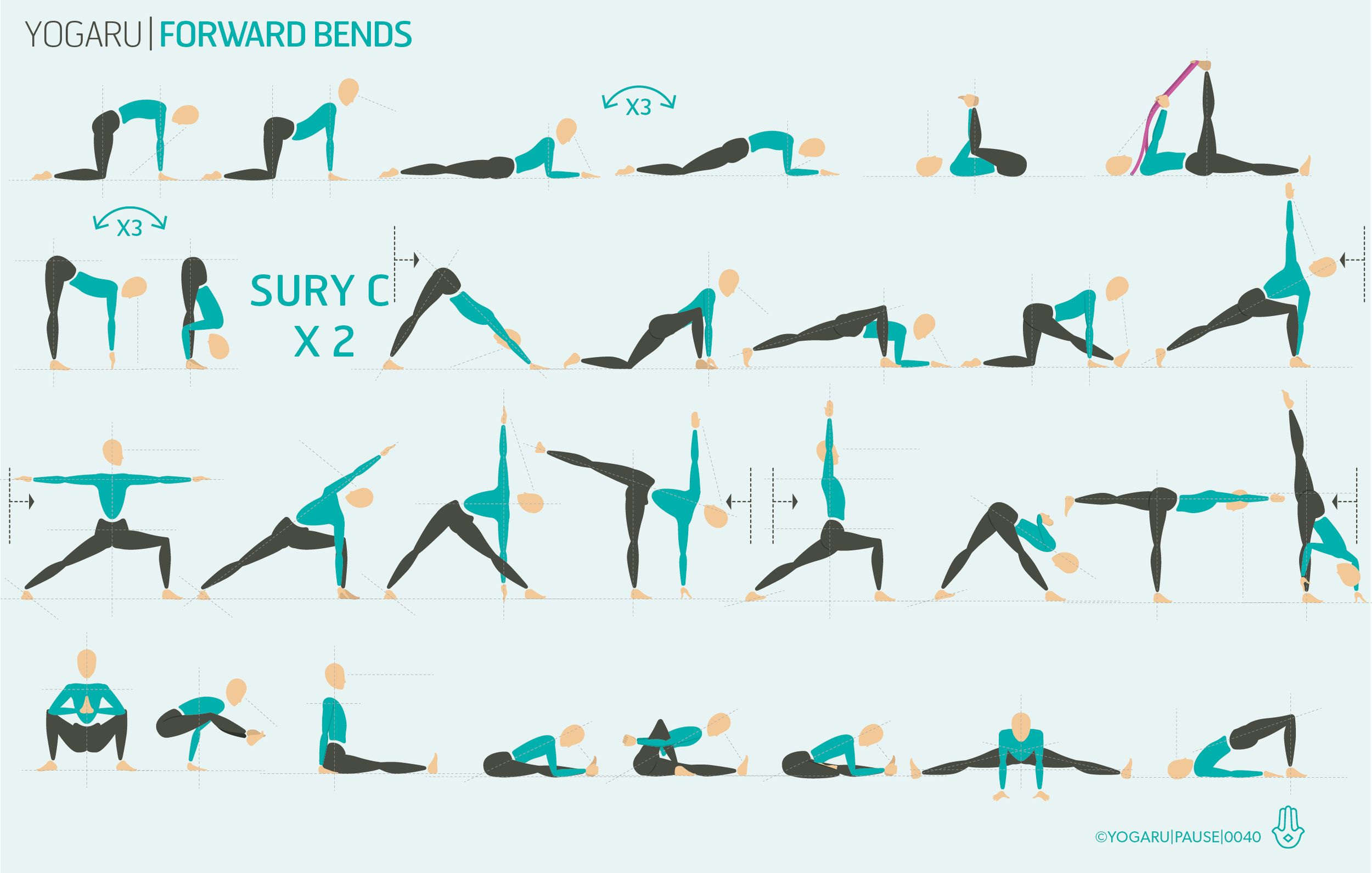
Forward bends

THE BACK BODY
The final axial plane in our spinal sequences is the humble, yet challenging, forward bends. Forward bends stretch the entire back body – starting at the soles of the feet, traveling up the achilles tendon, the calves, hamstrings, glutes, outer hips, inner groins, lower back and upper back. We often presume limitations in our forward bend come from tightness in the hamstrings, but when there is tension in any of these areas in the back body, it can hinder your ability to release forward. Forward bends take a lot of patience, time and kindness. The large muscle group running the length of the back of the thighs, including the hamstrings, like plenty of gentle encouragement and warming up before they release.

FORWARD BENDS AND THE PELVIS
In its essence, a forward bend is the forward rotation of the head of the two femur thigh bone in the two socket of the hip. To help initiate the movement from the hip joint in your forward bends, try a few standing and seated asana with your hands on your two pointy hip bones, and notice the forward movement or anterior tilt of the pelvis as you fold.

BENEFITS OF FORWARD BENDS
Our natural position of protection and self soothing is fetal position. In fetal position you’ll notice all the joints are flexed – the feet, knees, hips, back and arms. Forward bends flex the hips and spine. They are very calming and relaxing – easing anxiety, stress, tension and depression – helping us to move from the sympathetic nervous system of flight, flight and freeze, to the parasympathetic nervous system of rest and restore.

Spend some time in your warm ups paying particular attention to areas of tension in the back body. During your Surya Namaskara/Sun Salutations take a few breaths in Adho Mukha Svanasana/Downward Facing Dog, and follow the back body from the base of your feet to the tip of your crown – including the outer hips and inner groins. Supta Padangusthasana/Reclined Hand to Big Toe is a good starting point for gradually opening up the backs of the legs and the surrounding muscles. Print out the above sequence to release the whole back body. As with inversions there is lots of hidden forward bends. The ‘peak pose’ of the sequence is an arm balance which requires a deep forward bend. Click on this link to get a full list of forward bends.

To save the images for personal use click and hold down the image until the ‘save image’ option appears; on Mac hold down ‘control’ and click the image to get the option box; on PC right click on the image to get the option box. Scroll down in the ‘option box’ and click ‘save image’.

Ruth Delahunty Yogaru

Twists

TWISTS AND THE MIDLINE
The spine has a total axial rotation of 90 degrees – the neck/cervical has a range of 50 degrees, the upper back/thoracic of 35 degree and surprisingly the lower back/lumbar has only 5 degrees of rotation. For this reason, care needs to be taken with our twists, so that we don’t put excess pressure on the sacroiliac joint (where pelvis and spine meet). Our twists come from the waist and with the majority of the rotation coming from the upper back/thoracic. The spine has five different ranges of movement – forward, backwards, right side, left side and rotation. But we also have a fifth movement called axial extension. Axial extension is the movement we hope to achieve when we ‘reach through the tip of the crown’, to find as much space as we can between the vertebra, to allow the spine to rotate. When you are working with  twists, draw a line through your midline from the base of your spine to beyond the tip of your crown. When you have found this line twist your body, from the inside out, around this extended midline, like a spiral staircase. You will find you also get a better twist if you extend through your midline, and twist evenly from both sides of the midline.

BENEFITS OF TWISTS
Twists penetrate deep into the organs of the body, bringing fresh blood flow – stimulating the digestive system for maximum nutrition absorption, the liver and kidneys to remove toxins, and the lymph system which supports the immune system. They release stress and physical tension in the chest, shoulders, neck and hips. They also stretch and strengthen the muscles of the respiratory system, bringing with it the many health benefits of ‘good breath’. Try taking some deep breaths in your twists, to get the full stretch and benefits for the lungs. Click this link to get a full list of twists.

The above sequence has two peak poses – Parivrtta Trikonasana/Revolved Triangle and Parsva Bakasana/Side Crow. Before you come into your full expression of Parivrtta Trikonasana/Revolved Triangle on the right side, when you have reached forward with your spine, place your right hand on your right lower back and check if your hips are level. When you have found a level hip position, place your right thumb in your right hip crease to ensure the hips stay in place, as you slowly reach your left arm to a brick or the ground to the right side of your right foot. In Parsva Bakasana/Side Crow draw your navel strongly in towards your spine and reach up through the crown before you take the deep twist to the right. If taking the balance is not in your practice come to the setup stage of the asana for a really deep twist. Working towards hooking your left upper arm outside your right knee.

To save the images for personal use click and hold down the image until the ‘save image’ option appears; on Mac hold down ‘control’ and click the image to get the option box; on PC right click on the image to get the option box. Scroll down in the ‘option box’ and click ‘save image’.

Ruth Delahunty Yogaru