
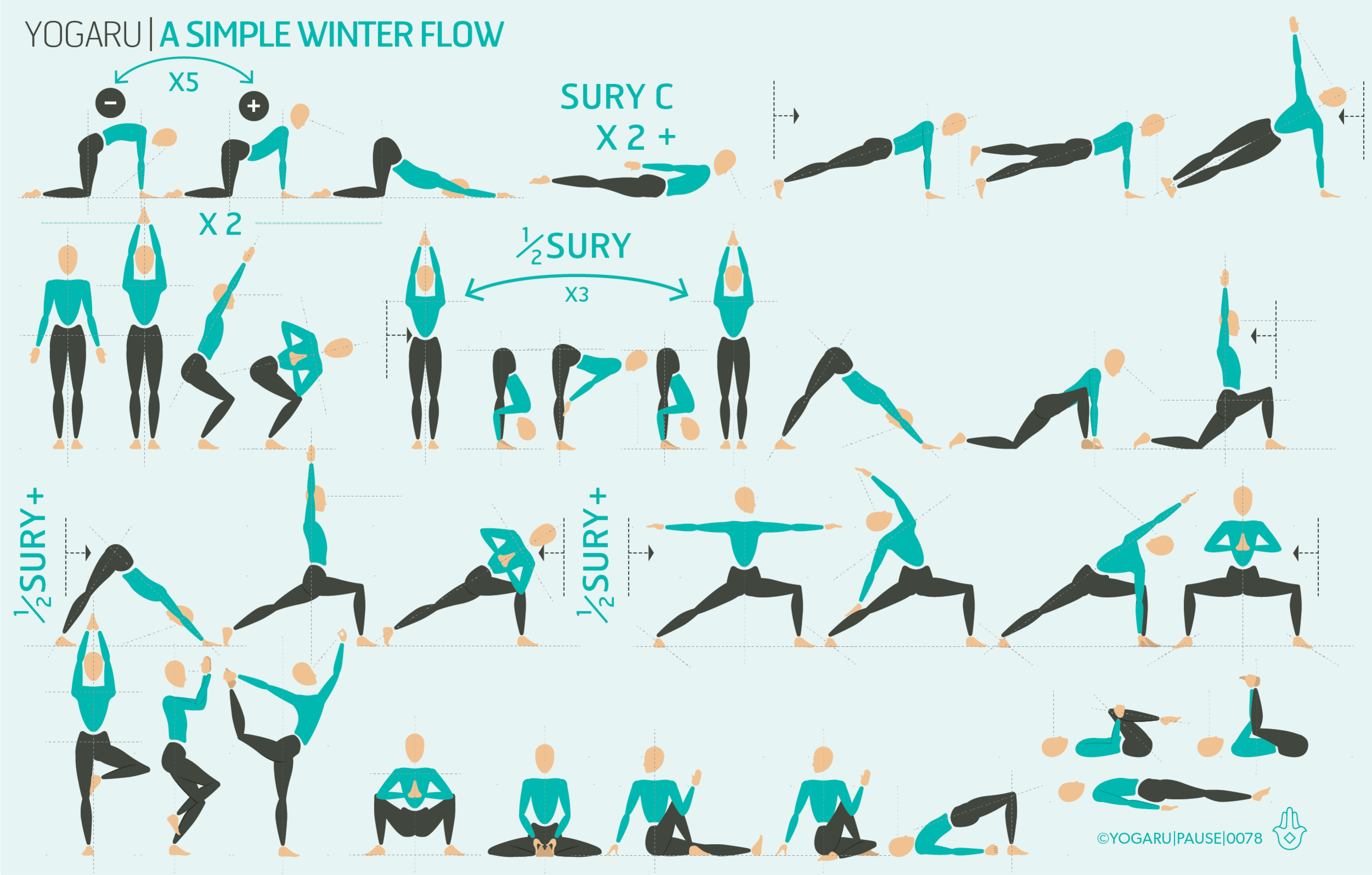
Sequences

Wintertime flow

PAUSE_0078.png

COMFORT IN FAMILIARITY
Now that we’ve officially stepped into winter I find I’m looking for a slow and steady practice, full of familiarity, comfort, a nice bit of heat generation, and poses I know will nourish me. This sequence is based on a recent article I wrote for Wellfest on Mini Winter Yoga Flows – which gives you four mini flows to combat four different winter challenges. Here I have given you an option to include a bit of everything – from standing poses, twists, backbends and hip openers – all in one sequence that will help support you over the winter months.

WARMING FROM THE INSIDE OUT
The gradual change through the seasons from Summer to Winter is much harder on the system than the change from Winter to Summer. It takes a while to get used to the colder days, and to make it even harder, as the weather adjusts we often have very mild days mixed with bitterly cold days. Twists fire up your internal generator and and get your circulation going. Warming yourself from the inside out is a much healthier and sustainable form of heat than cranking up the heating. This sequence also has lots of standing poses which utilise the big muscles of the legs and quickly generate a lovely bit of extra heat too.

STAYING WELL THIS WINTER
When it comes to a strong immune system prevention is better than cure. The gut produces 80% of the immune system. Backbends and twists stimulate the lining of the gut to help boost and maintain a strong immune system, and keep you fighting off those winter bugs. This is not the time of year for embarking on extended intermitted fasting! You need all the warming winter earthy foods and spices to help fuel every cells of the body, and keep you thriving over the winter months.

WINTER BLUES
You might find you are more inclined to feel more emotional and stressed at this time of year. It may be a consequence of work pressure, family commitments or just the lack of daylight. Symptoms of stress crop up in many different way – you might feel tension in the hips or shoulders, a busyness of the mind, a lack of focus or a general lethargy and tiredness. We hold physical and emotional tension in our hips. When we are stressed the muscles of the hips tense ready for fight or flight. This causes the body to hold physical tension as a result of the emotional tension. When you release the physical tension through hip openers you release the emotional tension too.

EXPLORING YOUR WINTER FLOW IN YOUR PRACTICE
As you run through this sequence keep it slow and steady to help get the wellness benefits from the poses, soothe a busy mind and regulate your energy levels. The Surya Namaskaras are the adaptogens of the yoga world. When you need calming they calm you, when you need energy they energise you! Yoga can be your most supportive method of self care. Your time on your mat can be the answers to all that ails you over the coming months.

ALIGNMENT CUES
Print out the tips below, along with the sequence, and stay happy and healthy this winter:

  • Start by deeping and slowing down your breath with your five rounds of cat/cow.

  • For your two Sun Salutation Cs take Salabasana/Locust instead of cobra to strengthen the muscles of the back and stimulate the gut and immune system.

  • Pause in Parivrtta Utkatasana/Revolved Chair for at least five deep breaths to warm up the system, stimulate the gut and strengthen the lungs.

  • In your three standing balance poses press strongly into your standing leg and firm the muscles of the buttocks to find a strong foundation.

  • Allow yourself a restful Savasana/Corpse pose and absorb the benefits of your time invested in your wellness.

To save the images for personal use click and hold down the image until the ‘save image’ option appears; on Mac hold down ‘control’ and click the image to get the option box; on PC right click on the image to get the option box. Scroll down in the ‘option box’ and click ‘save image’.

Ruth Delahunty Yogaru
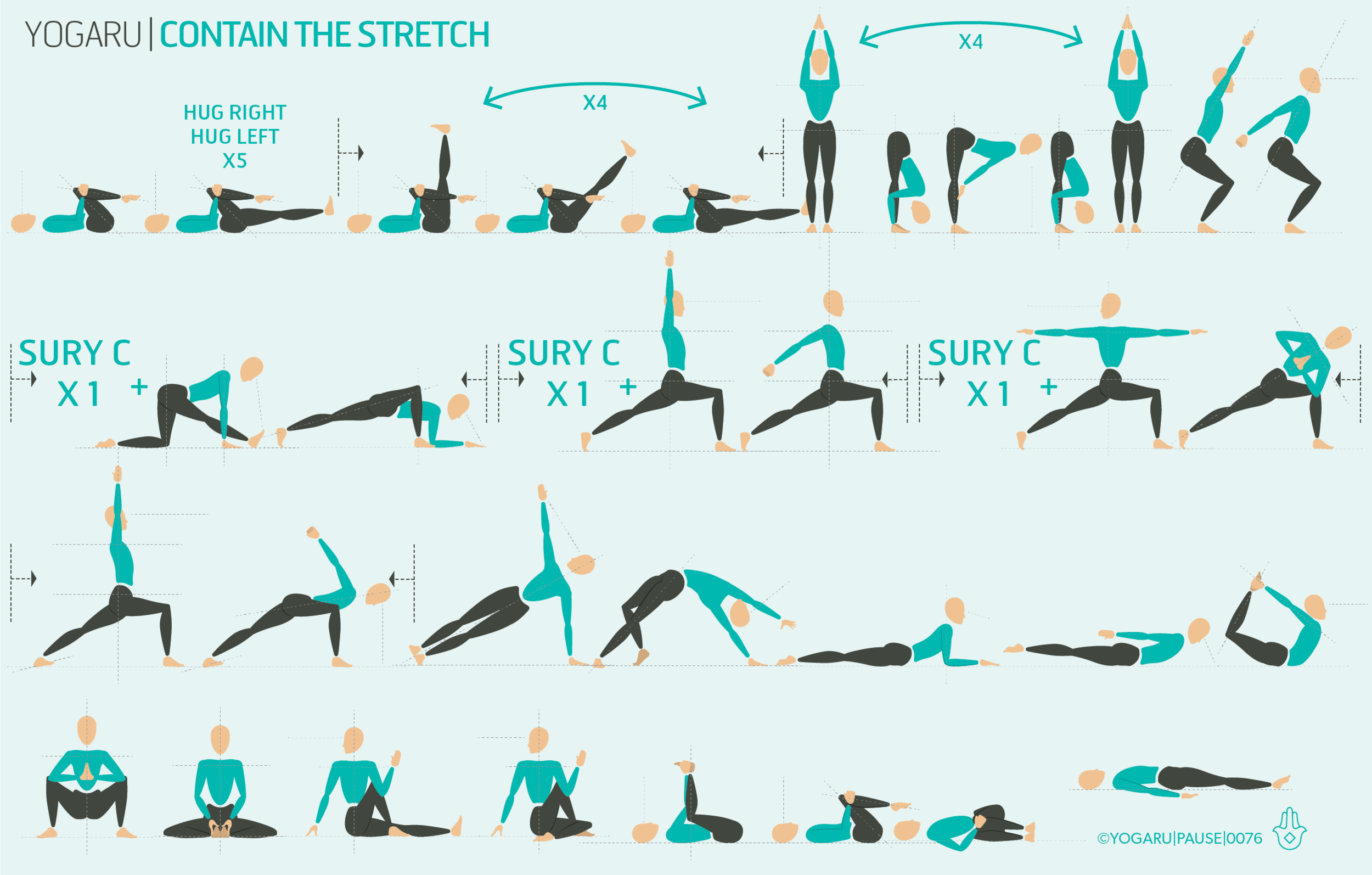
Contain the stretch

PAUSE_0076.png

THE ELEPHANT IN THE ROOM
I’m beginning to feel there is a big yoga elephant in the room who has hip issues! There is no disputing the many benefits of yoga, but like every activity or sport – regardless of whether they are strengthening or stretching actions, care needs to be taken with repetitive ranges of movements. Almost every yoga pose includes an element of hip activity. Without noticing it, your practice could very well be tilting more towards hip stretching than hip strengthening, which can leave you with some overstretch tenderness in the hip joint.

Recently I’m noticing my hips are quite loudly telling me to rethink how I approach my practice. This has led me to more consciously evaluate the balance of stretching v’s strengthening in my time on the mat. In last weeks post I talked about including equal amounts of mobility and strength work for a balanced, strong and flexible body. In this weeks sequence I’m looking at ways to incorporate this principle in Ashta Chandrasana/High Lunge. Yoga is not all about stretching, it’s about looking for the strength in each pose too – protecting the connective tissues and contain the stretch. You’ll sometimes hear phrases like ‘find your edge’. Playing with your edge is a dangerous game in my opinion, yoga is not about tipping over the edge! In my practice I am retraining myself to work on back off by about 10% of my end range of motion and find that sweet spot at 90%.

EXPLORING ASHTA CHANDRASANA IN YOUR PRACTICE
Using Ashta Chandrasana/High Lunge as an example, the temptation is to release the muscles that support the hip joint, and let the weight of the upper body sink the hips down as low as they can go, till you hit your end range of motion. In this position you have lost the support of the muscles in the hip joints and are more likely to overstretch any number of muscles. A more supportive version of the pose it to come to your 90% range of motion, firm the buttocks muscles of your back leg and hug your outer hips to the midline. Press your feet into the ground and draw your hip bone back in into their sockets like you have magnets in your hip. Feel strength in the muscles that are flexing and a contained supported stretch in the muscles that are extending. Get familiar with how this feels and how this principle might feel in all your poses for a more sustainable lifelong practice.

ALIGNMENT CUES
This sequence gives you plenty of opportunities to find your strong connective hip tissue in Ashta Chandrasana/High Lunge. Route your standing flow sequences through rounds of Sury Namaskara C, replacing the low lunges for the poses indicated in the sequence above. For the first Ashta Chandrasana/High Lunge see how it feels to bend the back knee slightly and allow the hip bones to lift up towards your bottom rib. In subsequent Ashta Chandrasana/High Lunge move towards straightening out the back leg, and pressing out through the heel, if the hip flexors feel warmed up. The feet are a crucial part of the pose for finding your strength. Use your feet and press into them strongly. This will trigger strength and stability up your legs and into the hip joints. Maintain this contained stretch throughout all versions of the pose in the sequence.

Print out the tips below, along with the sequence, and find a sturdy and stable Ashta Chandrasana/High Lunge:

  • From Adho Mukha Svanasana, inhale, step your right foot between your hands, exhale here.

  • Inhale, press into your feet to come up, reach your arms up high, shoulder width apart or palms together. Stack your front knee over your front ankle.

  • Press out through your left heel, firm your back leg, lift the thigh of your back leg up, hug your outer hips to the midline.

  • Press into your feet and push the floor away, firm your left buttocks.

  • Lift your point hip bones up to stack your pelvis perpendicular to the ground.

  • Draw your navel towards your spine, broaden through your collarbones, lengthen through your spine to the tip of your crown, gaze forward or to your fingertips.

To save the images for personal use click and hold down the image until the ‘save image’ option appears; on Mac hold down ‘control’ and click the image to get the option box; on PC right click on the image to get the option box. Scroll down in the ‘option box’ and click ‘save image’.

Ruth Delahunty Yogaru

Inner strength

PAUSE_0075.png

OUTER STRENGTH
After a busy September I’m focusing on finding my inner strength for the month of October. I’ve noticed I’ve been ignoring a few snags and tight spots in my hips, so I’m consciously working on staying out these areas and finding ways to strengthen them in my practice. The body is in perpetual healing till the day you die. Even though you may not be able to see it, it’s constantly busy mending, repairing and removing the natural byproducts of the metabolic actions in the body and external environmental toxins.

There is a common misconception in yoga and the fitness industry that flexibility means weak muscles, and inflexibility means strong muscles. Both principles crossover – you can maintain flexible, strong muscles by including equal amounts of mobility and strength work, and you can also have tight, weak muscles too which is what I’m currently working on in my right glute and sacroiliac joint.

To access your inner strength you must find your outer strength first. You’ll notice after a yoga class that has lots of standing poses, you leave your class feeling stronger, taller, and more confident. In yoga what we practice in the physical body trigger the same response in the emotional body. Outer strength naturally leads to inner strength.

FINDING STRENGTH IN YOUR PRACTICE
The muscles of the legs are the biggest muscles of the body. This sequence has lots of standing poses to get straight into these muscles. The core muscles wrap around to contain the organs of the body, support the spine and are the important structure that connect upper and lower body. Igniting these muscles will help you feel stronger and move more confidently with the 360 column you have created. Arm balances like plank and Bakasana/Crow build heat and require core activation to lift the hips into the required position.

ALIGNMENT CUES
Through this sequence look for the heat and strength in the big muscles of the body. Enjoy finding your inner strength and know that you are much stronger than you think you are:

  • Take your time with the first section of the sequence and work on keeping the back of the pelvis pressed into the ground, and the hips stable, while you warm up the core area.

  • From Adho Mukha Svanasana/Downward Facing Dog to Phlakasana/Plank Pose leg curls, move slowly and use your whole core to control the movement. Lift you pelvic floor to give the core a base to work from.

  • In Utkatasana/Chair stay here for at least five breaths before you move on to the Parivrtta Utkatasana/Revolved Chair.

  • Take Balasana/Child’s Pose after the plank sequence to rest your core.

  • When you are in Anjaneyasana/Low Lunge push the floor away with your feet, lift your ribs and hip bones up, and strongly squeeze the glute of the front leg. Keep this connection as you move into the variations.

  • When you’re in half boat play around with hands forward first then both hands to the right of your right leg followed by the both to left to get your muscles ready for Bakasana/Crow and Parsva Bakasana/Side Crow.

  • In Setu Bandha Sarvangasana/Bridge bend your elbows and place your fingertips on your hip bones to get feedback on where you hips are. Try to keep the hips perfectly level in both of these poses.

To save the images for personal use click and hold down the image until the ‘save image’ option appears; on Mac hold down ‘control’ and click the image to get the option box; on PC right click on the image to get the option box. Scroll down in the ‘option box’ and click ‘save image’.

Ruth Delahunty Yogaru