
Sequences

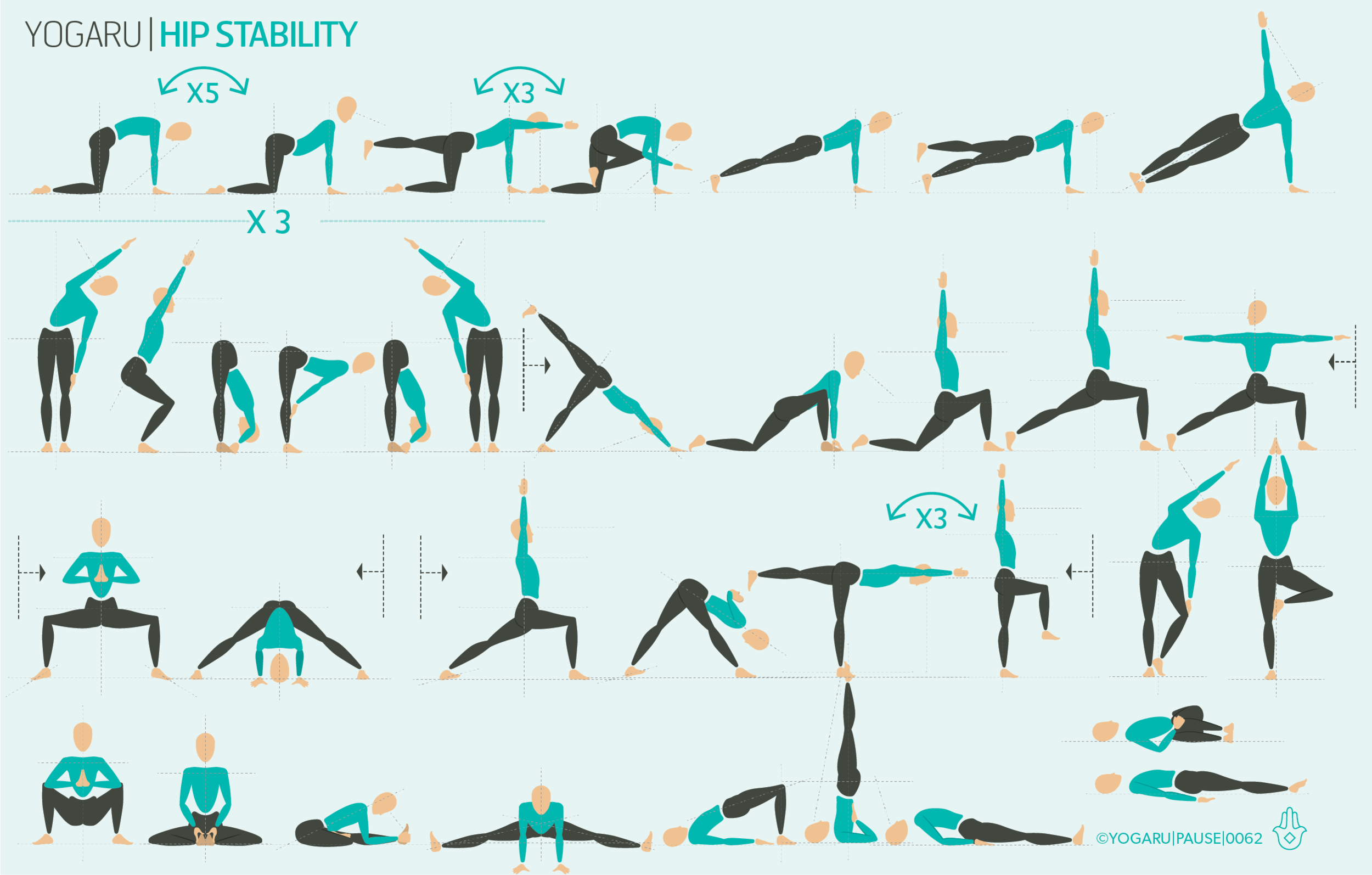
Hip stability flow

PAUSE_0062.png

YOUR POSE IS THE PERFECT POSE
What would a yoga class look like if we were to actually listen to what was right for our own unique bodies – rather than what we were told to do, or striving for what the person on the mat beside us was doing. The discipline of yoga, as with all movement, if not practiced with self care and awareness can lead to injuries. Your teacher is there to guide you and facilitate the movement, you are there to ultimately decide what feels right for you. There is many reasons why your body may never reach the perceived ‘perfect pose’ – from shortened muscles and ligament restrictions, to your unique skeletal structure. During our practice we are constantly getting feedback from our bodies – what feels good and what doesn’t. It’s up to us to listen! The deeper I go into my own practice, the more I pull back from being attached to perfection. Instead I look for a balance between mobility and stability by moving slowly and being guided by felt sensations and pulling back to a softer version of the pose when needed.

MOBILITY & STABILITY
With this in mind, following on from 360 Hip Openers, I have started to explore hip stability. As with everything in life, there has to be a balanced approach to both stretching and strengthening to avoid injuries further down the line. Hip openers have many benefits to counteract our sedentary lives, but hip stability is just as important to incorporate into your practice too. Supporting one with the other will help you to stay within your safe boundaries and give you the mobility of stretching with the stability of strengthening. There is a misconception of yoga that it is purely stretching, but it gives you both stretching and strengthening – using our own body weight, and pressing into our foundation to trigger strong muscle activity.

EXPLORING HIP STABILITY IN YOUR PRACTICE
The pelvis is the foundation of the body and encompasses the base of our spine (1st Chakra), our reproductive organs, our digestive system, and enables all movement. The pointy hip bones (iliac crest) at the front of our hips can tell us a lot about our alignment. As you work through this sequence place your fingertips on the hip bones at the front of your pelvis, or have a glance down at your hips, and looking for level hip bones. When you find your hip bones, hug your outer hips to the midline to activate your strong stabilising hip muscles of the glutes. This will help with your alignment in many poses - such as Phalakasana/Plank Pose, Virabhadrasana III/Warrior III and Setu Bandha Sarvangasana/Bridge. When the hips are not level it has implications on the whole body and brings the spine into a lateral bend or a twist to compensate. If you find this is the case for you, come back out of the pose and move into it slower – squeezing your outer hips muscles to the midline – and staying at the point just before the hips move out of alignment. For example in Virabhadrasana III/Warrior III - lift your left leg, pressing out through the heel, with your hands on your hip bones. If you feel the left hip hiking up pull back a little, and work on strengthening your version of the pose at this point. Your leg may not be perfectly parallel to the floor but your hips are learning all about stability and your supporting hip muscles are firing appropriately rather than being bypassed. This way you are being guided by your body rather than what you are being asked to do or what you see other people doing.

ALIGNMENT CUES
The peak pose of this sequence is Parivrtta Ardha Chamdrasana/Revolved Half Moon. Read through these alignment cues to help you find your optimum alignment for your unique body.

  • From Virabhadrasana III, inhale, lengthen up through your spine. Exhale, twist to your right from the waist, reach your left hand to the big toe side of your right foot, a foot forward, on a brick, or the ground. Keeping your left leg parallel to the ground, toes facing down, press out through the heel, roll the inner thigh of your left leg up.

  • Reach your right arm up high, palm facing right, stack your shoulders. Bottom waist rolls forward, top waist rolls back, lengthen from the heel of your lifted leg to the tip of your crown, gaze forward or to your right fingertips.

Print out the above sequence and practice with the intention of searching for a connection with your body rather than searching for perfection. Embrace what you can and can’t do as part of what makes you uniquely you. As you flow through this sequence remember our intention of stability and listening to feedback. When you find you’ve lost your connection move slower and isolate a single area (the hips points) to help you find that feedback again.

To save the images for personal use click and hold down the image until the ‘save image’ option appears; on Mac hold down ‘control’ and click the image to get the option box; on PC right click on the image to get the option box. Scroll down in the ‘option box’ and click ‘save image’.

Ruth Delahunty Yogaru

A simple morning flow

PAUSE_0061.png

EARLY MORNINGS
Finally we’re starting to leave behind the colder months and see the Spring making a brave appearance with the brighter mornings. I’ve always been a morning person – I love catching a glimpse of the silent sleeping world, with the anticipation of the start of a new day. It’s definitely my favourite time of day to get on my mat and instill a bit of calm. Getting on your mat in the morning is about taking time for self care, and realigning yourself physically and mentally for the day ahead. There is a misconception that if you’re not practicing for at least an hour you’re not ‘doing it properly’. You will still get lots of benefits from a simple 10 to 15 minutes flow of some of your favourite yoga poses. You’ll find that as you get into the routine, you’ll start to naturally wake up a little bit earlier and be ready for your practice.

THERE IS BEAUTY IN SIMPLICITY
Most mornings I like to keep my practice simple, and take a few extra breaths in each pose to scan through the sensations that arise. After years of not listening I’m finally more patient with my muscles, especially my hamstrings, and give them plenty of gentle encouraging to open up. I find when I have stretched and strengthened in the morning, and have oiled up the synovial fluid in all my joints, I can sit more comfortably throughout the day with more awareness of posture, and the importance of taking breaks from sitting.

FEEL THE BENEFITS
Morning yoga stimulates the gut – waking up good digestion for the day and builds a strong immune system. A healthy happy digestive system nurtures an Ayurvedic principle of ‘ojas’ – which means vitality or glow, and is considered to be the essence of health that supports wellness. Breath awareness in yoga triggers the ‘rest, restore and digest’ nervous system. When this conscious breath is practiced as part of your daily routine it rewires your brain to naturally reach for this calmer reaction rather than a ‘flight or flight’ response. Of course there is always exceptions where a bit of fight or flight is needed, but with awareness your responses are more informed and less reactive.

EXPLORING SIMPLICITY IN YOUR PRACTICE
This sequence has a bit of everything that will get your day off to a great start. Move slowly through the sequence and pause to take extra breaths when you encounter tightness. You can tailor the length of your flow by picking just one of the three main standing flows, skipping the extra vinyasas which link the flows, or reducing the amount of repetitions on some of the poses. In order to feel the cumulative benefits of this sequence, and get a sense of serenity in familiarity, practice this same sequence for 2-3 weeks. If practicing everyday is daunting for you, start with aiming for a 2-3 days a week, for 10-15 mins, and let it naturally build it up from there.

ALIGNMENT CUES
The peak pose for this sequence is Virabhadrasana II/Warrior II one of the classic poses of yoga that you will likely find in most sequences. Read through these alignment cues to find your expression of Warrior II.

  • From Adho Mukha Svanasana, ground your left foot at a 45 degree angle. Inhale, step your right foot between your hands, check for front heel to back arch alignment, exhale here.

  • Inhale, press into your feet to come up, open your hips to the side of the mat, front knee bent. Left hip naturally sits forward of your right hip. Reach your arms out to shoulder height, palms facing down.

  • Stack your front knee over your front ankle, working towards your front thigh being parallel to the ground.

  • Lift your inner thighs, roll your outer left thigh down, hug your right hip in, gaze to your right fingertips.

To save the images for personal use click and hold down the image until the ‘save image’ option appears; on Mac hold down ‘control’ and click the image to get the option box; on PC right click on the image to get the option box. Scroll down in the ‘option box’ and click ‘save image’.

Ruth Delahunty Yogaru
Rooting down

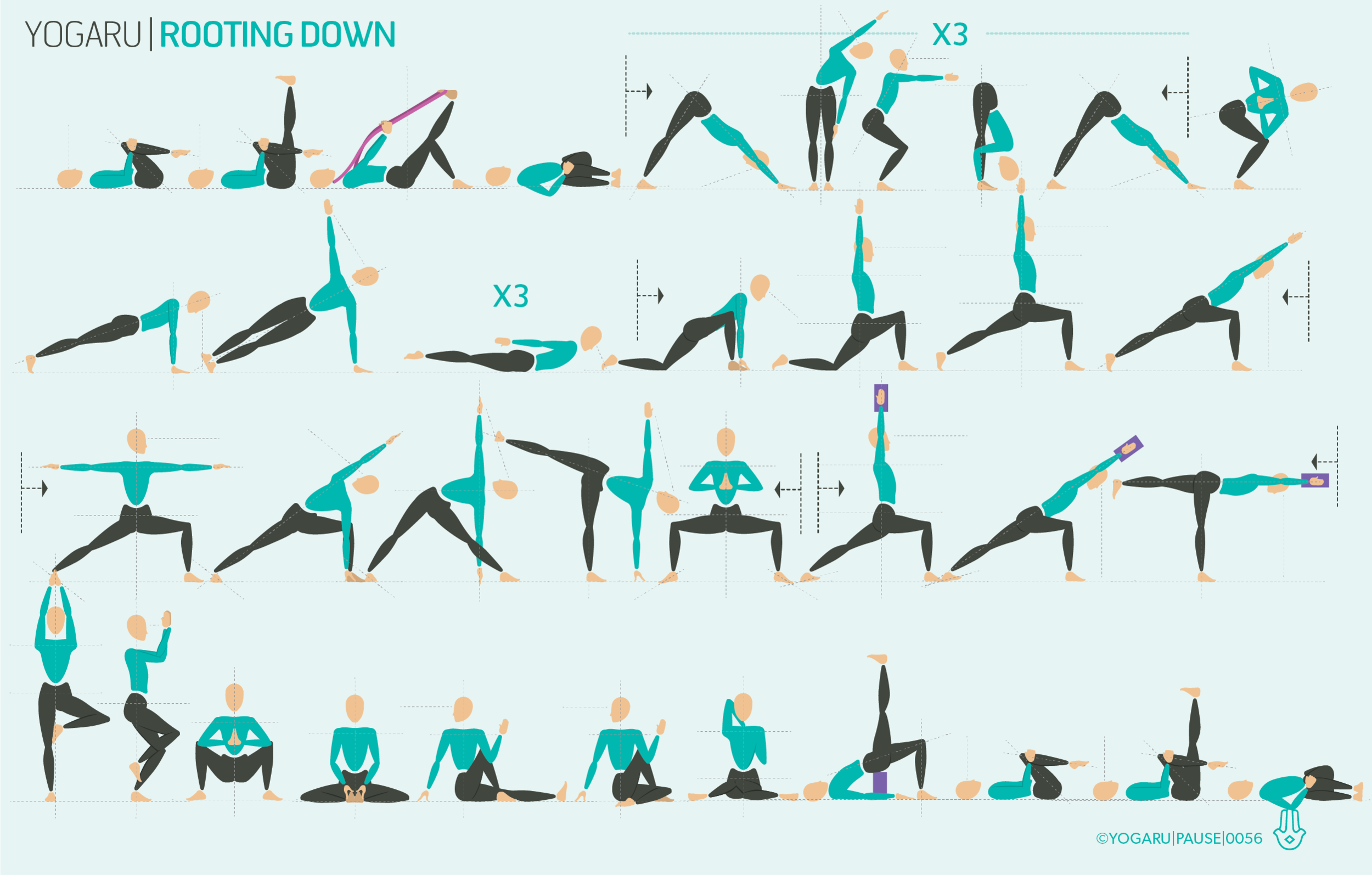
PAUSE_0056.png

GROUNDING
This week has been all about exploring the concept of rooting down and finding a solid foundation, in preparation for our next Living your Yoga workshop on Yoga for Grounding, with Aisling Conn Saturday 3rd Feb, The Yoga Room. Aisling takes the reins for the asana and my job is to prepare the take home booklet on methods for grounding through asana, pranayama, essential oils and nutrition to help you navigate life off the mat. So naturally my class plan this week reflected what I’ve been researching and sequencing into my home practice. Have a read of Con Sheehans article on Grounding Practices for an introduction to what grounding is all about.

FINDING YOUR FOUNDATION
Rooting down and having a solid foundation will help you establish a strong and stable grounding to develop your asana, and work on optimal alignment for your unique body. Bringing your attention to the points of contact with the ground connects you to the earth, and helps to quieten a busy mind, build focus, and bring us back to the body. Like a tree we plant strong and secure roots to grow from. In our practice we train our mind to deal with situations so that off the mat we become better at recognising and dealing with them. Laying a track for the mind to navigate smoothly these are called positive samskaras. We learn how to find our grounding on the mat so that off the mat we might naturally find our way back to this secure, supported and balanced state.

STANDING POSES
Standing poses are very grounding. They build focus and concentration, increases circulation, and improve coordination and proprioception. To explore the concept of grounding in your practice start by standing in Tadasana/Mountain and bring your awareness to the point of contact with the ground. Press into the big toe mound, the little toe mound and the centre of the back of your heel. When you do this you’ll notice your three arches of your feet and your inner ankle lifting.This action is called Pada Bandha (foot energy lock) and brings energy up your legs and wakes up the entire body. When you encounter a pose that challenges your balance imagine roots growing from the soles of your feet, weaving around, hooking into the soil and supporting you. Feel the weight of the body bound into this support and a rebound of energy coming back up from the ground. For more on the anatomy of the foot and how to work with Pada Bandha have a read of Anatomy 101 find your feet.

EXPLORING ROOTING DOWN IN YOUR PRACTICE
As you run through the above sequence keep coming back to your points of contact with the ground. Name what is in contact with the ground to yourself, to help direct your attention there. Start the practice by stretching out the soles of the feet and backs of the heel with a version of Supta Padangustasana/Reclined Hand to Big Toe. Using a yoga strap or a belt around the balls of your foot, keep yours knees inline with each other and concentrate on pressing your heel away from you and your toes towards you. In Ashva Sanchalanasana/Galloping Horse remember we are working with grounding so avoid leaning too far forward and losing contact with the back foot. In Virabhadrasana III/Warrior III bring the focus of the pose to the standing leg. You might notice your lifted leg become stronger and lighter when you find the strength and stability of the standing leg.

ALIGNMENT CUES
The peak pose for this sequence is Virabhadrasana III/Warrior III. Read through these alignment cues to find your Warrior III.

  • From Virabhadrasana I, place your hands on your hips, inhale, lean forward and step your left leg forward a little.

  • Exhale, hinge forward from the hip joint, lift your left leg parallel to the ground behind you, hips level to the ground. Roll the inner thigh of your left leg up, flex your foot and press out through the heel.

  • Reach your arms back or reach your arms forward in line with your ears. Lengthen through your spine and the sides of the body, gaze to the ground or to your fingertips if your arms are forward.

Print the above sequence and work through it slowly. Pause longer in each pose than you usually would will help to achieve deep grounding.

To learn more about grounding practices join Ruth Delahunty & Aisling Conn in The Yoga Room on 3rd February, 2pm, for meditation, asana practice, relaxation and take home material on top tips for grounding.

To save the images for personal use click and hold down the image until the ‘save image’ option appears; on Mac hold down ‘control’ and click the image to get the option box; on PC right click on the image to get the option box. Scroll down in the ‘option box’ and click ‘save image’.

Ruth Delahunty Yogaru