
Sequences

Find your favourites

PAUSE_0107.png

WHAT IS YOUR FAVOURITE POSE?
A great way to start building a home practice is to work out what your favourite poses are. They can be poses that challenge you; poses that stretch tight areas; or poses that help you focus, travel inwards and drop into your practice. They don’t need to be big statement poses, they are the ones that when you transition into them they feel you have arrived to a safe familiar place. Favourite poses are a very personal preference and magnify how amazingly different we all are physically and mentally. You might find yourself struggling, with all effort and no ease, in a pose and the yogi beside you is completely in their happy place. Next time you practice, and in the next class you go to, notice your reaction to the poses and work out which are your ‘feel good’ poses. Scan through your body from your big toe to the tip of your crown and see how it sits with every part of you. If it’s in a class take note of the poses after class and try them out in your next home practice. You’ll always pick up new versions of the pose and lots of fresh alignment cues from classes too.

EXPLORE THE BASICS
The longer I am practicing yoga the more foundational and simpler my favourite poses become. So much so that Tadasana/Mountain is definitely one of my current favourites. When I spend a bit of time in Tadasana/Mountain at the start of a practice it helps me build strength, stability and focused; and when I add it throughout my practice it resets me, ready to continue on. It is the foundational pose for all the standing poses, if you can master Tadasana/Mountain and bring it into all your standing poses it will help your practice enormously. Similarly you can apply the same principles to Dandasana/Staff, which is the foundational pose for all seated poses.

MY FAVOURITE POSES
The above sequence is a collection of my favourite poses which has become my daily practice that I dip in and out of depending on how much time I have. Below are some of the poses and the reason why they are there and why I am finding they tick all the boxes for me at the current stage of my practice.

SUPINE POSES
More often than not I start my practice on my back and circle and flex all my joints to gently warm them up. There is plenty of time for standing and stronger poses so I let myself gradually arrive and get ready for the work to be done on my mat.

CAT COW
Cat Cow is definitely one of the juiciest ways to warm up your spine and hips. They can be as gentle or stronger as you like depending on how your spine feels. You are also warming up the fascia and connective tissue of the shoulder blades which can be quite a sticky area for some people. From table top position I usually move through some leg lifts and side leg lifts (fire hydrant style!) to strengthen up the backs of my hips where I am currently rehabing an overstretch injury. To challenge my core I do the same leg lifts from Downward Dog/Adho Mukha Svanasana and Plankasana/Plank and hold each pose for 5 breaths.

CHAIR POSE
Utkatasana/Chair pose is a bit of a face grimacing pose but it is incredibly strengthening to the whole body. It helps me to find my outer hips and how to hug to the midline. In this mini flow I find my stability through Tadasana/Mountain, come up onto the balls of my feet to challenge this stability, then straight into Utkatasana/Chair press equally between the three points of my feet.

CRESCENT MOON
Ashta Chandrasana/Crescent Moon is the perfect standing poses to add in at the early stages of your standing section. It has just enough challenge without the complications of the asymmetrical, external hip opening. I will often add different arm positions and twists while I let my hip flexors and calf muscles open up.

LOCUST
Complete back strengthening, need I say more! Salabhasana/Locust counteracts all that sitting at desks and is fantastic for building a strong spine and good posture.

WARRIOR II FLOW
Virabhadrasana II/Warrior II is a pose I come back to time and time again. It features in most sequences, but sometimes this means we forget that it is jam packed with alignment up for grabs and all the amazing benefits it has. It is a strong leg strengthening standing pose with hip chest and lung opening which is very soothing to the nervous system.

WARRIOR I FLOW
Virabhadrasana I/Warrior I is actually quite a tricky pose for the hips and the back leg. Rather than get attached to the hips being squared I either use it as a directional guide not a target or just come into Warrior 1.5 where the hips are facing towards the top left corner of your mat. This half version is much kinder on the back knee joint.

SEATED
I usually treat the seated poses as a journey towards Savasana/Corpse and a way to counterpose my sequence. A seated twist will stretch out and release any tension from any spinal focused standing poses. Then I am ready to take Savasana even though some days my head is telling me to jump up and get on with your day, and I never regret it.

To save the images for personal use click and hold down the image until the ‘save image’ option appears; on Mac hold down ‘control’ and click the image to get the option box; on PC right click on the image to get the option box. Scroll down in the ‘option box’ and click ‘save image’.

Ruth Delahunty Yogaru
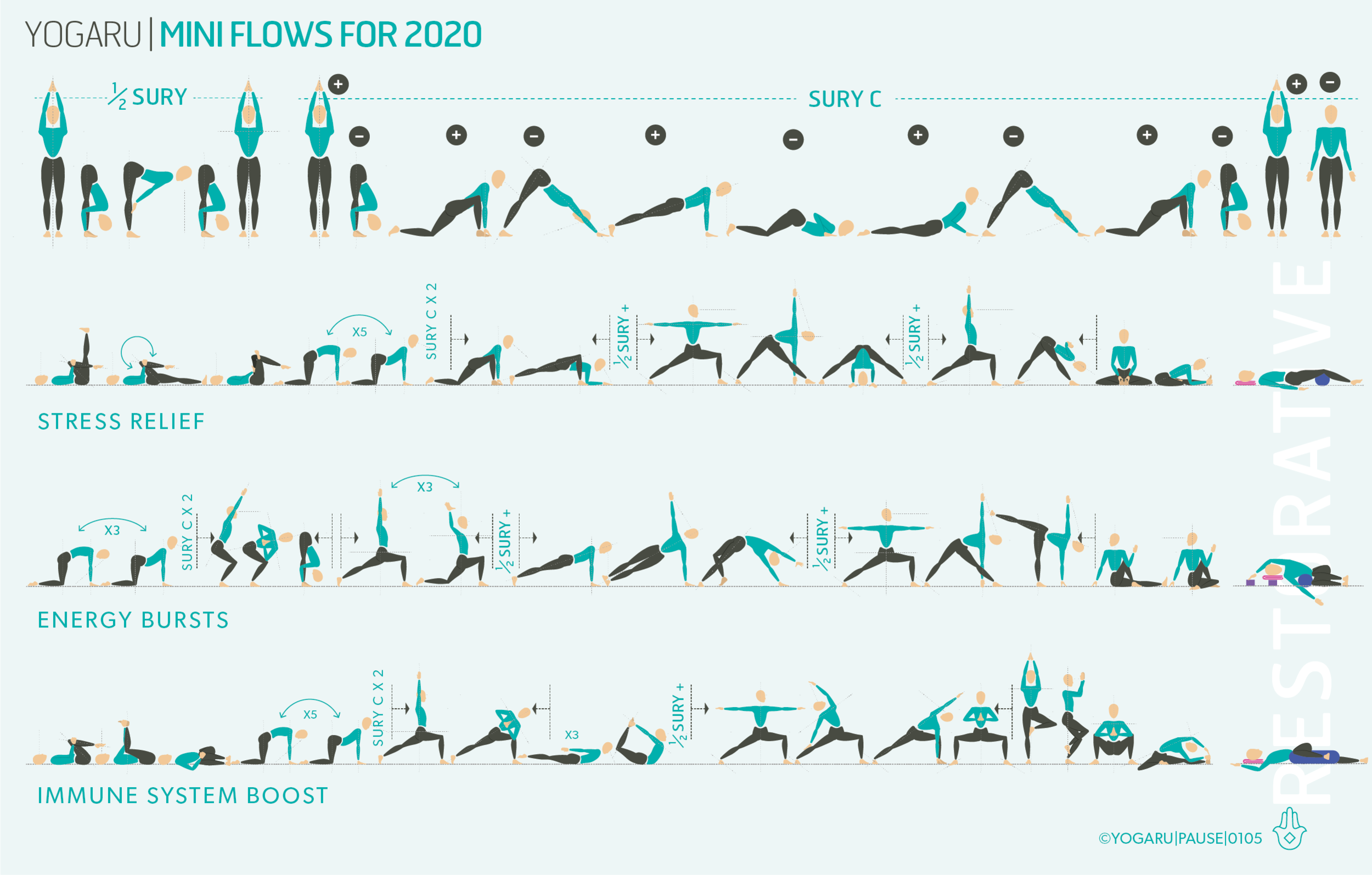
Mini flows for 2020

PAUSE_0105.png

BRINGING IT ALL TOGETHER
After teaching some Christmas restorative workshops I am reminded of the profound effect of consciously bringing the body to a state of complete relaxation. My intention for 2020 is to incorporate more restorative poses into my home practices, starting with these three simple mini flows. These three sequences give plenty of variety for the new year and help you settle at the end with a different restorative pose as an alternative to Savasana. Savasana is one of the most beneficial of the yoga poses but it’s all too tempting to roll up your mat at the end of a short home practice and jump back into your busyness. Incorporating a restorative pose will give you all the additional benefits of restorative yoga and help you to take that important pause to assimilate the practice before you move on.

BENEFITS OF RESTORATIVE
A lovely way to think of restorative yoga is ‘our body sleeps and our mind watches’. Our muscles can still be firing in different stages of sleep, particularly in a dream state. In restorative we consciously scan for any little bits of held tension in the body and mind and send signals to melt it away.

One of the main benefits of yoga, restorative yoga in particular, is that through the nervous system it strengthens the immune system. It does this with the breath which stimulates the vagus nerve, bringing the body into the rest, digest and restore response. This creates optimal conditions for the functionality of the organs of the body and strengthens the immune system, relieving symptoms of chronic stress, fatigue and tension.

EXPLORING MINI FLOWS FOR 2020 IN YOUR PRACTICE
These mini flows give you three new versions of the most downloaded themes from the website – stress relief with some hip opening and forward folds; energy bursts with twists and arm balancing poses; and immune system with plenty of twists and backbends to stimulate the digestive system where 80% of the immune system is made.

ALIGNMENT CUES
Below are the alignment cues to help you navigate the restorative poses. Comfort is king when practising restorative. Use plenty of props to find ultimate comfort. You don’t need to have an array of official yoga props. You can improvise with household items that can do just as good a job. The props you’ll need for these restorative poses are – a bolster, or use two stacked cushions; two yoga bricks, or two thick dictionaries; two to four yoga blankets, or regular blankets. I’m a big fan of blankets even if you are not feeling cold. The added weight on the body triggers sensors on the skin and tells you that you are safe and secure.

STRESS RELIEF - RESTING SAVASANA
Start lying on your back with a folded blanket under your head, a bolster under the creases of your knees and a blanket over you. Legs and arms extended, palms facing up, lift your buttocks and slide the flesh of the buttocks downwards. Feet gently flop out to the sides. Shoulders melt to the floor. Eyeballs become heavy in their sockets, skin on the forehead smooth as silk. Soften the temples and find ease in the tiny lines around the eyes.

ENERGY BURSTS - BLISSFUL BANANA
Make a pillow with a brick and a blanket on top of it at the top of the mat, place an additional brick above this at arms reach. Place your bolster horizontally on your mat with a space between your bolster and pillow. Sit with your right hip next to the long edge of the bolster, knees bent. Lengthen the spine along the mat and nestle the bolster into the curve of your waist. Place your head on your pillow, your shoulder in the space between your props and extend your right arm forward. Extend your left arm overhead and place it on the brick. If the raised arms doesn’t suit you bring your arm down and place it on your right arm. Repeat on the left side.

IMMUNE SYSTEM BOOST - BOLSTER TWIST
Place your bolster vertically along the left side of the middle of your mat. From lying, with a blanket under your head, extended both legs out along the mat and roll your hips to your left, bend your right knee and place it on the support of the bolster, left leg remains extended. To feel this twist let your upper body and right shoulders settle down onto the mat. Bring your arms to cactus position, with arms lifted and elbows bent either side of the body, gaze over your right shoulder. If the twist is too intense add a folder blanket under your knee on the bolster. If the raised arms doesn’t suit you bring your arms either side of the body palms facing up. Repeat of the left side.

To save the images for personal use click and hold down the image until the ‘save image’ option appears; on Mac hold down ‘control’ and click the image to get the option box; on PC right click on the image to get the option box. Scroll down in the ‘option box’ and click ‘save image’.

Ruth Delahunty Yogaru

10 benefits of twists

PAUSE_0104.png

WINTER TWISTS
When the temperatures drop and we start to move towards to depths of winter twists help to calm the nervous system, balance hormones, release tension, and help the body to adjust to the sudden change in season. They also stoke your internal generator to help you stay warm when there is a nip in the air, warming you from the inside out.

While Springtime is a time for getting into some deeper twists, Wintertime is more suitable for gentler twists to keep the spine supple over the winter months without going too deep into potentially seasonally tight muscles. Try this simple yoga sequence to get some twisting benefits into your day. Explore giving yourself permission to not go into your deepest twist and pause to take a few extra breaths in each twist to build strong winter ready lungs. Here are 10 benefits of adding these twist into your practice:

1. Aids digestion - twists penetrate deep into the body, stimulating the organs of the abdominal region. One of the most important organs which benefits from twists is the digestive system, also known as the enteric nervous system, or the ‘second brain’. Twists stimulate maximum nutrition absorption and distribution throughout the body.

2. Eases constipation - the digestive system is happiest when it is kept regular. Constipation can leave you feeling sluggish and bloated. Twists wake the digestive system up and gently squeeze it to help keep everything moving efficiently. When practising twists turn to the right first to stimulate the ascending colon, then twist to the left after, to stimulate the descending colon.

3. Aids detoxification - twists temporarily constrict blood flow in the bowel, liver and kidneys. In releasing the twist a surge of fresh oxygenated blood rushes back which flushes out unwanted toxins.

4. Increases metabolism - your metabolism is the rate at which your body process matter to create energy. Twists boosts the metabolism by aiding good digestive. The metabolism also functions best in a stress free environment – twists soothe physical and emotional tension in the body through triggering the parasympathetic nervous system.

5. Boosts immune system - a healthy immune system starts in your gut. As 80% of our immune system is generated in the gut it makes sense that twists are a very powerful tool for a strong immune system. Along with the digestive system, twists also stimulate the circulatory, the nervous and the endocrine systems – which all have an important part to play in building the immune system.

6. Increases circulation - good circulation brings oxygen and nutrients to the whole body. Sitting at a desk all day is one of the main culprits of poor circulation. Yoga, twists in particular, increase your circulation – with the additional benefit of adding a healthy glow to your complexion after your practice!

7. Energising - the increased circulation from twists of oxygenated blood to the brain gives you a fresh boost of energy. They also stir up your internal prana (life energy) and increases energy flow throughout the whole body.

8. Eases stress & anxiety - a healthy gut has a strong link to our moods and emotional well-being. Stress leads to gut issues and similarly gut issues lead to stress. As 95% of serotonin (the happy hormone) is produced in the bowel, stimulating the gut through twists release these happy hormones into the system.

9. Balances nervous system - the sympathetic nervous system (fight & flight) is in constant alert in our busy lives. Sometimes we may need a bit of ‘fight & flight’, but most of the time it’s a result of our brain being overwhelmed and leads us to make impulsive decisions. Slowing down and taking some deep breaths in your twists rewires the brain to pause before it reacts, and triggers the parasympathetic nervous system (rest & digest).

10. Improves spinal health - last but not least, twist help maintain a healthy spine by wringing out and lubricating the connective tissue of the spine – keeping them strong, supple. They stretch, strengthen and release tension from all the muscles of the spine.

To save the images for personal use click and hold down the image until the ‘save image’ option appears; on Mac hold down ‘control’ and click the image to get the option box; on PC right click on the image to get the option box. Scroll down in the ‘option box’ and click ‘save image’.

Ruth Delahunty Yogaru