
Sequences

How to build a home practice

PAUSE_0110.png

PRACTICE ON
Now, more than ever before, your yoga practice is a complete support system for all your physical and mental needs. In all this uncertainty your home practice will give you back a sense of empowerment again. We are all feeling varying degrees of anxiety and fear. Yoga, the breath and a meditation practice will help you get through this unprecedented and challenging period. Cultivating a safe space at home and building a calm environment will not only benefit you, it will also benefit worried kids, family or whoever you may be sharing a space with. To help you get started with these mini flows visit my YouTube where you will find a series of tutorials to accompany these sequences.

THERE TO SUPPORT YOU
We are going through some tough emotional times. Learning to listen to what you need when you step on your mat, and having no expectations of your strength or flexibility, will help to stay calm and well. Be guided by how the practice sits with you, everyday you will feel differently. Some days you might be feeling quite anxious and haven't slept very well. Your practice for that day might be a restorative pose to help you dissolve all your worries away. Other days you might be feeling more energetic and ready to move. Try to get onto your mat each day, even if it is just for a few minutes to mobilise all your joints (ankles, knees, hips, spine & shoulders) to move and sit with more ease for the rest of your day. Home practice will help you to process all that is going on in the world and give you the strength to see this tough period through to the other side.

GETTING STARTED
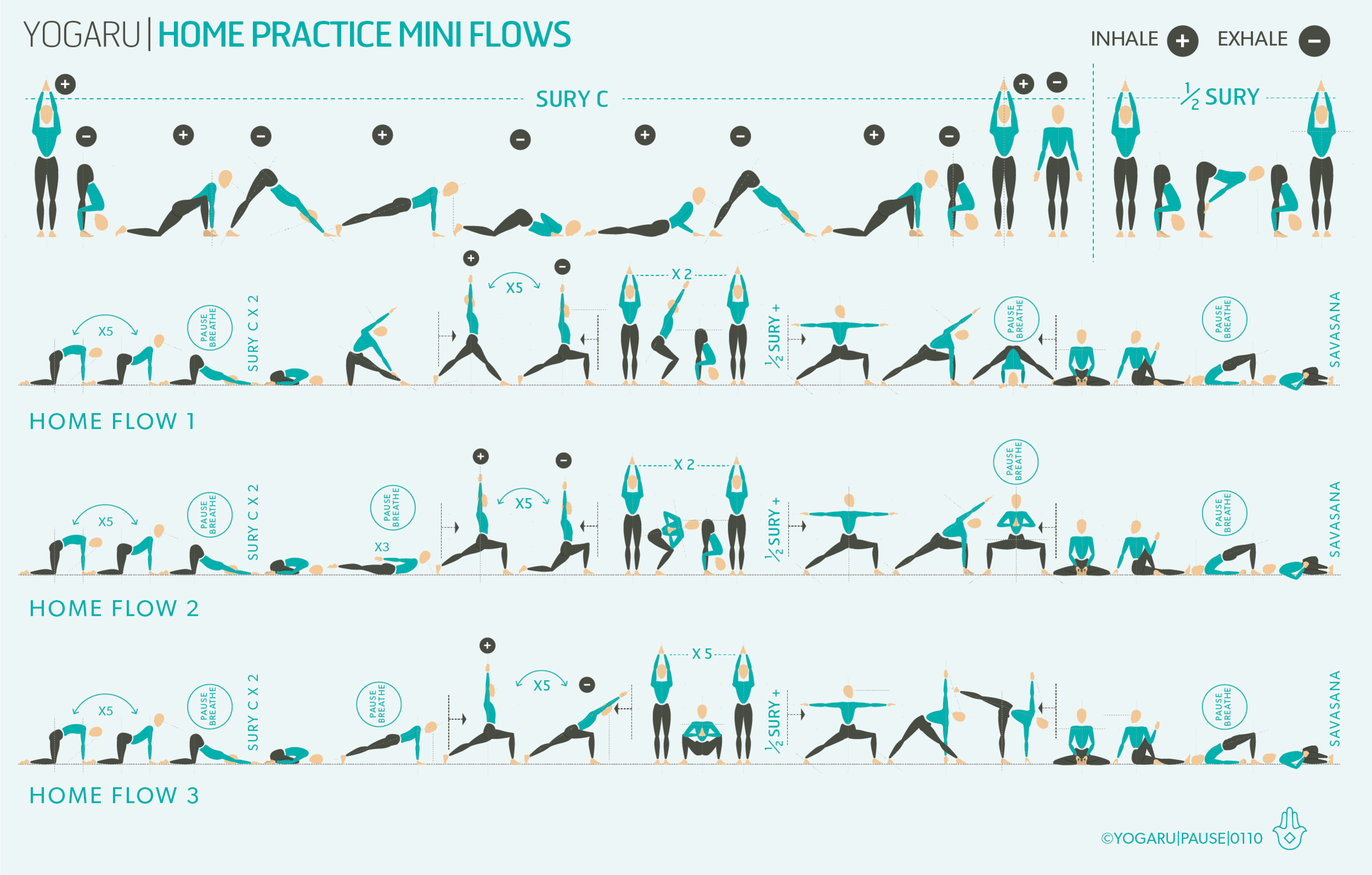
There are three home sequences to get you started above. The warm ups and cool downs are the same throughout to keep it simple and let you concentrate your energies on the standing sequences. Before you start with the five rounds of cat/cow, lie on your back, place your hands on your belly and take five deep breaths. Then spend a few moments waking up all the joints. Hug your knees to your chest and roll around on your lower back. Keep the left knee hugging and stretch your right leg up and slowly circle the ankle, bend and straighten the leg a few times. Drop your left leg down, hold onto your right knee and circle the knee to warm up the hip joint. Repeat on the left side and you're ready to get started. I have focused on the most common poses in yoga to make sure you can follow the asana illustrations. If there is a pose that you’re not sure of you can find all 108 poses in my asana section. You can narrow down your search by clicking into the asana families in the bar on the right.

When you’re ready to move on you will find lots more in the sequences section. As you become more in tune with what your body needs, delve into the asana section and pick some poses that you’d like to explore. Start with poses that are familiar to you before you get more adventurous. Remember to always take Savasana at the end of your practice to assimilate the time you have invested in your wellness. But most of all, own your practice and enjoy it!

SUN SALUTATIONS
Traditionally practised in the morning as a salute to the rising sun, the Surynamaskaras or Sun Salutations are multifunctional and can be practised at any time of the day. They are the perfect way to start building a home practice. The three versions strengthen and stretch all the main muscle groups, build stamina and prepare you for more challenging poses. They also build heat and increase circulation throughout the whole body.

They include standing poses, forward bends, backbends and inversions. Each asana correlates to either an ‘inhale’ or an ‘exhale’. This makes it a good start to your practice to establish the link between breath and movement. The repetitive quality of the movements relaxes the mind and reduces stress and anxiety.

TRANSITIONS
Bringing your attention to transitions and moving consciously from pose to pose threads the practice together like a string of pearls and cultivates a meditative flow. Slow your practice down and savour the in between moments just as much as the poses themselves.

Sequences are often built of mini flows where you step from one pose straight to the next. You will see these in your four home practice sequences as a selection of 2-5 poses enclosed by two arrowed lines. You flow through these connected poses on the right side first (right foot forward) and then take those poses on the left side (left foot forward). Downward Dog or simply Tadasana are often used as the transitional pose between mini flows.

The breath is one of the most important elements of stress relief in yoga. As you move try not to get caught up too much on whether it should be an inhale or an exhale, just don’t forget to keep breathing!

If you have any questions or are struggling with knowing where to start please feel free to email me at ruth@yogaru.ie. In the face of adversity communities knitting together to help each other is what will see us through this.

Stay safe.

To save the images for personal use click and hold down the image until the ‘save image’ option appears; on Mac hold down ‘control’ and click the image to get the option box; on PC right click on the image to get the option box. Scroll down in the ‘option box’ and click ‘save image’.

Ruth Delahunty Yogaru
Immune system mini flows

PAUSE_0109.png

THE BENEFITS OF YOGA
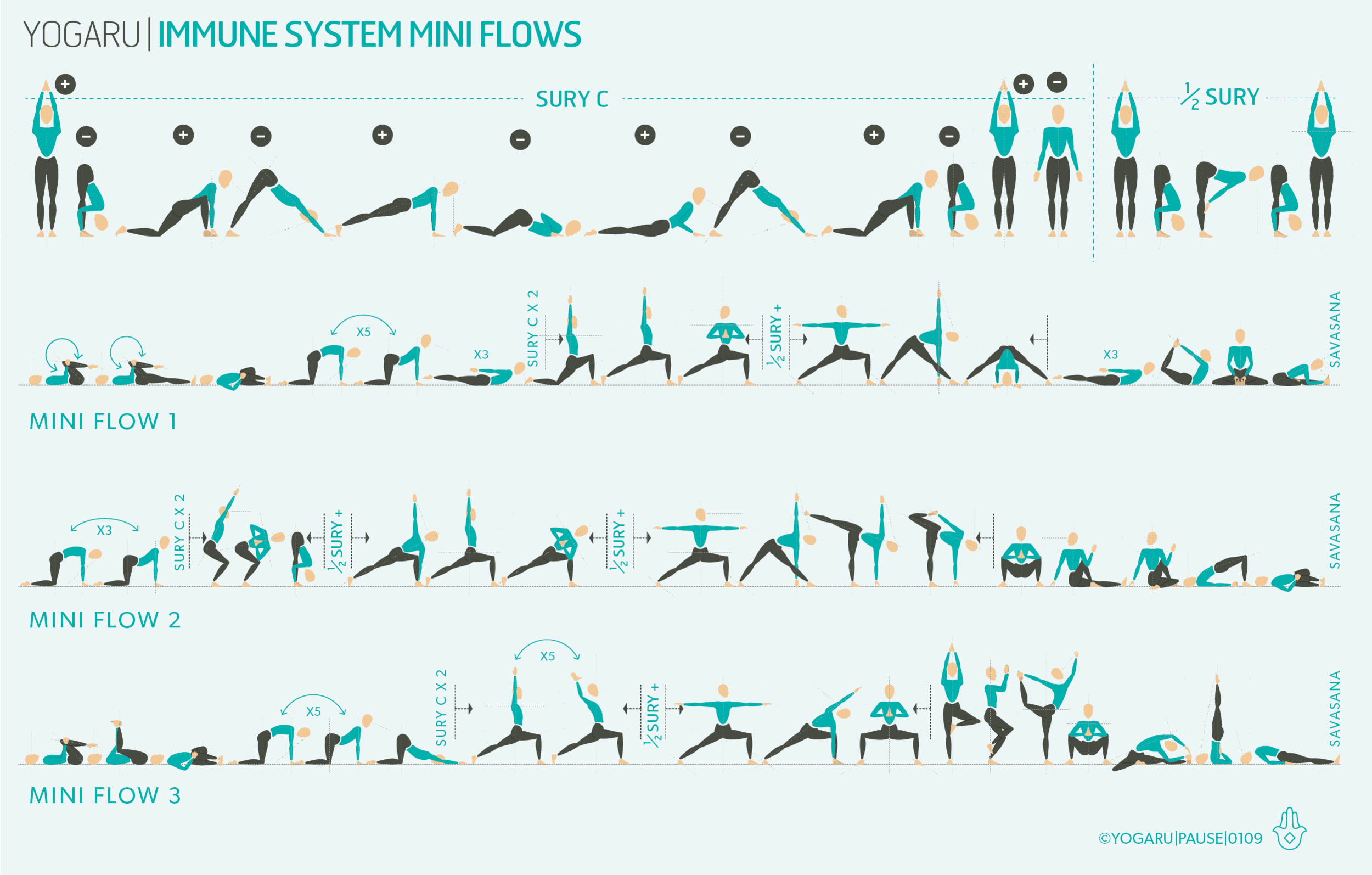
We know that the immune system works best when the body is in a state of homeostasis or put simply in balance. Balance is a word strongly connected to the many benefits of yoga. Regardless of the different reasons that bring us to yoga we inherently move towards balance physically and mentally when we practice. Yoga, and its many benefits, is one of the best supports in your toolkit for a strong immune system which helps you stay healthy and balanced. These benefits have been recorded for thousands of years and are only being scientifically proven in more recent years. Below are some answers to the question ‘how does yoga build a strong immune system?’. Along with some easy to access flows with poses that are particularly good at helping to boost your immune system.

YOGA & THE IMMUNE SYSTEM
Yoga stimulates several systems in the body which work hand in hand with strong immunity – the nervous, the digestive, the respiratory, the circulatory, the endocrine & the lymphatic systems. Stress related illness, ranging from the common cold, obesity, heart disease and depression, are on the rise. Stress causes inflammation in the body and weakens the immune system. Yoga is known to reduce physical and emotional stress in the body by tapping into the parasympathetic nervous system (rest, digest & restore response) when we use breath awareness; slow mindful movement; and repetitive flows. Yoga also promotes good gut health by stretching and compressing the whole digestive system and encouraging peristalsis (waves of muscular contractions) to remove unwanted waste and toxins from the body. The practice of yoga also brings our attention to the breath. Lengthening and slowing our breath is both very calming for the mind and helps the lungs fight off chest infections. The movement of yoga promotes good circulation which in turn increases the function of the lymphatic (white blood cells and toxin removal) and endocrine (hormone production) system to keep them working more efficiently and in harmony with wellness. For the immune system to work at its best all these systems need to be working in symmetry. Yoga is one of the few disciplines that benefits all these systems with an added bonus of giving you the ‘feel good factor’ too. Although all yoga will help keep these systems in balance, twists, backbends and inversions are the most powerful poses to practice when working with the immune system.

THE BENEFITS OF TWISTS, BACKBENDS & INVERSIONS
In yoga philosophy texts it is said that twists ‘destroy disease’. When we twist we temporarily constrict blood flow and when we release the twist a surge of fresh oxygenated blood rushes back. This twist and release action massages and stimulates the organs and helps the digestive system with maximum nutrition absorption; the respiratory system to build strong lungs; the liver and kidneys to remove toxins; and the lymph system to support white blood cell production. The same principle applies to backbends which stretch the front of the body and stimulate the organs of the abdominal and chest cavity. Backbends are particularly good for expanding lung capacity and opening the chest region. The higher the lung capacity the better our ability to feed all the cells of the body with fresh oxygen.

A healthy gut also has a strong link to our moods and emotional well-being. Stress leads to gut issues and similarly gut issues lead to stress. 95% of serotonin (the happy hormone) is produced in the bowel, stimulating the gut through twists and backbends release these happy hormones into the system and relieve stress, tension and anxiety and allow the body to concentrate on other jobs like building its defences.

Inversions boost circulation and increase blood and lymph flow which helps clear bacteria and toxins from the body and plays a vital role in building a strong immune system. Inversions are hidden everywhere in the practice. They are any pose where the heart is above the head. Along with the obvious poses like handstand and headstand there are lots of opportunities to take inversions in standing forward bends, downward dog, bridge and restorative poses like Viparita Kiranai.

EXPLORING IMMUNE SYSTEM FLOWS IN YOUR PRACTICE
Above are three mini flows, each sequence includes lots of twists, backbends and inversions to your practice to help keep your immune system strong. These three families of poses are all very invigorating and energising poses. For this reason these sequences are best practiced in the morning rather than in the evening. Each pose has a variety of different benefits so it is always good to mix it up as much as possible and alternate between the three sequences when you practice.

To save the images for personal use click and hold down the image until the ‘save image’ option appears; on Mac hold down ‘control’ and click the image to get the option box; on PC right click on the image to get the option box. Scroll down in the ‘option box’ and click ‘save image’.

Ruth Delahunty Yogaru

Find your favourites

PAUSE_0107.png

WHAT IS YOUR FAVOURITE POSE?
A great way to start building a home practice is to work out what your favourite poses are. They can be poses that challenge you; poses that stretch tight areas; or poses that help you focus, travel inwards and drop into your practice. They don’t need to be big statement poses, they are the ones that when you transition into them they feel you have arrived to a safe familiar place. Favourite poses are a very personal preference and magnify how amazingly different we all are physically and mentally. You might find yourself struggling, with all effort and no ease, in a pose and the yogi beside you is completely in their happy place. Next time you practice, and in the next class you go to, notice your reaction to the poses and work out which are your ‘feel good’ poses. Scan through your body from your big toe to the tip of your crown and see how it sits with every part of you. If it’s in a class take note of the poses after class and try them out in your next home practice. You’ll always pick up new versions of the pose and lots of fresh alignment cues from classes too.

EXPLORE THE BASICS
The longer I am practicing yoga the more foundational and simpler my favourite poses become. So much so that Tadasana/Mountain is definitely one of my current favourites. When I spend a bit of time in Tadasana/Mountain at the start of a practice it helps me build strength, stability and focused; and when I add it throughout my practice it resets me, ready to continue on. It is the foundational pose for all the standing poses, if you can master Tadasana/Mountain and bring it into all your standing poses it will help your practice enormously. Similarly you can apply the same principles to Dandasana/Staff, which is the foundational pose for all seated poses.

MY FAVOURITE POSES
The above sequence is a collection of my favourite poses which has become my daily practice that I dip in and out of depending on how much time I have. Below are some of the poses and the reason why they are there and why I am finding they tick all the boxes for me at the current stage of my practice.

SUPINE POSES
More often than not I start my practice on my back and circle and flex all my joints to gently warm them up. There is plenty of time for standing and stronger poses so I let myself gradually arrive and get ready for the work to be done on my mat.

CAT COW
Cat Cow is definitely one of the juiciest ways to warm up your spine and hips. They can be as gentle or stronger as you like depending on how your spine feels. You are also warming up the fascia and connective tissue of the shoulder blades which can be quite a sticky area for some people. From table top position I usually move through some leg lifts and side leg lifts (fire hydrant style!) to strengthen up the backs of my hips where I am currently rehabing an overstretch injury. To challenge my core I do the same leg lifts from Downward Dog/Adho Mukha Svanasana and Plankasana/Plank and hold each pose for 5 breaths.

CHAIR POSE
Utkatasana/Chair pose is a bit of a face grimacing pose but it is incredibly strengthening to the whole body. It helps me to find my outer hips and how to hug to the midline. In this mini flow I find my stability through Tadasana/Mountain, come up onto the balls of my feet to challenge this stability, then straight into Utkatasana/Chair press equally between the three points of my feet.

CRESCENT MOON
Ashta Chandrasana/Crescent Moon is the perfect standing poses to add in at the early stages of your standing section. It has just enough challenge without the complications of the asymmetrical, external hip opening. I will often add different arm positions and twists while I let my hip flexors and calf muscles open up.

LOCUST
Complete back strengthening, need I say more! Salabhasana/Locust counteracts all that sitting at desks and is fantastic for building a strong spine and good posture.

WARRIOR II FLOW
Virabhadrasana II/Warrior II is a pose I come back to time and time again. It features in most sequences, but sometimes this means we forget that it is jam packed with alignment up for grabs and all the amazing benefits it has. It is a strong leg strengthening standing pose with hip chest and lung opening which is very soothing to the nervous system.

WARRIOR I FLOW
Virabhadrasana I/Warrior I is actually quite a tricky pose for the hips and the back leg. Rather than get attached to the hips being squared I either use it as a directional guide not a target or just come into Warrior 1.5 where the hips are facing towards the top left corner of your mat. This half version is much kinder on the back knee joint.

SEATED
I usually treat the seated poses as a journey towards Savasana/Corpse and a way to counterpose my sequence. A seated twist will stretch out and release any tension from any spinal focused standing poses. Then I am ready to take Savasana even though some days my head is telling me to jump up and get on with your day, and I never regret it.

To save the images for personal use click and hold down the image until the ‘save image’ option appears; on Mac hold down ‘control’ and click the image to get the option box; on PC right click on the image to get the option box. Scroll down in the ‘option box’ and click ‘save image’.

Ruth Delahunty Yogaru